I was writing a RE-view earlier today, but it will have to wait until I am less distracted. And because you are in need of a distraction:
I started reading Cloons' New Yorker profile when I first heard about it last week, but I have yet to successfully finish it. It is what one might call, "crazy-ass long."
On the fluffier side (yes, fluffier than a celebrity profile), enjoy a little Good Cop/Bad Cop slideshow.
Also from last week, Bob Dylan won an honourary Pulitzer, which is bitchin'.
Jeff Simon's got a love/hate thing going on with film critics.
The Vulture's got career advice for Robert DeNiro (let's hope someone sends him the link).
Sars' kindly revives one of my favourite childhood movies. Blue light special indeed.
And, finally, news that was apparently posted last August, even though Le Journal de Montréal only published it within the last week or so. Whatevs - Colm Feore's going to be First Husband, and I am all about it.
Friday, April 18, 2008

Thursday, April 17, 2008
The Savages (2007)
 Short: Two adult children, a professor, Jon (Philip Seymour Hoffman), and a failed writer, Wendy (Laura Linney), are forced to care for their absentee father (Philip Bosco) when he develops dementia.
I remember when this movie came out people were kind of excited about a new movie from writer-director Tamara Jenkins. Turns out that I've seen her only other feature length picture: Slums of Beverly Hills. It's been a while since I've seen it, but I remember that I watched it more than once, liked it, and particularly liked Natasha Lyonne* and Maris Tomei** in it. But that was a decade ago, so I can't be certain of how good it was.
This movie, sadly, is not so good. I had high hopes, due to the cast alone, but it didn't work out. To be honest, it's all there in the title. Savage? Yeah, that's their last name. It's the kind of thing that seems clever on the surface, but the more you think about it, the less clever it becomes. You get to the "Okay, so?" moment when you contemplate it.
Linney and Hoffman are fantastic actors, and I'm pretty sure Hoffman in particular could create a fulled formed character out of thin air, but they just don't have enough to work with. Thanks to Linney, we can see Wendy trying to connect with her father, looking for some closure for whatever's gone on between them in the past, and finding that her father isn't present enough to give it to her. Wendy's really the protagonist, in that we see Wendy without Jon, but it's kind of a shame because I want to know more of Jon's story.
We never really get to know enough of any one's story, which I suppose is a point unto itself from Jenkins' script, but it hurts the finished product. There's a suggestion in the middle that their father was physically abused by his father, and another one right at the end that Jon was physically abused by their father, but we never get a sense of who their father was. As wonderful as Bosco is in what's, frankly, a thankless role, there really isn't enough of a character for us to care like we should about his deteriorating mental condition. He's less a person than a series of things that have happened to Jon and Wendy: he left them, and now that they've got him, he's gone.
There are moments, whole moments, when it seemed like Hoffman was in another, better movie, one that dug deep into life's cruel joke called growing old, into the reality of adult children caring for their dependent parents, into the horror of figuring out what to do next. I wish I could have seen that movie. It could have starred all the same people but instead of wasting time on Wendy's affair with a married man, it would have shown us Jon grading papers in a chair next to his father's bed for just a few seconds before Wendy found him there. B-
*Whatever happened to her? She's still making movies, but I feel like I haven't seen her in anything since approximately 2001.
**I love Marisa Tomei, and I kind of wish Tomei was one of those actors who used to be bigger but now has a TV show. Christian Slater's supposed to have one in the fall, for pete's sake. And if you think I wouldn't watch it just because it stars Christian Slater, you really missed the boat on that one.
Tuesday, April 15, 2008
The Counterfeiters (2007)
 Brief: Salomon Sorowitsch (Karl Markovics) is a renowned counterfeiter in 1936 Berlin. He gets caught, and his jail sentence leads to a concentration camp. Toward the end of WWII, the detective who arrested him, Herzog (Devid Striesow), now an SS officer, brings Sally in along with other printing (Adolf Burger, as played by August Diehl), inking (Sebastian Urzendowsky), and bank specialists to perfect the British pound and American dollar in order to finance the war.
A few weeks ago in Ask the AV Club, a reader wondered what the clubbers' problem was with this and other Holocaust movies (it's the third letter, so you've got to scroll). I read the response and started to worry about what would happen when I saw it for myself. Tasha Robinson is right in that the movie presents a story we've never seen before in a way that we have. For the most part, though the material is fresh, the movie seems familiar. Writer-director Stefan Ruzowitzky's script, based on Adolf Burger's book, is facile. It's somewhat strange that it's Burger's book, but his character isn't the hero (at least not in the short term) or even the protagonist. At any rate, Ruzowitsky is too quick to set up Burger and Sally as polar opposites. Sally will do anything to survive, while Burger is so steadfast to his principles that he's willing to get them all killed. If there's anything in between, Ruzowitsky doesn't want you to think about it.
Still, this movie has its good points. Markovics gives an astonishingly cold and reserved performance. He's careful not to reveal any emotion until the last possible moment, making even the slightest twitch of the eye shattering. His will to survive is so strong that he can bend others to it, but we never see why. That's just the way he is. Plus he's got a sexy thing going with his strange, beautiful face.
Combined with Marius Ruhland's fantastic score (he puts aside the stirring strings for a more folk feel) and the amazing lighting that I must attribute to cinematographer Benedict Neuenfels (if this movie was silent, you could understand it entirely from the shifting lighting. I wish I knew who designed the concept because it is beautifully evocative), it's easy to overlook the film's characterization flaws and still get something out of it. It makes me want to read the book, to be honest. B
Monday, April 07, 2008
Whoa, whoa, whoa, Tobias, listen to me. Dreams are worth fighting for. Now, are you gonna be an actor, or are you gonna be a doctor?
Not to spoil anything, but he's gonna be an actor. A bad one. Carl Weathers makes a good point, though. Dreams are important, so you can read all about movies that are in whole or at least in large part dreams in my latest Culture article.
Saturday, March 29, 2008
Across the Atlantic Sea
Alright, so I'm not in Manchester. But I am in London, and, thus, I will be posting even less than usual. I have movies I want to write about, gentle readers, but no time in which to do it. That should change upon my return. Until then, rent Before Sunrise and Before Sunset and think of me off having my own European adventure.
Tuesday, March 25, 2008
Starting Out in the Evening (2007)
 Premise: A graduate student (Lauren Ambrose) seeks out a reclusive, out of print author (Frank Langella) as the subject of her master's thesis, while his daughter (Lili Taylor) seeks out an ex-boyfriend (Adrian Lester) recently returned to New York.
Would that this movie had come out here before I wrote my Top 10. There's a large extent to which this movie is about the cruelty of having to grow old, so I briefly considered comparing it to the recently viewed The Savages. That would have been wrong. It would do the movie an injustice. Instead it's closer spiritual cousin is found in Once. Fred Parnes and Andrew Wagner's screenplay, from Brian Morton's novel and directed by Wagner, is as much about artistic creativity as John Carney's beautiful picture. It shows artistic creativity as it comes out the other side: deadened, perhaps lost, an ember awaiting a bellows.
Who is Langella? Where has he been hiding? I've been watching him in movies for years, but now I'm seeing him: his brown eyes, his blue lips. He's a giant, and he's adept at using his physiognomy against himself when needs be. It's a performance that requires a closed man to open himself for reasons you that would seem to be the opposite of those intended, and Langella carries it of so gracefully.
Ambrose has recently reminded me that I like her even if I didn't go in for that show she used to be on. There's genuine passion in her voice when she talks about Schiller's characters, an unmistakable literary love. You can hear the subtle differences in the way she talks about them and the way she talks about everything else. Her voice is rich with subtext even when her character isn't.
I can never get enough of Taylor, and now I feel like I'll never be able to get enough of Taylor and Lester together. Ariel's honest in a way that kills me because she's caring and she's also self-reflexive. As for Lester, he should be doing Shakespeare every day of his life. And complaining about people glowing at him. Every movie couple should be so luck as to have such natural intimacy and chemistry.
What a gloriously literary movie. I could say nothing better about it than it makes me wish I could read the (non-existent) books discussed therein. A+
Friday, March 14, 2008
Pop Culture Round Up: March 15-21
Sorry I haven't posted more this week, kids. Soon as I get the chance, I'll have more for you. Until then, enjoy your PC fun.
Whoa, what? "Reinventing" Cupid? I wonder how that's going to work.
Whoa, what? "Reinventing" Cupid? I wonder how that's going to work.
The accent fun continues apace.
That she is. Wait, is her hair blonde in that photo? Oh, no, just light brown and blonde highlights. I can live with that. A bit fug the photo shoot, though, no?
What kind of movie? Eh, Scott Cohen's still cool.
Yay, math! Wait, what? Movie math, peeps. Don't worry.
That she is. Wait, is her hair blonde in that photo? Oh, no, just light brown and blonde highlights. I can live with that. A bit fug the photo shoot, though, no?
What kind of movie? Eh, Scott Cohen's still cool.
Yay, math! Wait, what? Movie math, peeps. Don't worry.
Pop Culture Round Up: March 10-14
WHAT? If I knew for certain that Buffy would be available, I would upgrade to a faster connection today.
Damnit, I am going to have to get a faster connection. This is the motherload.
Okay, now this trend is just out of control.
Whoa, Cherry Jones as a female president? Sign me up! But what will her relationship to Jack be?
Doesn't everyone know by now that "In the butt, Bob" is true?
Well, aside from the fact that J.M. Barrie was Scottish, I never much cared for Gywneth's accents, and Kevin's spotty attempt is part of the joy of watching Robin Hood, I quite like this list.
I went ahead and let my jaw drop when I read this news. I realize that glorious Rob Thomas wrote a little Dawson's Creek back in the day, but wouldn't you like to see 90210 filtered through V-Mars's neo-noir (and orange and blue) lens? Or maybe kind of whimsical like that other show he created?
I'm all about this list (esp. No. 10) except number six. If you know you are in for a long movie or that you are the type of person that normally has to go, just make a point of sitting on the aisle and perferrably on the same side as the exit. It works, and it's not nearly the distraction that he's suggesting.
Damnit, I am going to have to get a faster connection. This is the motherload.
Okay, now this trend is just out of control.
Whoa, Cherry Jones as a female president? Sign me up! But what will her relationship to Jack be?
Doesn't everyone know by now that "In the butt, Bob" is true?
Well, aside from the fact that J.M. Barrie was Scottish, I never much cared for Gywneth's accents, and Kevin's spotty attempt is part of the joy of watching Robin Hood, I quite like this list.
I went ahead and let my jaw drop when I read this news. I realize that glorious Rob Thomas wrote a little Dawson's Creek back in the day, but wouldn't you like to see 90210 filtered through V-Mars's neo-noir (and orange and blue) lens? Or maybe kind of whimsical like that other show he created?
I'm all about this list (esp. No. 10) except number six. If you know you are in for a long movie or that you are the type of person that normally has to go, just make a point of sitting on the aisle and perferrably on the same side as the exit. It works, and it's not nearly the distraction that he's suggesting.
Tuesday, March 11, 2008
Dialogue avec mon jardinier (2007)
 Story: An artist (Daniel Auteuil) on the brink of divorce and fed up with Parisian life returns to his country home, where he employs an old school friend (Jean-Pierre Darroussin) as his gardener.
It's a little facile that someone in need of saving in a movie always seems to find someone to save him or her. Unless, of course, you are watching a dramatic-thriller, in which case the person in need of saving will meet an Artful Dodger-type and have to learn to save him- or herself.
Still, as a man in need of saving, you could do a lot worse than Auteuil. He excels at the uptight Parisien in need of saving, even when he's as loose as the philanderer he plays here. He doesn't go in for big scenes so much as quiet implosions, and it makes the man at the centre seem all the more real for it. Plus he gets to laugh and smile a lot more here than I've ever seen him.
As the man who could save the city man with his country wisdom and down to earth nature, Darroussin goes beyond the archetype. As the eponymous gardener, he has just enough linguistic tics and odd habits to make him a believable human being without pushing him into quirky territory. To be honest, there's something luminous, almost angelic, in his dedication to gardening. To watch him rekindle a decades old friendship with ease is all the more touching.
Director and co-writer Jean Becker has little to do between the talent of his co-stars and the stunning backdrop of the painter's country estate photographed by Jean-Marie Dreujou, so he mostly stays out of the way. I can't blame him. If I had that sun dappled garden, Auteuil, and Darroussin to work with, I'd certainly be tempted to stand back and admire. B+
Friday, March 07, 2008
Pop Culture Round Up
"Cynicism is very easy. You don't have to justify it. You don't have to fight for it." Michel Gondry is lovely man.
This is sort of underbaked, but I feel like I know where Molly Redden is coming from. I'd rather see Casino Royale than The Holiday, too.
Would anyone else rather hear about some of the matches in the poll than in this post?
EW's 30 under 30.
For bacon joke enthusiasts.
I wonder if Simon Pegg could take McG in a bar room brawl, though.
He has carved out quite the niche for himself, hasn't he?
“Multiply the number of big laughs in the movie times $10 million, and you get the ultimate domestic box office,” Mr. Pollock said. “Ten big laughs, $100 million.” Leave it to the Times to end an article about comedies on a sour note.
This is explotative and wrong. Good thing those nice folks at the Vulture are around to take the piss out of it.
Victory in our time!
YES! Yes, yes, yes! The greatest show on television finally has the greenlight for a third season. Will that waitress keep Jason's baby? We'll find out! Will Matt and Julie ever get back together? We'll find out! Will Taylor Kitsch take his shirt off? Probably repeatedly! Best! Show! Ever!
Thursday, March 06, 2008
The Short Take: the unexpected edition
Live Free or Die Hard (2007) 
 Definitely, Maybe (2008)

 The Dreamers (2003)
Perfect St. Valentine's Day movie: heavy on the explosions and eye candy, light on pretty much everything else. It's delightful popcorn fare that offers little besides Timothy Olyphant's steamy good looks and Bruce Willis and Justin Long getting into silly tiffs. It's everything you want in an action movie. B
 Definitely, Maybe (2008)
I think this movie may even been slightly worse than I was anticipating. At least I know that Abigail Breslin's mom isn't dead or out of the picture. In the face of her parents' pending divorce and as the result of her first sex ed class, Maya asks her dad (Ryan Reynolds) how it came to pass that her parents got married and had a child. For reasons that only make sense in as much as they are necessary for the plot to occur, her dad opts to tell her the overlapping story of the three most significant romantic relationships in his adult life and let her figure out which one he ended up marrying. During this time he tells her terrible things about her mom (like how she cheated on him), about himself, and convinces her that he was secretly in love with another woman all along. Aside from a teary-eyed moment, this apparently has no lasting damage on the poor child's psyche. Too bad the entire movie wasn't about Kevin Kline's character. That I'd like to see. C

Being Julia (2004)
This has to be one of the most charming movies I've seen in a long while, and Annette Bening's breathtaking performance as an British stage actress taken in by young American man makes it all the more frustrating that she just can't beat Hilary Swank. I love seeing a woman scorned come out on top. Between Bening and Jeremy Iron's giggling make up scene and Bening's final drink, you pretty much want to pull up a seat and have a beer with her. Plus it's got Bruce Greenwood and Michael Gambon as a ghost. Who can argue with that? A-
 The Dreamers (2003)
If I never see this movie again, it will be too soon. It's not that it's that bad, really, but, like The Other Boleyn Girl, it can never seem to make up its mind as to what it wants to be. Why have Matthew (Michael Pitt) narrate much of the story only to show scenes of which he has no knowledge? It's weird sticking point, I know, but it can be easily rectified by not putting so much emphasis on Matthew, Protagonist. The best part of his narration (and his character for that matter) are the monstrously idiotic things he says, and how believable it is that this 20 year old American in 1968 Paris would say or think such stupid things. Even better than that is Eva Green playing Isabelle as a deranged child instead of an adult. If only the movie could stop being so gross and start being as cool as it seems while "Hey Joe" plays over the DVD menu. C
Undertow (2004)

I could not for the life of me figure out why I rented this one not even after I watched the trailer. Do I really like Jamie Bell enough to seek out his movies? That would mean that I have to go see Jumper, so I am guessing not. Having seen it, the only thing I can figure is that a) I read a positive review somewhere (perhaps claiming that it is underrated?) or b) I wanted to hear Philip Glass' sparse and sadly underused score. Director and co-writer David Gordon Green's feature has a groggy, underwater quality to it that draws you in, but it also makes it difficult to connect with the story at large. It focuses on familial overreactions that could benefit from a little more background and exposition. On the other hand, the scene with Dermot Mulroney telling the story of the gold coins has a lasting quality far beyond the rest of the movie. B-
Wednesday, March 05, 2008
In Bruges (2008)
 Premise: After a hit goes awry, boss Harry (Ralph Fiennes) sends hitmen Ray (Colin Farrell) and Ken (Brendan Gleeson) to Bruges to await instructions. When the instructions come, however, it doesn't appear that either one is up to following them.
Tragic. Comic. Tragic-comic. Tragicomic. If you can imagine these two things smushed up together, overlapping in unexpected ways, you can imagine writer-director Martin McDonagh's sophmore feature. His story of guilt, retribution, and spiritual awakening clinches on a dead priest and a midget (Jordan Prentice) filming a dream sequence. It's hilariously sad.
McDonagh's found the best way to work with Farrell's range, in what's probably the best performance I've seen from him since Tigerland, if only because the role in no way depends upon Farrell's charisma. It loosens him up to be a natural, regular sort of bloke. Ray's a mess, but he's not a soapy over-acting mess. He's the quiet kind of mess that shouldn't be left alone to think about what a mess he's in.
Farrell's has an easy chemistry with Gleeson, as Ray's put upon minder who tries to make the best of the situation, sightseeing Bruges' medieval glories. Ken's the only character who's sadder than Ray in all of this, so watching him try to save Ray is all the sadder. He just wants a chance to do some good, to save the next one.
Would that I could see Fiennes this loose on a regular basis. Harry may have principles, but they're fun ones to watch at work. There's also a terrific pair of women, Clémence Poésy and Thekla Reuten, as Ray's love interest and the inn owner, respectively, that brighten up their scenes considerably.
The tragic and the comic go slapping against each other regularly, turning into each other in a split second. It's equally delightful and sad. A-
P.S. To the man who walked up to the other man with a three year old in the theatre, asked pointedly, "Do you know what movie this is?", and reminded the guy that there was a lot of violence to follow: je t'aime.
Tuesday, March 04, 2008
The Other Boleyn Girl (2008)
 Idea: Seeing a chance to swoop into a power vacuum, Thomas Boleyn (Mark Rylance) encourages his eldest daughter Anne (Natalie Portman) to catch the eye of King Henry VIII (Eric Bana) during a visit. But when Anne out rides Henry during a hunt, his attentions turn to Mary (Scarlett Johansson), Anne's younger and married sister. Exiled to France, Anne returns a changed woman, and she sets out to win the King for herself.
Philippa Gregory's best selling novel has the impressive pedigree of having been adapted for the screen by Peter Morgan. Not only did he pen two of 2006's best reviewed movies, but he also wrote the 2003 mini-series Henry VIII, starring Ray Winstone. All in all, I'd say he knows his stuff.
It also has powerful, impassioned performances going for it. This is the best Johansson that we've seen since Ghost World. Her heart and face are open and exposed for the camera. It's a delicate performance, to make Mary chafe against her oppression and grow up, and it's one suited to Johansson's talents.
Portman is, as always, a working wonder. Anne goes from schoolgirl to vamp to beaten down in so short a time, and Portman carries it off with natural grace. It's too bad she's not much of a yeller, though. She gets a bit raspy at times.
Bana is also quite good, although I feel like he plays two Henrys instead of one. It's not that either isn't believable or well done; it's not even that the first Henry couldn't turn into the second. It's more that we are missing a scene or two that would make the transition easier to swallow.
That's the problem, really, with this adaptation: it can't decide what it wants to be. It can't decide if it wants to be about Mary or about Mary and Anne, and it suffers for it. The focus on Mary suggests that it is the former, as well as the fact that we see and hear nothing of Anne when she is in France. But later in the movie we are treated to scenes involving only Anne that we know right well Mary has no knowledge of. Because of those scenes, it feels like screentime is lost to other important aspects of Mary's story, like when, exactly, she fell in love with Henry (her admission comes out of left field) and what became of her husband.
Largely, though, the movie suffers under Justin Chadwick's ridiculously over the top dramatic direction. Give it a rest with the pathetic fallacy and tell me how you get the light to caress Portman's neck like that, would ya? B-
The best way I could sum him up is to say Bob Dylan has never been about to get out of town before the shootin' starts.
After you read my incredibly long review of I'm Not There., did you wish you could read just a little bit more of my thoughts re: Todd Haynes' take on Dylan's life and his music? And, hey, wouldn't it be cool if I threw in some thoughts about Superstar: The Karen Carpenter Story and Velvet Goldmine? Of course you did. So read all about it in my latest Culture article.
Tuesday, February 26, 2008
Top 10 of 2007
 I made a list. Then I whittled it down to a second list. Now I'm presenting you the third. It was tough. It was a spectacular year for movies, and I only saw and reviewed 50 of 'em in the last year. A whopping 22 received grades in the A range (surely I sign that I am going soft?). Here's the cream of that crop:
- Grindhouse (theatre version only, which is why . . . )
Okay, so that's technically 13 movies. I've got Grindhouse on there as a whole that is greater than any one of its parts (not that those parts aren't awesome), but I had to go to 11 because Grindhouse, as I knew it, has ceased to exist. You are really missing out, by the way, if you have picked up either feature on DVD on its own on if only because you'll never know what I'm talking about when I menacingly intone, "He's saving up his nickles and dimes . . .". As for the double count for 11, I reviewed the two together, and I don't want to pick between them. So I didn't. Ten's a nice round number that everyone can count to, but it's not always the best number to go with.
As for the rest of it, what a romantic, depressing, funny, crazy, beautiful year. Oh, and a little happy birthday shout out to Feria Films, who turned four last month. It's going to start asking 4000 questions a day, I just know it.Monday, February 25, 2008
Oscar Wrap Up (2008)
 Well, I got a lot of those wrong.
Good for me, though. Good for you.
Good for the Coens even if I didn't think a sweep was forthcoming. I sincerely hope their little corner of the sandbox has room for all those statues. Good for the Academy for rewarding a critically beloved picture instead of a middling one.
Good for she who would call herself Diablo for giving a short, sweet, touching speech in a Betty Page inspired outfit.
Good for the insanely dreamy Javier Bardem busting out the Spanish.
Good for Marion Cotillard for struggling valiantly to deliver her speech in English, for being so genuinely surprised, and for being genuinely happy when Lavergne and Archibald won for makeup.
Good for The Bourne Ultimatum for picking up so many technical awards. People like it, critics like it, why shouldn't the Academy?
Good for Swinton for not only being herself but for giving a delightfully off centre speech.
Good for Daniel Day-Lewis' speech, so strange and smart. If your acceptance speech isn't the moment to refer to your picture as a golden sapling springing forth from Paul Thomas Anderson's head, when is it? And that he wished he had his son, H.W. Plainview with him? Made it seem like even if he was a lock, he still had the good grace to feel awed.
Boo on Rebecca Miller's dress. She's an attractive lady, so I don't understand why she would do that to herself.
Boo on Colin Farrell's hair.
Boo on the lack of screen time for my dear Jon. I'd rather see him, even slightly stiff as he was, than any of those "reflecting on my win" montages. Unless, of course, they could rustle up some more footage of Jack Lemmon. He's great at everything (even beyond the grave).
Boo on having Miley Cyrus say "awesome" during her presentation just because she's young.
Boo on whatever was happening to the bust of a variety of normally good looking women, like Jessica Alba's purple feathers or Anne Hathaway's garland or Jennifer Garner's squashy pancake boob.
Boo on Gil Cates, who hates Amy Adams for some reason, and on Bill Conti, who hates any one who didn't win an acting award. I want to hear what those who made shorts or editing decisions have to say, damn it!
 And finally, may the prize of the best part of the whole shebang go to Glen Hansard and Markéta Irglová. Their song was truly the best, their speeches about hope inspiring, and the moment when Jon brought Markéta back out* the most tear worthy.
*We all secretly believe that this was his idea, right? Right.
Stayed tuned tomorrow for the greatest of all post-Oscar events: my top 10.
Saturday, February 23, 2008
Oscar Round Up (2008)
To review the rules, click the label and read the original Oscar Round Up post.
Forgotten who's nominated? Here's your hook up.
Last year I was once again stuck at a rate of 5/6, but I am learning to live with it. It's a good ratio if you think about it. This was, as it turns out, a spectacular year for movies, and it's even more exciting to see that a lot of deserving movies are up for Academy Awards this year. Let's move on to the predictions then, shall we?
Performance by an actor in a leading role
George Clooney in Michael Clayton
Daniel Day-Lewis in There Will Be Blood
Johnny Depp in Sweeney Todd The Demon Barber of Fleet Street
Tommy Lee Jones in In the Valley of Elah
Viggo Mortensen in Eastern Promises
George Clooney in Michael Clayton
Daniel Day-Lewis in There Will Be Blood
Johnny Depp in Sweeney Todd The Demon Barber of Fleet Street
Tommy Lee Jones in In the Valley of Elah
Viggo Mortensen in Eastern Promises
This has got to be one of the saddest line ups I've seen in years. Not because the performances are poor. They're are each individually astonishing. It's sad that they all have to go up against each other at the same time knowing only one will win it, especially given that who will win is a virtual lock. It's a pity really. I'd like to see what, say, Mortensen or Depp would say given the opportunity.
Who will win: Day-Lewis.
Who should win: The far recesses of my brain just spat out Steven Buscemi for Interview, if you can imagine, although I'd add Glen Hansard for Once to that list. Choosing amidst the list, it would really have to go to Depp. He sings and slashes throats. What more does the Academy want from him?Performance by an actor in a supporting role
Casey Affleck in The Assassination of Jesse James by the Coward Robert Ford
Javier Bardem in No Country for Old Men
Philip Seymour Hoffman in Charlie Wilson’s War
Hal Holbrook in Into the Wild
Tom Wilkinson in Michael Clayton
Who will win: Bardem.
Who should win: Affleck, for lead actor. For reals.Performance by an actress in a leading role
Cate Blanchett in Elizabeth: The Golden Age
Julie Christie in Away from Her
Marion Cotillard in La Vie en Rose
Laura Linney in The Savages
Ellen Page in Juno
Damn it, why did they have to go and make the men's categories so easy to call and the women's so tough? Let's drop Blanchett for her unappealing turn in an unappealing movie, and Linney for no other reason than the fact that is just seems so unlikely. That leaves us with Page (a relative newcomer, which Oscar has traditionally favoured in this category), Cotillard (a young French stunner), and Chirstie (stirring performance in a thoroughly depressing movie). Page is the odds on favourite, although I'd say that the real grudge match is between Cotillard and Christie. Tricky.
Who will win: Christie.
Who should win: Wei Tang for Lust, Caution, Emily Mortimer for Lars and the Real Girl, Markéta Irglová for Once.
Who will win: Christie.
Who should win: Wei Tang for Lust, Caution, Emily Mortimer for Lars and the Real Girl, Markéta Irglová for Once.
Performance by an actress in a supporting role
Cate Blanchett in I’m Not There
Ruby Dee in American Gangster
Saoirse Ronan in Atonement Cate Blanchett in I’m Not There
Ruby Dee in American Gangster
Amy Ryan in Gone Baby Gone
Tilda Swinton in Michael Clayton
Tilda Swinton in Michael Clayton
Who will win: Dee (?). This one's gonna be close. I wish we could see the numbers on it after the envelope is opened.
Who should win: Blanchett. Who am I to deny it?
Achievement in directing / Best motion picture of the year
Directing:
The Diving Bell and the Butterfly, Julian Schnabel
Juno, Jason Reitman
Michael Clayton, Tony Gilroy
No Country for Old Men, Joel Coen and Ethan Coen
There Will Be Blood, Paul Thomas Anderson
Juno, Jason Reitman
Michael Clayton, Tony Gilroy
No Country for Old Men, Joel Coen and Ethan Coen
There Will Be Blood, Paul Thomas Anderson
Picture:
Atonement
Juno
Michael Clayton
No Country for Old Men
There Will Be BloodAtonement
Juno
Michael Clayton
No Country for Old Men
There's no better way to handicap one than to invoke the other. A given movie won't necessarily bring home the pair, but it will almost never bring home the big one without at least a director nod.
That said, we can eliminate . . . Atonement. Aw, crap. I didn't think Atonement would win in the first place. Now I am going to have to think about this. Clayton was smart and twisty, and, while everyone likes it, no one seems to love it. If Juno goes home with the prize, it would be the result of No Country and Blood splitting the dark, decaying America vote. I hope it doesn't. Both of the last two films are masterworks bound to resonate for years to come. I may have given them different grades, but I'm not sure one truly is better than the other. They're both outstanding examples of why filmmaking can be vital. They are both nominated for picture, director, and adapted screenplay. It's simply a question of whether there will be a sweep or whether someone will be going home with a consolation prize.
Who will win: Schnabel / No Country for Old Men.
Who should win: I'd be more than pleased to see either of the last two take Oscar home in both cases. Otherwise, stay tuned next week for my Top 10 of 2007.
What a fantastic year for film. I could be wrong about many of these. They're all so hard to call, and I love the Academy for getting that much right. Let's see what fun Jon has in for us come Sunday night.
Friday, February 22, 2008
Persepolis (2007)

Premise: A young girl, Marjane (Gabrielle Lopes as a child and Chiara Mastroianni as a teen and adult), lives through the Islamic revolution in Iran, finding quiet moments to be true revolutionaries with her politically active parents (Catherine Deneuve and Simon Abkarian), her grandmother (Danielle Darieux), and her influential uncle (François Jerosme).
This is an astonishing picture. It takes a time into which we have little insight on the individual level, focuses it through the lens of a precocious child, and refuses to make a big deal out of everything. It's not that there aren't big deals in the movie. There are plenty of them. But it's filled quiet with moments that the movie allows to resonate in ways I don't think it would have if it had been a live action feature. There's an excellent sense of when to linger and when to move on to the next. Most importantly, in her co-written and co-directed film based on her autobiographical graphic novel, Marjane Satrapi doesn't spare herself.
It's that insight into herself, her willingness to show times when she did mean things and times when she did stupid things, that makes this picture, co-written and co-directed with Vincent Paronnaud, so poignant. It's easier to believe someone who doesn't give herself a free pass. And, as such, she gives us wonderful insight into the real dangers of neither assimilating into a monolithic culture nor outwardly rebelling.
I feel like I am being vague about this film, and I don't mean to be. I'm reluctant to spoil even one minute of the gorgeous black and white frames for you. There is something so beautiful and interconnected about this film that I'm not sure we can talk about it until you see it for yourself. Until then, A+.
While I've got you here, I should mention that I  also saw another of last year's fantastic animated features: Ratatouille. Oh, how sweet, how funny, how sumptiously wonderful. It really does deserve to be one of the best reviewed movies of the year and one of the biggest commercial successes. I'm at a loss to tell you if I think the moment when a drunk Linguini complains that ratatouille sounds like rat patootie or if the entirety of Peter O'Toole's performance as restuarant critic Anton Ego is the most hilarious bit. Suffice it to say that this movie is charming, clever, and inspiring. Everyone should see it. A+
 also saw another of last year's fantastic animated features: Ratatouille. Oh, how sweet, how funny, how sumptiously wonderful. It really does deserve to be one of the best reviewed movies of the year and one of the biggest commercial successes. I'm at a loss to tell you if I think the moment when a drunk Linguini complains that ratatouille sounds like rat patootie or if the entirety of Peter O'Toole's performance as restuarant critic Anton Ego is the most hilarious bit. Suffice it to say that this movie is charming, clever, and inspiring. Everyone should see it. A+
Thursday, February 07, 2008
Lust, Caution (2007)
 Brief: A group of drama students led by Kuang (Lee-Hom Wang) decide to carry their work further by infiltrating the life of Mr. Yee (Tony Leung Chiu Wai), a high up member of the Chinese collaborative government in WWII, setting up Wong Chai Chi (Wei Tang) as his mistress, and plotting his assassination. As the plot takes longer than original intended, Wong's life (and her heart) are increasingly in danger.
The buzz on this one wasn't all that positive, but I was looking forward to seeing it anyway. If there's a team out there today that I can get behind, it's director* Ang Lee and co-writers/frequent collaborators James Schamus and Hui-Ling Wang. No matter the story they are telling, whether it's suburban subterfuge or a Civil War epic or a damn comic book adaptation, their combined ability to tap into the human emotion at the core of these stories, to explore its grand range, and to make that range seem like the most epic, operatic thing that has ever occurred is unparalleled. It's both a call to action and a call for self-reflection.
To that end, this movie is no exception. The acting is beautiful and nimble with Wai balancing menace with undernotes of sexiness and sorrow, and Wang taking Kuang from a passionate but sheepish boy to a far more measured adult. Despite all that, it's (possible**) newcomer Tang that will steal your heart. Her naïve dedication flowers into heartbreaking devotion and shatters into divided loyalties. And she does it all with her soft, dancing eyes.
So it's too bad that when the closing credits started to roll I said, "Well, that sucked." It didn't entirely suck. All the things I wrote above remain true. There are two reasons that this movie didn't make it as far as it needed to: 1) the sex scenes and 2) the decision at the climax that leads to the dénoument. As for the former, they're not indifferently filmed, nor is the sex treated as reverentially as it was in Brokeback Mountain. It's just not sexy. There's a lot of sex, and it's supposed to have a profound effect on the two characters having it over the course of the film. You can sort of see it for the one, but it never really comes through for the other, which is what makes the former hard to swallow.
Well, partially. It's not difficult to believe or understand why these two people end up caring about each other. It's that the decision she makes ends up affecting so many other people, and you know she knows exactly what will happen, and she does it anyway. But why? We never get to the heart of that decision, of why she makes it and what that means for the character. It just happens and then pow! Story done. The door closes, and we're left out. B-
*It's the Tim Burton thing all over again, isn't it? Hey, did you guys know that Ang Lee is a director?
**IMDb lists this movie as her only credit, but they aren't always as up-to-date on foreign productions.
Wednesday, February 06, 2008
Change moves in spirals, not circles. For example, the sun goes up and then it goes down. But everytime that happens, what do you get?
Which, of course, explains why we haven't seen a "change" in romantic movies in about, oh, ever. For more of my romantic movie-related loathing, the circle of lies on which said movies are based, and a breakdown of the Feb premieres, check out my latest Culture article.
Tuesday, February 05, 2008
Charlie Wilson's War (2007)
 Outline: In the early 1980s, Charlie Wilson (Tom Hanks) is a US congressional representative from Texas seemingly more devoted to having a good time than to politics. He is also a member of two major foreign policy and covert-ops committees. Prodded by his major conservative supporter, Joanne Herring (Julia Roberts), Wilson learns about the plight of the people are suffering in the brutal Soviet occupation of Afghanistan. With the help of a CIA agent, Gust Avrakotos (Philip Seymour Hoffman), Wilson dedicates himself to supplying of Afghan mujahideen with the weapons and support necessary to defeat the Soviet Union.
If this movie had a subtitle, it would be, "Philip Seymour Hoffman and Amy Adams should star in everything." This is Hoffman's magic: even though he's a much better actor than everyone else involved (I'm not saying that lightly nor to be flippant) and even though he was clearly playing the character Toby would have been had Sorkin had been free to include as much swearing as he pleased on network television, he still creates a believable, enjoyable, full-fleshed human being. Then he goes ahead a quietly pockets his scene with Roberts without even looking like he's going to. It's like it just happens to him. The smartest guy in the room is too angry to be listened to, and he finally gets the ear of the very people who can help him make a difference, and he doesn't even take a moment to consider his good fortune.
Roberts gets swallowed up by her accents, which is a shame (!) because there are non-verbal moments when it was clear how good a job she was doing in the roll. Hanks is great, but he's been better, as though some of the vivacity has been drained from what should have been a larger than life character. Adams, on the other hand, has a small part and makes me wish I could see her sparkling, expressive face wherever I go (movie-wise, of course).
Director Mike Nichols and screenwriter Aaron Sorkin have a pretty good thing going here. It's smart and funny and sometimes even sexy, which is a great way to present a story every American (at least) should know. But the early violence looks surprisingly fake, and it's hard to know who to cheer for when you've living through the long-term consequences. The movie pays lip service to Charlie and Gust's attempts to head the Taliban off at the pass, but it's all over in an instant. It seems like another movie is poised to begin where this one abruptly leaves off, and the sequel is more vital than what came before it. Still, this is pretty good. B+
Wednesday, January 30, 2008
Lars and the Real Girl (2007)
 Idea: A quiet young man (Ryan Gosling) shocks his brother (Paul Schneider) and sister-in-law (Emily Mortimer) by ordering a Real Doll and introducing her as his girlfriend Bianca. When their psychologist (Patricia Clarkson) advises them to act as though Bianca is a real person, the community embraces Bianca and helps her integrate into daily life.
 Listen, I would probably follow Ryan Gosling anywhere, cinematically speaking. When I saw a link for this list, I knew he would be taking home number one. That said, I've got to agree with David Edelstein on this one: he plays it asexually, and I have no idea why. It's not that Gosling isn't, as per usual, perfectly timed and adorable and believable. It's that a man who has no sex life and apparently no desire for one would order a life-sized sex toy, continue to have no sexual relationship with it, and, eventually . . . Well, we won't talk about eventually.
It's not so much a problem with Gosling's performance, per se, as it is with Nancy Oliver's script in general. The idea that a young man would have such a delusion and what real problem he would use it to help him deal with (the problem is obvious to the point of being annoying when it is finally identified out loud within the movie, but fortunately it's only a minor annoyance) are both excellent cinematic ideas. Oliver's script is deadpan and darkly funny and occasionally very sweet. But it also refuses to deal with any adjacent issues to the one that Lars is working out via Bianca, and it ends before it should. We get about nine-tenths of the way through his problem, but the audience needs the home stretch. I know I am being very vague (well, more so than usual), but I don't want to give too much away. Or maybe I am wrong. Maybe I am supposed to tell you what exactly Lars is working through because it isn't supposed to be that much of a reveal. But I think it is. Why else wait to get specific until so close until the end of the movie if you want people to know up front?
First time-ish director Craig Gillespie (he also directed last year's Mr. Woodcock, which makes me very sad for him, but the point is that I don't know which one he directed first) proves himself more than capable with bringing out the dark humour in the process Lars goes through, particularly with his cuts and the way he holds his camera. He's got a good eye for being sensitive and respectful and still hilarious. I hope his next picture is more like this one.
The rest of the cast give uniformly wonderful performances: Mortimer is a fluid actress; Clarkson rarely raises her voice above a whisper and breaks our hearts without trying; Schneider is enraged and mortified. Kelli Garner is a treat as Lars's co-worker with a crush (three guesses on who!), but she plays another character that Oliver's script has no interest in looking at too deeply. It's a shame, really. I think there might have been something there.
If you can see yourself past premise, there is plenty to enjoy. If you can't, there's still some fun in there for you. B
Monday, January 28, 2008
There Will Be Blood (2007)
 Premise: Following a tip, oilman Daniel Plainview (Daniel Day-Lewis) and his son, H.W. (Dillon Freasier) head to the Sunday ranch and quickly discover that there is oil to be had. Daniel buys up as much as of the land as he can and sets to drilling, but he meets opposition from Eli Sunday (Paul Dano) , the town's fiery preacher from the Church of the Third Revelation.
If they gave out director's awards for balls alone, screenwriter and director Paul Thomas Anderson would win this one in a walk. He isn't afraid of anything. He rarely captures his protagonist in the centre of the screen; he trusts that you'll find the action all on your own. Hell, he'll hide the action behind trees and houses and expect you to wait for it. He put minute upon minute together with only ambient noise to back it up. He lets things go without saying. He'll put together one of the grandest American epics of greed and corruption ever committed to celluloid (from Upton Sinclair's novel, Oil!), and then he'll end it ambiguously. And you know what? I don't think he even cares what you think about that. He'll just keep on drinking your milk shake.
So long as this is what we get from Day-Lewis, there's no reason to begrudge him the self-imposed exile, the lengthy, secretive prep process, or the delay between films. So long as there is a sociopath that he can tear into ferociously, imbue him with the kind of slippery evil that keeps you up at night, and still make him seem like a cross between the hallmark of an American family man and the most dangerous creature you are ever like to meet, there is no reason to complain. And - love him for this - he does it all without being in the least bit showy. There's certainly a fussiness about how he gets there, but you can tell the difference between the actor or the character going over the top. With Day-Lewis behind the wheel, you'll never see it from the actor.
Dano may have had less time to prepare, but he has worked with Day-Lewis before. Even so, he must be a prodigious young talent not to get eaten alive by Day-Lewis in some of those scenes. He rightly plays it very close to the chest, leaving you to wonder to what extent Eli holds himself responsible for what follows after the sale and to what extent he wishes he were responsible. It was a deft casting moment for Anderson to call Dano back after his small role as Paul Sunday.
I am going to tell you that Anderson's writing and directing and that Robert Elswit cinematography are brilliant and beyond reproach, so we can move on to the single most important non-actorly element of this impeccably made picture: Jonny Greenwood's score. It isn't one score but twenty different interlocking musical moments that come together with the utmost sensitivity. Every time you think you got Greenwood's game beat (I see, you say, heavy on the trumpets), he'll throw you for a loop (no, violins! piano!). Then, just when you think you are about settled, boom! Diegetic music fading away in the background. Non-original, non-diegetic music. A little Brahms for ya.
Actually, Greenwood's game is pretty much Day-Lewis's game, which is the sum total of Anderson's game. He's got a lot to say about greed, vengeance, and blood (it will be spilt if you'll only wait for it). Pay attention. A+
Wednesday, January 23, 2008
I'm Not There. (2007)
 Premise: I'm not going to write a plot description. It doesn't make sense to sit here and try to tease out this dense, tangled knot of a movie into a pithy paragraph. It won't help you understand what you see.
 Cate Blanchett, "Jude Quinn": We'll start here for two reasons: 1) She's getting the most press of the six actors to take on the role, and 2) she plays the most easily recognizable Bob Dylan. I don't mean that it is a caricature. I'm not saying that she doesn't resemble a young Dylan (you'll marvel at her ability to hold her face that way). Simply, she plays the most easily recognizable period in Dylan's life (Dylan goes electric; Dylan gets into a motorcycle accident). The level of technical mastery on the part of the actress that goes into transforming this stunning woman into an angry, fragile, drug addled young man is worth the admission price alone. The creative spark that allows Blanchett to go beyond that, to move out of the shadows into real darkness, is worth a mint. All of the Dylans display some level of repulsion with the media and its creation/destruction of celebrity; Blanchett plays it as its ugliest: baiting interviewer Bruce Greenwood, fighting with his loyal band mates, tossing out insults to Michelle William's Edie Sedgwick for sport. It's in Blanchett's scenes that you can genuinely feel why Dylan couldn't stay folk forever.
 Christian Bale, "Jack Rollins": Bale portrays Dylan at the height of his folk scene and again in Christian revival mode. The two sections fit perfectly around Blanchett's, feeding and informing them in their initial stages and then showing us the results. Bale's section is one of two that take on a more artificial form. Instead of watching it unfold naturally, it is a documentary TV piece exploring Rollins' rise and fall and presenting us with his first interview in decades. It's framed by black and white photographs, grainy footage, and Julianne Moore's Joan Benz providing interview material. If Blanchett's Dylan was angry, then Bale's is furious. He's also furiously disconnected, which suits the material and the role, but ends up disconnecting the audience as well. It's a great role and portrayal, but it doesn't dig as deep as it could. I'd sooner put that on director and co-writer Todd Haynes than Bale, though.
Heath Ledger, "Robbie Clark": Clark is the actor who portrays Rollins in a biopic, a moment that ends up being the high point in the young actor's career. He's also the only one we capture in a relationship (with a woman he meets on set) and the only father (of young girls). It's more than a little strange to be writing about the day of Ledger's sudden death. It's sad. Should you see this movie (and you should), you can find all manner of similarities that make writing about Ledger in this role now heavier than it ought to be. Ledger's work here is a marvel of foreshadowing. Even the slightest movement or gesture lets you know how it will end. At no point are any of the Dylans any happier than Clark is in those early days with Claire (Charlotte Gainsbourg), and his broad smile and down-to-earth manner are thrown into sharp relief by the places his ego and personal disappointment will take him.
 Marcus Carl Franklin, "Woody Guthrie": As a young troubadour riding the rails (and possibly on the run), Franklin's Dylan would seem out of place if the simple edict to write about his times instead of those of the past didn't feed directly into Rollins's arc. Haynes has a created a wonder in how each individual Dylan fits together even when you can't imagine how it will work out. Franklin is the only one who does his own singing. His Dylan brings sweetness and levity into the film, but there's also a scary dark side at which Franklin more than capably hints. He's all set to sell himself out to Hollywood until tragedy forces him to rethink what being a musician really means. Franklin's Dylan is filled with hope in his observant youth.
Richard Gere, "Billy the Kid": More than a few have said Gere's Dylan is the silliest, but I can't agree with that. For one, Billy is Guthrie pushed to his illogical extreme, and there is something exciting in the telling of it. For two, it's not hard to see the relationship between a Billy the Kid who dodged Pat Garrett's bullet and went into hiding and the artist who takes on new personae with ease and regularity. Each townsperson calls him by a different name when he rides into town, and it is in this vignette/story/whatever you want to call it that we get closest to what Dylan's own constant metamorphosis as artist has cost him as a man. As an actor, I've always found Gere difficult to pin down. The performance here is smooth and unfussy, providing the film with a perfect coda even if some of my fellow viewers jumped up at the end of the previous scene (one of Blanchett's) and applauded pre-emptively.
 Ben Whishaw, "Arthur Rimbaud": I got all excited to call Whishaw a young whippersnapper here, only to discover that he is older than I am. Whishaw as the (mis?)fortune of playing the most reflexive of the sextet, but it doesn't do him a disservice. Arthur is tethered to a chair in a bare bones press conference, and he provides the context and sometimes even subtext for the other Dylans (more so than even Kris Kristofferson's narration). He channels the jangling nerves that characterize Quinn's interactions with the press as well as Rollins' disconnection into a series of strange Dylan-isms, both grounding and enlightening.
 If one man was going to do it, it had to be Haynes. From the blinking "i'm not here/her/there" title in the opening shots to Ginsberg (David Cross) and Quinn hanging out with Jesus to the fantasy sequence with Rimbaud tethered to the earth below, this movie is as unmistakeably Haynes as it is Dylan. Only the man who brought us Bowie by way of Citizen Kane and a biopic starring a Barbie Doll could present us with so something far from a conventional biopic that could still manage to be the definitive take on the life of an ever changing artist.
In the end, this movie isn't about Bob Dylan, Man. It's about our perceptions of Bob Dylan, Artist, as funnelled through his music and pushed back out again to its extremes. It's as if everything we ever thought about the voice of so many generations sprang to life from hazy dreams and fantasies to something fully formed, intelligent and strange. It's a beautiful picture and one that goes on long after you leave the theatre. A
Tuesday, January 22, 2008
CBC bumps up announcement, Oscars mildly confusing
 Don't want anyone to be embarrassed about getting the bum's rush. , but CBC.ca totally put up a press release earlier than they should have in order to make way for the Oscar traffic. Don't say it if you know whose. If they are so keen to get the nominations out there, I should probably throw my hat* in the ring** as well.
*I initially typed 'hate.'
**Here it was 'wring.' I apparently am dealing with some Oscar-related stress rather passive aggressively.
Let's see, let's see.
Surprises: It comes to a surprise to no one but me that Ellen Page got the nomination for actress. I mean, she actually got it. The entire time everyone was saying she would, I started to think that it would be all buzz and then pffft. It's nice to be wrong sometimes.
I can't believe that Jason Reitman made it through in the directing category. Feels unlikely, like maybe he snuck past when a couple of other contenders split the vote.
Atonement sticks out like a sore thumb for best picture. It seems normal and natural following on the heels of its Golden Globe win, but it's strange to see it there without a nomination for either McAvoy or Knightley.
Snubs: Tim Burton for directing, naturally. What is it going to take for these people to give him the attention he deserves? It's just nonsense.
Pleasantries: I am very pleased to see The Assassination of Jesse James by the Coward Robert Ford getting some attention for its austere cinematography even if Diving Bell will likely take the award.
I do like that so many of the documentary feature nominees are docs about Iraq. It's time.
I love that "Falling Slowly" was nominated, but I worry about its chances against three Disney songs. Maybe Hansard and Irglova will Three 6 Mafia Menken and Schwartz. I sincerely hope they will be on hand to perform.
In other news, the CFTPA decided to make up their own Indie Awards, and I love them for it.
Now I'm going back to look at the Vulture's predigious amount of Oscar coverage.
Thursday, January 17, 2008
I am a Kraken from the sea!
Harry Hamlin does rock, but does anyone else see a similarity here? First, watch this. Then, take a look at the close up here. The Cloverfield monster is like the Kraken only Hulk-ier. Knowing that they (possibly) ripped off Clash of the Titans makes the whole thing less scary, right?
Thursday, January 10, 2008
I saw . . . this: the Hepburn/Stewart edition
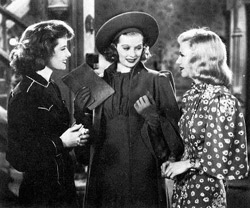 Stage Door (1937)
This is sort of a strange picture in that a lot of the plot revolves around what is or isn't happening with Kay Hamilton (Andrea Leeds) at any given moment, yet she has very little screen time compared to top billed stars Katharine Hepburn and Ginger Rogers. Set a boarding house, the Footlights club, occupied young women all jockeying to find a role, any role, on Broadway, the house is thrown off balance when an heiress (Hepburn) decides to try her hand at the theatre. Naturally, everyone hates her until the last possible second when a personal tragedy transforms her into a great actress. What I liked best about Hepburn's character (and the movie) was that she was awesome only when no one was around to see it. Other than those moments, as fun as it is see a bunch of young actresses early in their careers (notably Lucille Ball), it's more of a diversion than a classic.
The Philadelphia Story (1940)

Now this is a classic and with good reason. Minus two remarkably sexist scenes, it's the story of a woman (Hepburn, as you well know) who finds herself days away from wedding number two, struggling to find someone who will love her instead of putting her on a pedestal. She almost finds it with a visiting reporter (James Stewart), but, in the end, love is waiting for her with husband number one (Cary Grant). Hepburn rode the success of this Broadway smash all the way back to Hollywood, and she plays the hell out of this role. I'm not as familiar with Grant's work compared with the other two leads, and I admit that I found myself wondering what the big deal about him is, especially given that after Stewart's "hell fires and holocausts" monologue, that's the one I would have chosen. Still, Grant grew on me as the film rolled. By the time he's pulled his legs up on the chair like a child and giggling, I was hooked. When Tracy finally promises to be yar and Dexter replies, "Be whatever you like," it's impossible not to smile, teary-eyed. One of the sweetest, most charming, and utterly clever movies you will ever see in your life.
 The Shop Around the Corner (1940)
As fantastic as Stewart is in the above, it's more Hepburn's movie. Shop here, while it may be a romantic comedy about a relationship conducted by letters between Alfred Kralik (Stewart) and Klara Novak (Margaret Sullivan) who also happen to have a work relationship filled with animosity, it's Stewart's movie. In a lot of ways, it's a movie about a young man getting his life together that just happens to involve an anonymous, amorous pen pal. Whether he's threatening a punch in the nose or explaining the subtle joys of an unopened envelope, he never ceases to amuse or charm, much like the movie itself. Although, I must confess, it's a toss up between Pepi (William Tracy) and Pirovitch (Felix Bressart) for funniest character. This movie is a gem well worth checking out.
Now if only someone could explain to me what all those Americans were doing in Budapest in the first place.
Wednesday, January 09, 2008
Are you A: handsome; B: smart; C: scrap metal; or D: all of the above?
Are you in need of a makeover, makeover, makeover, makeover, makeover, makeover, MAKE-O-VER?! Personality-wise, that is. Look no further than my latest Culture article, grab some character scraps, and quilt yourself a new you for the new year.
Monday, January 07, 2008
Stephen and Jon are still figuring out what they're going to do on Monday night's show.
Thanks, Comedy Central spokesman Tony Fox. But between you, me, and USA Today, I can't imagine what could possibly happen on tonight's new shows. Stewart and Colbert are members of the WGA, for pete's sake. Why, why, why are they doing this? Why come back at all without writers?
This strike is getting so weird.
This strike is getting so weird.
These are my awards, Mother. From Army. The seal is for marksmanship and the gorilla is for sand racing.
Let's take a look at a few more awards, nominations, and best of lists, shall we?
National Society of Film Critics top picks for the year
Toronto Film Critics Association top picks for the year
Screen Actors Guild award nominees
Independent Spirit award nominees
Dana Stevens' Top 10 of 2007 in Slate
The AV Club's Best and Worst of 2007
David Edelstein professionally and more personally
National Society of Film Critics top picks for the year
Toronto Film Critics Association top picks for the year
Screen Actors Guild award nominees
Independent Spirit award nominees
Dana Stevens' Top 10 of 2007 in Slate
The AV Club's Best and Worst of 2007
David Edelstein professionally and more personally
Friday, January 04, 2008
Juno (2007)
 Idea: Juno MacGuff (Ellen Page) finds herself pregnant after one night with her best friend Paulie Bleeker (Michael Cera) and, after opting out of an abortion, looks to Vanessa (Jennifer Garner) and Mark (Jason Bateman), a couple she found in the Pennysaver, to adopt her unborn child.
I got over my Juno backlash (OMG, you guys, best movie ever! Diablo Cody used to be a stripper! Give Page an Oscar already!) long enough to go see the picture. Is the movie all it's cracked up to be? Pretty much, but not quite.
Remember how people loved, loved, loved Little Miss Sunshine? It's sort of like that. On one hand, a great movie. On the other hand, you have to kid yourself in order not to acknowledge its flaws.
Cody's screenplay is a hoot and a half, and I hope she has a long career ahead of her in Hollywood. She nails Juno's outsider dialogue, as well as the relationships between Juno and her father (a pitch perfect J.K Simmons), Juno and her stepmother (the peerless Allison Janney), and the stepmother and father. There's a scene early on in the movie that you see in the trailers where Juno tells her parents that she's pregnant, and her father exasperatedly says, "I thought you were the kind of girl who knew when to say when." Juno replies, "I don't really know what kind of girl I am." What the ads fail to show you is that this reply comes several beats later and on the verge of tears. The sentence has little meaning to it on the page, but it's exactly the kind of nonsense that we've all gotten from our parents over the years, and it does its work beautifully. It levels Juno completely.
Cody's work is filled with that level of believable, livable detail for the most part. Occasionally Juno's slang heavy dialogue slips past "teenager searching for an identity" and into "wildly unbelievable bullshit." Once, just once, she makes an homophobic remark that doesn't jive with the personality already established for the character. Mostly Cody's smart about her lead and about the casting thereof.
Is Page all she's cracked up to be? Yes. She's come a long way from chicken chips and pepperoni runs. In her hands, and her hands alone, Juno is whip-smart and a heartachingly vulnerable. Above all, she's an idiot who's at least smart enough to know she's an idiot. I know that doesn't sound like much, but few people out there can convincingly portray the maturity it takes to know you are immature without forcing the character to instantly fill the gap. Pitted against Cera's affectless and deft comic hand, they make one of the sweetest pairs.
So what's my big problem? Director Jason Reitman. I don't get what the big deal is there. Critics loved, loved, loved his last picture, Thank You for Smoking. They thought it was brilliant. And it was. For the first hour. There was a moment when we are watching the movie when we pulled into a close up of Aaron Eckhart's evil, smiling face, and I thought, "This is genius." Then it kept going for another 32 minutes. For what reason? What purpose? I couldn't tell you.
To be honest, I think he is to blame for the ridiculously obvious acting Garner and Bateman have on display for much of this film. I've seen them enough of both to know that they are both capable of playing complex and subtle when it is called for, so it's unlikely that they would suddenly disappoint me so keenly. With Vanessa, it's a little more believable that her desire for a child would be so naked, and it does deliver a nice pay off in later scenes when Garner gets to tap into the maternal warmth beneath the frosty, WASP-y exterior. With Mark, however, there is no pay off. It's obvious which way he's going from the word go, and the way things end up re: Mark have less of an emotional impact because of it. I just don't see a reason to pin that, at least not in whole, on Bateman.
I still wish Janney got more sexy lady roles than frumpy mom roles, but hey. What the hell. B+
Thursday, January 03, 2008
Sweeney Todd: The Demon Barber of Fleet Street (2007)
 Premise: Judge Turpin (Alan Rickman) wrongfully imprisons Benjamin Barker (Johnny Depp) in order to get to Barker's wife (Laura Michelle Kelly). 15 years later, Barker returns to London as Sweeney Todd with the assistance of the sailor, Anthony (Jamie Campbell Bower). Todd discovers that Turpin is raising his daughter, Johanna (Jayne Wisener), and vows revenge with help from his landlady, Mrs. Lovett (Helene Bonham Carter).
*Tim Burton should teach a master class in how to adapt stage for screen. I realize that John Logan, who wrote the screenplay, should get some credit here as well, but come on. I think we know Burton when we see it, don't we?
Listen, this isn't just a filmed version of Stephen Sondheim and Hugh Wheeler's musical. This is something else entirely. Logan and Burton don't just open it up. Under Burton's deft hand the movie has room to soar. He fills his Gothic masterpiece with whirling, twirling fantasy sequences and fantastic bloodletting. Raoul would be proud. A number of songs get dropped (most notably "The Ballad of Sweeney Todd"), but it's all in the service of making a better film. If you can show, why would you tell?
Burton is aided ably, as always, by long time collaborator Depp. Only Depp could play these deranged levels of blood lust and destruction and still let heartbreak bleed through his performance. He's not a singer, and he didn't train as one for the role, but he can sing nonetheless. He doesn't have pipes, per se (if this were Broadway, he'd never hit the cheap seats). He is good enough to let a snarl creep into his voice when necessary, and, with his powdered complexion, Rogue-streaked fright wig, and deep eye liner, his face does the rest.
Bonham Carter makes a lovely Mrs. Lovett, equally deranged but not as equally driven. When they hit upon their plan to bake his victims into her pies and begin waltzing around the shop with weapons behind their back, they make the perfect pair. She plays slightly obsessive, unrequited love so very well.

Rickman is wonderfully menacing, Sacha Baron Cohen a brief delight, Campbell Bower has the best voice in the house, and Kelly looks like Kate Hudson. My favourite, though, is probably little Ed Sanders as Toby, the nipper Mrs. Lovett takes on to help her around the shop. Kid's got a big career ahead of him. His Toby is grown-up, naive, sweet, mean, too big for his britches, innocent, and protective. He's the mixed up jumble that real kids tend to be, and that's tough to play. And he can sing. Love him.
With additional music by Sondheim himself, it feels like a stamp of approval on the whole production. And why shouldn't it? It moves along at a good clip, trust its audience not to be stupid, and showcases amazing performances. It's a morality tale with an antihero at its centre that features cannibalism. It's got something for everyone. A
Now, where can I get that bitchin' leather jacket?

*Do we still have to put director here? I feel like everyone should know that by now. You guys, Tim Burton is a director. I'm glad we had this talk.
Subscribe to:
Posts (Atom)