Sunday, November 05, 2006

The U.S. vs. John Lennon (2006)

Focus: Lennon's life during the late sixties and seventies when he became more politically active, lived in New York, and perceived by the US government as a national threat.

It's all in the tagline: Musician. Humanitarian. National Threat.

I'm about to say a lot of things that are going to sound ridiculously stupid and fangirl-esque, so allow me a brief explanation. It's been a long time since I saw a documentary with a positive focus. I've grown accustomed to polemic, one sided stories like Fahrenheit 9/11 or Outfoxed. Even something like Control Room, which presented a different side of the story than we normally get, still only presented one side of the story.

In that respect, this doc is no exception. Only a handful of interviewees are offered the opportunity to defend the US, and most of them end up looking ridiculous in the process. Co-writers and co-directors David Leaf and John Scheinfeld are smart enough to give the "experts" enough rope to hang themselves -- and I'm not saying that they put words in any one's mouths -- but we can see that Leaf and Scheinfeld aren't going for balance.

Nevertheless, the doc is compelling. It's a wonder what went on behind closed doors in Washingston when they decided that deporting John and Yoko would be their best move, and the Lennons refusal to take the situation lying down is as encouraging as it is challenging.

There is another thread to this movie that is heart wrenching - the love story. I'm too young to know how John and Yoko appeared to the outside world. I never thought Yoko broke up The Beatles. In fact, from what little I've known of her, I've always kind of had a soft spot for her. She seems so effortlessly cool, and she seems to have effortlessly weathered being the mouthpiece and collective memory of a lost legend. I think may be in awe of her.

And, oh, to see their bed-ins for the first time. To watch them waltz through Central Park. To glimpse how over-the-top and absolutely they were in love. It's truly touching.

Love story aside, the doc drags in parts. It's still pretty darn good. B+

Friday, November 03, 2006

Pop Culture Round-Up

I remember two of these songs. Can anyone best me?
This list contains all three shows I would nominate. The Rogen factor goes a long way.
David Edelstein reminds me why I like him.

Monday, October 30, 2006

Marie Antoinette (2006)

Idea: The empress of Austria's daughter, Antoine (Kirsten Dunst), is promised to the dauphin of France, Louis XVI (Jason Schwartzman). She leaves her life and family behind to become Marie Antoinette at Versailles. Marie struggles against her naiveté to fit in with French society (Rose Byrne, Shirley Henderson, Molly Shannon, Steve Coogan), please her father-in-law (Rip Torn) and his mistress (Asia Argento), and produce an heir.

Although I had been keeping with my policy to avoid reviews, I did know that writer-director Sophia Coppola's third offering was booed at Cannes. Further, my office mate announced to me that this was the worst movie he had ever seen. Now, I've seen a lot of movies. A comment like that makes it clear to me that he has not.

I liked both of Sophia's* other movies. I've watched The Virgin Suicides repeatedly. Part of what makes Sophia's movies work is her quiet and slow storytelling. It's not economical so much as it is hazy, lulling you into contemplative complacency like a cat lying in a shaft of sunlight. For Suicides and Lost in Translation, the deliberate pace works against the audience, blinding you to how invested in the story you've become. You're mesmerized.

Here, however, the very thing that made Sophia's movie work in the past has the opposite effect. Her protagonist barely speaks for the first twenty minutes, which is indicative of the minimalist dialogue and plot. Endless shots of sumptuous Laudrée cakes and gorgeous Manolo Blahnik shoes do not a story make.

Much like Wing Chun, I've seen a lot of Dunst movies without ever being certain that I like her . There certainly is a place for effervescence with an undertone of petulance, and I hold it possible that I want Dunst to be the person to fill that niche. She tries, but she's sort of lost here. I'm not even sure that I would blame Dunst - she nails Marie as an easily influenced kid in the wrong place at the wrong time, but Sophia doesn't give her a character to work with.

She neither gives her cousin much of a character, but somehow Schwartzman comes across as adorably and amusingly befuddled. To be honest, I would sit through it all again to see - and I swear this happened - an elephant flirt with Schwartzman.

The problem lies with Sophia. Given the international success and acclaim for her sophomore effort (which she penned while trying to work this story out), she seems to have fallen into complacency herself. I counted seven different scenes with visible boom mics. Not in the film geek, I-spotted-one-in-the-reflection-off-a-toaster way. In the there's-one-above-the-actor's-head-right-now way. Budget restrictions aside, that's just lazy. Re-shoot, use a different shot, digitally edit that shit out.

The movie's not bad - just boring. I have no problems with the anachronisms, pop music included.** The movie lacks the emotional connection that made her other pictures palatable. There's little substance to weigh down the fluff. C

* Liz was right. Calling her Coppola is just weird.

** There was one song that I hated. We will speak no more of that hideous thing.

Also, I agree with the Fug Girls. I would totally go see that movie.

Saturday, October 28, 2006

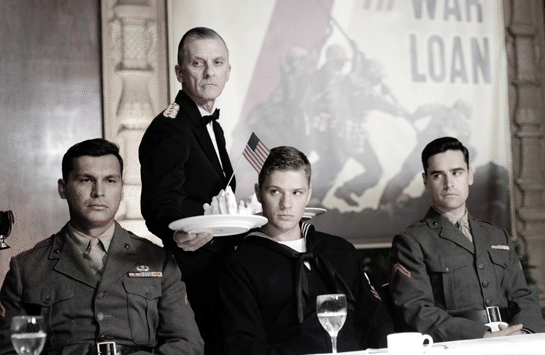
Flags of Our Fathers (2006)

Outline: Three men (Adam Beach, Ryan Phillippe, and Jesse Bradford) who managed to survive Iwo Jima are shipped back home to stomp for war bonds, but they can't manage to leave the horrors of war behind them.

I feel as though I cannot criticize this movie without it seeming like I am criticizing veterans. Can you just take my word for it that I have nothing but the utmost respect for veterans of the Allied forces? You can? Okay, good.

Because this movie . . . isn't that good. It's not bad, per se, but there are times when it is downright ridiculous. Forehead smackingly so. Bradford's accent is one of those things, but I am sure there are more subtle examples.

I should probably tell you that it is not the direction that is at fault. Clint Eastwood is an amazing director, and his pluckly little score is lovely. He's working with some great people, like Barry Pepper, Robert Patrick, Harve Presnell, Jamie Bell, and Joseph Cross, so it's no surprise that the picture is, at turns, very moving.

Even so, I get the feeling that co-writer Paul fucking Haggis (as his name will forever me to be) woke up one morning and announced, "Non-linear is so fucking hot right now." I'd say it was William Broyles Jr., but his filmography suggests that he wouldn't go there. I've never read James Bradley and Ron Powers' book, so I guess it could be non-linear, but that seems unlikely.

Listen - I like non-linearity from time to time. The Prestige used it to great aplomb. It's an effective device to get the audience to stay in the now of a given moment, to focus on the scene instead of working on the story. Here, however, the non-linear plot works against any tension the movie may have had, dramatic or otherwise. An argument could be made that because the movie is historically based, there was never any tension in the first place. I would challenge that person to find ten average Americans who know anything about that battle other than the iconic image.*

In any case, by telling us in the first few minutes who lives and who dies, the movie looses any shot at dramatic tension it may have once had, and the denouement, minus a few touching moments, ends up feeling drawn out and overwrought.

Nevertheless, there are enough tearjearking minutes and good action sequences to redeem the film from Paul fucking Haggis' "handiwork." We'll see how the companion piece compares next year. B

*Props for acknowledging the belief that the planting of the flag was a PR stunt.

Monday, October 23, 2006

The Illusionist (2006)

Story: Edward and Sophie, although a peasant and a duchess, manage to meet and fall in love. Finally tore apart, Edward disappears for more than a decade. He reappears in Vienna as Eisenheim the Illusionist (Edward Norton), just as it appears that Sophie (Jessica Biel) will marry Crown Prince Leopold (Rufus Sewell). Leopold becomes suspicious of Eisenheim and Sophie, and he orders Chief Inspector Uhl (Paul Giamatti) to find a reason to arrest the magician.

After publishing my own review of The Prestige, I happily settled into reading others' reviews. Imagine my disappointment when I discovered that most critics, or at least the ones I have read so far, felt that The Prestige didn't stack up the year's earlier magic-centric movie, The Illusionist. I had put off seeing the latter until I could screen it for a little less at ye olde Bytowne, and the reviews had me baffled.

So what makes this movie any better than the other one? In a word? Nothing. It's not that writer-director Neil Burger's adaptation of Steven Millhauser's short story isn't good. It's plenty of good. It may even be very good.

It is, however, hollow. From the dialogue to the acting to the director, there's no emotion in any of it. We're kept at an arm's length, and, well, it's hard to love a picture that won't take you in.

Giamatti comes close to inviting us into what should be a passionate love story. Subverting his schluby, stuttering Everyman type, Giamatti displays a sweet confidence that is undercut with menace. It's pretty clear which side Uhl will line up with, but Giamatti makes sure that even Uhl is surprised by his choices and actions.

It's great that Norton has found something worthy of his intensity. Too often the material before him isn't up to what he pours into the role, but he and the love-sick Eisenheim are a good match.

Biel pulled a Perabo, managing to not annoy me. It's quite a feat on her part. It would have been nice if she had put a little more emotion behind her heaving bosom, but it's a start.

Oh, Sewell, with your lazy pupil built for bullying. Remember when you were the hero that one time? Or - dare I mention it - the romantic lead? Me, too. Oh, well. You were meant to be an villain, weren't you? It's that display of cunning and intelligence combined with the very real possibility that you could kill someone with your bare hands.

It's Philip Glass' lush, elegant score that steals the show in the end. When you've got a composer like Glass on contract, you want to put the music out in the open as much as you can, but it is to the film's detriment that Burger does so. Entrancing though the score is, it also serves as a reminder of what the movie is not.

The movie is like a trick with a pledge and a turn but no prestige. The final explanatory montage is a cheap let down, as well as the annoying bit of contrivance that led to it. Good thing we have Giamatti's low angle laugh to get me through it. B+

Saturday, October 21, 2006

The Prestige (2006)

Premise: Apprentices Alfred Borden (Christian Bale) and Rupert Angier (Hugh Jackman) are competitive but friendly. An accident during Milton (Ricky Jay)'s magic show leads to a death, and their competition turns to rivalry. Angier's the better showman, but Borden's the better magician by far, forcing Angier to wonder if Borden has gone beyond tricks and illusions. Angier's obsessive need to beat Borden feeds Borden's own obsession, consuming both of them until it leads to murder.

Co-writer and director Christopher Nolan is a prima ballerina. His moves on the screen are so graceful, so delicate, and so disarming that you are hardly watching a movie at all. I was about 40 minutes in before I even remembered it was a movie. He and his brother, Jonathan, composed the screenplay, based on Christopher Priest's novel, in the three acts of a magic trick: The Pledge - the magician shows you something ordinary. In this case, it's a trial. The Turn - the magician makes the ordinary extraordinary. Film making is magic in and of itself, and here the magic comes from making you believe. Obviously the suspension of disbelief is required in all storytelling, but the Nolans go beyond that. They don't care about your disbelief because they do a lot more than get you to suspend it momentarily - they get you to leave it behind entirely.

Getting a convincing performance out of Bale is hardly extraordinary. Borden isn't one person but a plethora - a magician, a showman, a husband, a father, a lover, a friend, and an enemy. The characters are a lot to keep track of, and Bale's best moments are when the discrete personae begin blur and overlap. He never plays one emotion without the undercurrent of at least one more, if not two, and it's in that conflict that he achieves the extraordinary. He doesn't have to will you to believe in him as a great magician - he is one.

Perhaps the more extraordinary feat from C. Nolan comes then in Jackman's performance. It's not that I didn't believe that Jackman was a good actor before. It's just that he's not had much of a chance to prove it. Here he takes on a plethora of roles as well, but there's an emotion that each must possess and that Jackman embodies with a ferocity never before seen: hate. Hate is a complex human emotion, and a lot more goes into it that simply intense dislike. There's jealousy and admiration and loathing, and all of it is only a split hair away from love. I was awestruck by how much Jackman put into this role.

Another extraordinary feat was making me maybe, a little bit like Piper Perabo. She's not in the movie for long, but she didn't annoy me once, so I have to credit where it is due. Where isn't it due? Scarlett Johansson. What was that crap? I can get past her Gwyneth Paltrow English accent, and there's still nothing to get to. Her husky voice and opaque sexiness mean nothing if there isn't something behind them. And there wasn't. None of the love or hate or betrayal she should have felt as a pawn of these men was there. Instead Johansson was the apotheosis of John Berger's comment that "Men act. Women appear."

It certainly didn't help that Rebecca Hall, as Sarah, created a complete and compelling character. Or that Michael Caine delighted as Cutter, an engineer and inventor who made Angier's illusions possible. Or that David Bowie made quite an impressive entrance as Nikola Tesla.

David Julyan's score gives the movie just the right atmosphere of deception, as does Wally Pfister's compelling cinematography.

It is the third act, the Prestige, that gets you. The Turn on its own isn't enough. It's clever and nice, but figuring it out is too easy. No, the Prestige is the twist that makes you believe. The Prestige is the moment you realize the ordinary thing you thought you saw at the beginning was never ordinary. A

Monday, October 16, 2006

The Departed (2006)

Premise: Boston Mob boss Frank Costello (Jack Nicholson) gets a rat (Matt Damon) in the state police at the same time that the staties manage to get a rat (Leonardo DiCaprio) into Frank's crew. Sullivan (Damon) is tapped to track Frank's rat down, while Costigan (DiCaprio) attempts to flush the snitch out.

And you know who else is in this movie? Martin Sheen and Mark Wahlberg as DiCaprio's supervisors, Alec Baldwin as Damon's supervisor, and Ray Winstone as Frank's no.2, Mr. French. You guys, I love Ray Winstone. He kicks ass.

Ooo, and Special Agent Charlie Brown! It's too bad you guys don't know that ref. And Anthony Anderson! And Kevin Corrigan! As Em pointed out, who isn't in this movie?

Although I do not have confirmation, I believe this movie occurs in five acts instead of the standard three. Or, you could say that it has three acts as well as a prologue and epilogue. I say this because, as a viewer, I could feel the gears shirt between the acts, much to my delight.

Act 1: Setting the stage. At this point you pretty much nod your head and wait for director Martin Scorsese, in his infinite wisdom, to situate you. You pick up as much as you can (for there are clues to be had), but you mostly sit back and relax. You're in the hands of a master, right?

Act 2: And, by golly, he's going to set that scene. He's going to set this premise up like no premise has ever been set up before. You think about attempted Boston accents with varying degrees of success. You commend Nicholson for not bothering. You note Nicholson isn't playing Nicholson, and you appreciate Scorsese for that tender mercy.

Act 3: You lose complete track of the movie. You know who's a good guy and who's a bad guy and you are following the plot, but you find yourself wondering what's happening. As in, what's going on around here? Turns out Scorsese is lulling you into a false sense of security, however, as the movie hits a turning point (you'll know if the instant you see it). The action starts ramping up, hard, and the tension hits 11. And never comes back down. Thank goodness . . .

Act 4: Because it is on. And it's going to be messy. Scorsese excels in telling raw, human, American stories, and this one, although adapted from a trio of flicks from Hong Kong, is no exception. People make decisions, often the wrong ones, and those decisions always have consequences. Scorsese's lens spares no one from this fact. It was as Act 4 came to a close that I started to giggle maniacally because this movie, for reasons I can't quite put my finger on, had seeped into my very bones. Of course, this meant that I knew what had to happen next.

Act 5: It came to pass. I knew it could only go down this way for some time, I knew who would pull the final trigger and against whom for a long time, long before I knew who would be left standing at the end. This act is only a scene long, which is why it may be better to look at this film as three acts + prologue + epilogue. By the time Scorsese hits his final shot, as groan-inducing as it may seem, you don't mind because he's earned it. It's not annoying - it's hilarious.

DiCaprio continues to delight me as adult player who puts so much intensity and vulnerability into his roles. His ferrety movements and red-rimmed eyes at his first meeting with Dignam (Wahlberg) and Queenan (Sheen) is just the beginning. It's great that he's found a director willing to push him as further each time they collaborate.

I may not like Damon, but he makes a great prick. So smug, with the intelligence and the confidence and the inseparability.

But the best thing about this movie, perhaps the best thing about many of Scorsese's movies, is that it's not about good versus evil. There's no triumph. Instead, it's about achieving equilibrium. It's about symmetry. Things have a way of evening out. Victories are small, and they don't last. The fight does. So you fight. Scorsese gets that. A-

Sunday, October 15, 2006

The Science of Sleep (2006)

Premise: At his mother's behest, Stéphane (Gael Garcí­a Bernal) returns to France following his father's death. He gets a mind numbing job, and his coworkers Guy (Alain Chabat), Martine (Aurélia Petit), and Serge (Sacha Bourdo) begin to populate his dreams. Stéphane has always had a problem inverting dreams and reality, and he believes he has found a kindred spirit when Stéphanie (Charlotte Gainsbourg) moves in next door.

I cannot recall the last time I saw such a charming film. Writer-director Michel Gondry has created a winsome word that defies you not to surrender to it. Visually arresting, Stéphane's dream world takes on the characteristics of joyful artistic expression occasionally tainted by the pressures of adulthood, but, for the most part, it remains childlike and honest. The entracing work of composer Jean-Michel Bernard and cinematographer Jean-Louis Bompoint certainly help immerse the viewer in Stéphane's universe of cardboard toilet paper rolls and candy wrappers.

Although each performer conceives a memorable character (Chabat is a standout as older, randy coworker who needs Stéphane to keep him entertained), it is Bernal who owns the movie from start to finish. Rather than grounding the action with temperance, Gondry gives him carte blanche to elevate the film to fantastic heights. Stéphane exists in a world apart, and Gondry makes sure to blend the realms of the imagined with reality in order to ensure that the audience sees the world as Stéphane does. It is a credit to Bernal's talent that he can make the protagonist, even in his most annoying and obnoxious moments, the most delightful of the bunch.

It is a credit to Gondry's quixotic picture that he never reveals the basis for Stéphane's feelings of rejection and his need to create elaborate delusions. Hints are dropped throughout, but there's never an eureka moment. Gondry never suggests you to feel that you should try to live as Stéphane. There is magic in this world, and some people are fortunate (unfortunate?) enough to find it. A

Tuesday, October 03, 2006

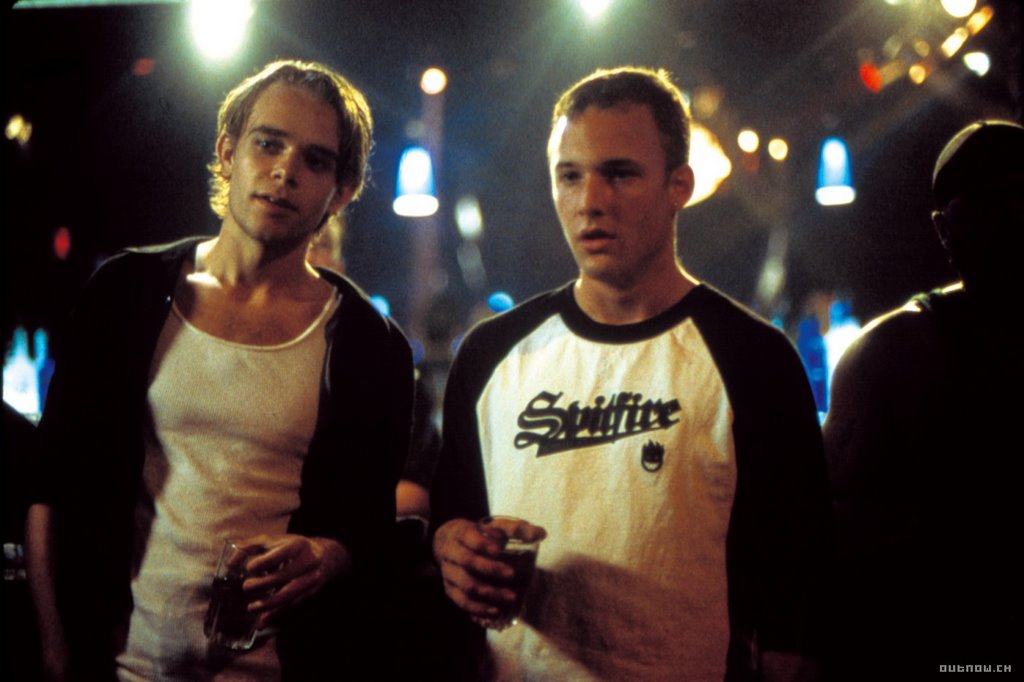
Bully (2001)

Brief: Marty (Brad Renfro) and Bobby (Nick Stahl) are best friends. They meet Lisa (Rachel Miner) and Ali (Bijou Phillips), and Marty and Lisa end up together. After rapes, beatings, and psychological torment at Bobby's hands, Lisa becomes convinced that Bobby is the source of everyone's problems and starts a plot to murder him. Ali rounds up her new beau (Michael Pitt) and friend (Kelli Garner) and hires a hitman (Leo Fitzpatrick), while Lisa enlists Derek (Daniel Franzese) to help.

Here's the kicker: it's a true story.

Often times, I receive movies from the kind folks at Zip and wonder, "What? What is this movie and why did I put it on my ZipList?"

Despite the fact that I had never seen this movie before or have it stored in my mental file of must-sees, I quickly put together the wherefore of it landing in my mailbox: it must have been the climax of my "Nick Stahl is good looking and a good actor" and "Whatever happened to Brad Renfro?" zipping extravaganzas. No, an ordinary person wouldn't wonder what happened to Renfro. Even if someone did, that person wouldn't look up the actor and make a point of seeing all that actor's movie from the last five years. But, well, that person isn't writing this blog.

When I watched the trailer, I suddenly remembered why I had nearly removed the movie from my ziplist more than once. The answer is simple - director Larry Clark. Clark made his infamous debut writing and directing Kids, a movie so thoroughly horrifying that I have yet to make it through an entire screening. I've seen a lot of things, moviewise, that I might want to unsee (and a fair amount of them involve Stahl, now that I am thinking about it), but I can't think of a single other movie that I don't think I have the emotional or visual capacity to sustain. Maybe, maybe A Clockwork Orange, but I'd sooner do that than Kids.

Aside from any aesthetic or artistic merits that a Clark movie may or may not possess, the critical argument always circles back to this: Does Clark exploit his barely legal young stars, or is he showcasing teen reality in a way that pretty much every other director is afraid to?

While he does a commendable job drawing the line between sex and rape (both of which you see graphically), I'm coming down on the side of exploitation. I've seen plenty of graphic scenes in my days, and these were, for the most part, no worse than ones I've seen before or will likely see again. It's the excessive nudity on top of that pushed me to side with the exploitative argument. Am I really supposed to believe that a teenaged girl who dresses in only giant men's clothes that add a solid 30 pounds to her frame sleeps nude, makes all her phone calls nude, and takes pregnancy tests nude? Or that guys normally just take their shirts off while over at other people's homes, watching TV? I was about throw in another example, then I remembered that he was naked so we could have the faintest whiff of sexual abuse by the father. Thanks for that, Clark. How such intimate details could be known about the dead guy are beyond me, but thanks anyway.

I'd get into the storyline or the acting, but, well, I'm still too saddened by the sentences the seven received. Hasn't anyone in California ever heard of mitigating circumstances?

Overall, an appalling movie that neither performances nor style could rescue. D

On the positive side, a list I thoroughly support. I was surprised at how many where among my favs.

Monday, September 25, 2006

half nelson

Half Nelson (2006)

Premise: Dan Dunne (Ryan Gosling) is a popular history teacher at an inner-city middle school. He's also an addict. He keeps his two worlds separate until Drey (Shareeka Epps), one of his students, finds him in the girl's locker room with a crack pipe.

This indie is not part of the fantastical movie world where people can save each other. Redemption isn't easy, and it doesn't come quickly. There's always further to fall for Dan, a clever composite of the worst side of addiction and the best inspirational teacher model. Early in the movie he tells his students that history is about dialectics: opposing forces work against each other, resulting in change. This monologue informs that rest of the movie, yet it does so without coming across as a cheesy after school special. For Dan, it's the drugs and the students. Every time he's stoned he wonders, ceaselessly, how he can reach his students. When he finally hears about the impact he's had, he's too far gone to understand.

For Drey, it's Dan and Frank (Anthony Mackie), a local dealer whose work landed Drey's brother in jail. Drey can't save either one of these men, and both relationships have the potential to destroy her.

What a movie, people! So . . . economical. But in a good way. Relationships, characters, and plot points are established in seconds, not sprawling over unnecessary minutes. Anna Boden and Ryan Fleck (who also directed) have a story to tell, and they are not screwing around. Time goes into smart camera work, perfect pacing, and clever plotting. Nothing too Hollywood happens, allowing the story to maintain a realistic, even documentary edge.

That edge is carried over to the performances, especially those of the two leads. It's easy to forget that Gosling and Epps are acting, given how raw they play it. Gosling is a rare firecracker whose lean good looks never hold him back from hitting the emotional underbelly in his characters, but it's Epps that will capture the audience's heart. Her toughness isn't put on; it's the product of hard earned everyday lessons that occur outside the classroom. When you see the vulnerability of her youth, despite her intelligence, it's heartbreaking.

One minor thing: I didn't always jive with Broken Social Scene's dissonance.

Otherwise, a dream of a movie. A

Wednesday, September 20, 2006

I've tried other cocoas, and this one's the best!
 
What? The Truman Show is hilarious.
 
The point being, of course, completely unrelated: If you reside in one of the areas affected by this test deal, please take advantage of it. Not because I think you should line the studio's pockets, but because if it's successful, it will become permanent. And if that happens, other chains would be forced to adapt. C'mon, people! Don't you want cheap Tuesdays back?

Monday, September 18, 2006

The 50 Best High School Movies
 
While I would have shuffled a few titles around, I concede that this list is one of the most insightful and sweetest I have ever read. Some of the titles are among my personal favourites. What can I say? There's never going to be a day in your life when you forget what it was like to get older in tiny, significant increments.

Sunday, September 17, 2006

The Last Kiss (2006)

Idea: Twenty-nine year-old Michael's (Zach Braff) life feels pretty planned out: he works at a great architecture firm, he's still friends with all his pre-school friends, and he lives with his pregnant girlfriend (Jacinda Barrett) of three years. Naturally, he meets a cute co-ed (Rachel Bilson) and starts having doubts about where his life is going. Meanwhile, in sub-plot-landia, Chris (Casey Affleck) is considering leaving his wife (Lauren Lee Smith), although he doesn't want to leave his toddler behind; Izzy (Michael Weston) can't win Ari (Marley Shelton) back, so he's heading to South America; Kenny (Eric Christian Olsen) may have found a girl worth more than a one-night stand; and Stephen (Tom Wilkinson) and Anna's (Blythe Danner) relationship is headed for rocky road.

Although I cannot find any proof of my conviction, I am certain that The Hater made some crack about this movie being a run-of-the-mill can't commit movie with a patina of Garden State to make is seem worthwhile. I had no idea how right she was until last night. In fact, she's not enough close to being right.

This movie is crap. Absolute, fucking crap. So little in this movie is genuine. And I realize that some people would tell me that asking for something genuine from Hollywood is asking too much. Listen, those people, something like that is pretty much all a movie like this has going for it. Something genuine, something true to life that the audience can connect to. Not something that the 14 year-old girls sitting behind me who had never been out in public before, much less to a movie before (Audible stage gasp "Do you think he's going to? Omigawd, he did!"), would swoon over. There were multiple points during this movie that I reached over to grab my purse and leave, remembered that I was with three other people, and settled for a full-on eye roll instead.

Most notable point? The fucking narration at the beginning of the movie. Does it ever reappear? Nope. Not a once. Is it in anyway necessary? Not really. Most of that could have been worked in as exposition, and the rest would have worked better as part of the dialogue that occurs later in the movie. Instead, you have to suffer through its "feeling"-ness. Shut up, shut up, Paul Haggis. You are making me sorry I ever touted the genius of Million Dollar Baby. I hope you are happy with yourself. Knowing you are involved with Clint Eastwood's latest movie is making me reconsider seeing it as well.

Shut up about women. Apparently, there are only slutty, shrewish and/or pathetic women in your world. My world is a bit more diverse, but let's look at yours for now. 98% of women, and I'm being generous to you here, Paul, 98% would walk away when they found out the object of their affection had a girlfriend. Esp. if they learn that fact at the first meeting. Don't get me wrong -- Michael misleads Kim in a lot of ways, but he cops to that one pretty quick. Their every interaction after that fact comes off as false. This is largely based in the way Kim in written and in the fact that Bilson doesn't have the acting chops to redeem her in anyway, but everything out of Kim's mouth and all her actions were so pathetic and unconnected to way that real women act as to be a farce.

Shut up about men while you are at it. If you want to see an example of men's relationships done well, watch any episode of Rescue Me. That show, too, short-changes women, but it nails male interaction bar none. As much as I have enjoyed Braff if the past, he, too, doesn't have the chops to rise above the mediocrity he is surrounded by. Mind you, he's not so bad since he gets to play pretty much the only fully fleshed character in the movie, but it's still pretty sucky.

Can I tell you guys something? I loves me some Casey Affleck. I want him to be my boyfriend. He's broody without being dark (a rare feat), and Chris is a grown-up who makes decisions and lives with their consequences. Because I am old, I find that dreamy.

To be honest with you, I mostly wished that Affleck and Wilkinson had a better movie to be in. I hope they find one. D-

Saturday, September 16, 2006

Little Miss Sunshine (2006)

Premise: Runner-up regional winner Olive (Abigail Breslin) gets a chance at the national Little Miss Sunshine title when the winner is involved in a diet-pill scandal. The entire family accompanies Olive on her trip across the country: Mom/Sheryl (Toni Collette), who keeps the family together with fried chicken and new age platitudes; Dad/Richard (Greg Kinnear), who is desperately trying to turn his nine step self-help program into a book; brother/Dwayne (Paul Dano), who has taken a vow of silence until he achieves his goal of becoming a test pilot; uncle/Frank (Steve Carrell), who recently attempted suicide after his lover leaves him for his academic rival; and Grandpa (Alan Arkin), Olive's choreographer, who snorts heroin and swears like a sailor because "[he's] old."

So, in other words, everyone is forced to come along with her because of contrivance. There were a few moments in the beginning of the movie where I rolled my eyes at the over-the-top quirkiness of it, but you sort of fall into a lull after a while and start to enjoy it. Plus, Carrell is really, really good in it. Technically speaking, everyone is really good in it -- it's the quality of the performances that elevates the piece above the trappings of the script. I have to single out Carrell, though. That deadpan? Those dead-eyed looks? That nerd run? Fantastic.

By the time you get to the completely ridiculous, completely unearned, completely hysterical climax, you've been won over. Like the beat-up VW they drive, it's slow to start, but there's no stopping it once it starts humming along. Husband and wife directing team Jonathan Dayton and Valerie Ferris keep a tight reign on newcomer Michael Arndt's screenplay, and the viewer is the beneficiary. A-

Thursday, September 14, 2006

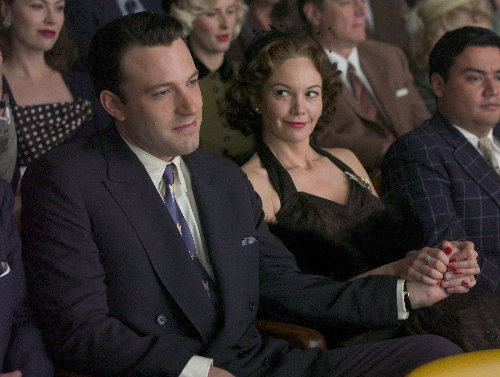
Hollywoodland (2006)

Summary: Following the suicide of TV's Superman, George Reeves (Ben Affleck), private detective Louis Simo (Adrien Brody) is encouraged to look into the incident as a possible murder. Although he initially seeks to pick up a little money and publicity, Simo becomes engrossed in the mystery. His story plays out against the relationship between Reeves and Toni (Diane Lane), wife of MGM studio head Eddie Mannix (Bob Hoskins).

Let's start with the obvious. Recently, Affleck picked up Best Actor at the Venice Film Festival. Did he deserve it? As Em and I put it, it's a career best performance. Of course, we are talking about Ben Affleck's career. Yeah, sometimes he's so good that you forget that he's acting (something that's never happened to me while watching him before), but sometimes that slips and he's Ben Affleck again. There is a little bit, completely silent, in combination with a little spoken bit, that's breaking my heart nearly a week later, but I think that's more about Reeves that anything Affleck said or did. He's good, but he's not great. I wouldn't toss him another Oscar tomorrow.

As for Lane, who's name is also currently floating around with Oscar's, I'm going to have to say . . . really? For this? I rather enjoy Lane on most occasions -- she's quiet and powerful and sexy and sad and all around good. But here, well, here. Most of the time, she's wonderful: playful and sad in just the right combination. Every once and a while, however, she overacts. Not good.

Hoskins does his Hoskins thing, which is being a consistently good actor.

Oh, Brody. I think I am starting to . . . like you less. I know. I know. I don't know quite how it happened either. I still think you are beautiful, and your delivery is superb, and sometimes your eyes grow to three times their size and glisten just so . . . but, I don't know. Simo just seemed so ahistoric. And I never thought I'd say that about a character you played. Even so, a lot of your character's dialogue sounded so modern that it threw me right out of the movie. Of course, you didn't write the script, so I suppose I should pin the blame on . . .

Paul Bernbaum. Dude, I know you're a television writer, but do some research! Pay someone else to do it for you! I don't care as long as it gets done. And, while we are here, that's your conclusion? Seriously? I can understand it, intellectually. It works best with the evidence that we have and is certainly a possibility. But as a viewer? Left me hanging. Didn't entirely appreciate that. Your script was mostly smooth sailing before that.

Props to director Allen Coulter, who also made the jump to the big screen with this picture. Between you and your DP, Jonathan Freeman, I rather enjoyed what I saw.

Have you ever heard that Ella Fitzgerald classic, "You Won't Be Satisfied"? Although I do not recall it playing during the movie, it is the song that started playing in my head afterwards, and I continue to associate it with the show. It tells the long and short of the movie -- kind of dissatisfing but at least it's pleasingly melancholy. B-

Friday, September 08, 2006

Humour isn't that subjective
 
What the crap? Why is this happening? I know things weren't perfect last year, but is Jon so . . . what, exactly? Why can't he do it again? He's too East Coast? Too outsider-y? Too funny?
 
Not that I don't like Ellen. I do. I think she's hilarious. But her brand of humour, at least on her talk show, is so middle of the road. It's too "don't rock the boat" for Oscars. I like a little spice with my awards shows.

Wednesday, August 23, 2006

Serenity (2005)

Whoo! More RE-views! Rules.

You know, I really got into that review last time. I got into the movie this time around, too, and I probably will next time.

I'm not even sure my RE-view has a purpose, as my feelings about the movie haven't changed. I suppose I could write ruminations about Mal and River as father and daughter, Watcher and Slayer, unconditional love and duty, but I won't. I could tell you about how I approached the show from Simon and River's relationship, from his point of view specifically, but I won't do that either. Jacob's recap does that much and more. To be honest, it's so detailed and expertly written that I'd wager it might be better than the movie itself. I mean, you need to see the movie to understand, but his recap digs deep into the myth-arc of the series, of any Joss series. There's little I say that he didn't.

I can say that I didn't mind Book being marginalized in the movie because he could grate in the series, but his character is marginalized to the point where someone who didn't know him from the series wouldn't entirely understand his relationship with the other characters, generally, and Mal, specifically. Joss excels at establishing believable characters in a matter of seconds, so that's not the problem. It's the part where Book dies and Mal gets all worked up about him being part of the crew even if he does live on Haven now that would go over the head of someone who had never seen Book living on the boat to begin with.

It sucked that Jayne's character was dumbed down for the movie. I don't mean that he was a braintrust in the series, but a lot of his complexity, or startling lack thereof, was removed in the movie in a way that didn't work for me. You know that arc where Jayne tries to sell Simon and River back to the Alliance, then he seems to change his mind, gets double-crossed, discovered by Mal, almost killed by Mal, buys them apples, then warned by Simon? You know, that one? Those apples were my character touchstone. Jayne wasn't motivated by guilt (at least not entirely so). He wanted to buy back his place on Serenity. He needed to show Mal he was a valuable resource. It was, for me, the beginning of his transformation from mercenary to loyal member of the crew, but the movie kind of . . . pretends that none of that ever happened. Which sucks.

Of course, the worst marginalization was that of Wash because it gave Joss license to spearify him! What was that? I get it, sort of. It works along the same principle as Anya dying in the series finale of Buffy or Wesley in that of Angel. Someone has to die because none of them should have lived that long in the first place. There's no reason to think that everyone would survive a combined Reaver/Alliance attack, and Wash had the least to lose. His death could have the greatest emotional impact with the least plot impact.

I'm stickin' with my original grade. This movie rocks pretty hard.
 
Holy shit, people! I knew things were getting bad for Hollywood's resident crazy, but I didn't realize they were this bad. This is just paint nuts. Tom, what the hell are you going to do?
 
Okay, I know what you need to do. Take a big, long break. Say you are going into semi-retirement to spend time with your kids, plural, and actually marry Kat[i]e. Magazine covers are telling me you kind of don't want to anymore, but do it anyway. Patiently wait for other big stars to continue self-destruct (nature of the game, after all). Cautiously begin search for next script after a minimum of one year, take a huge cut on your crazy complicated pay scheme, and don't ever talk to anyone again about your "religious" beliefs. I think that should do.
 
Assuming you hit upon another Jerry Maguire or Rain Man, things will turn around for you. You've been on top for longer than pretty much anyone, ever. I think this could turn out very well for you.

Monday, August 21, 2006

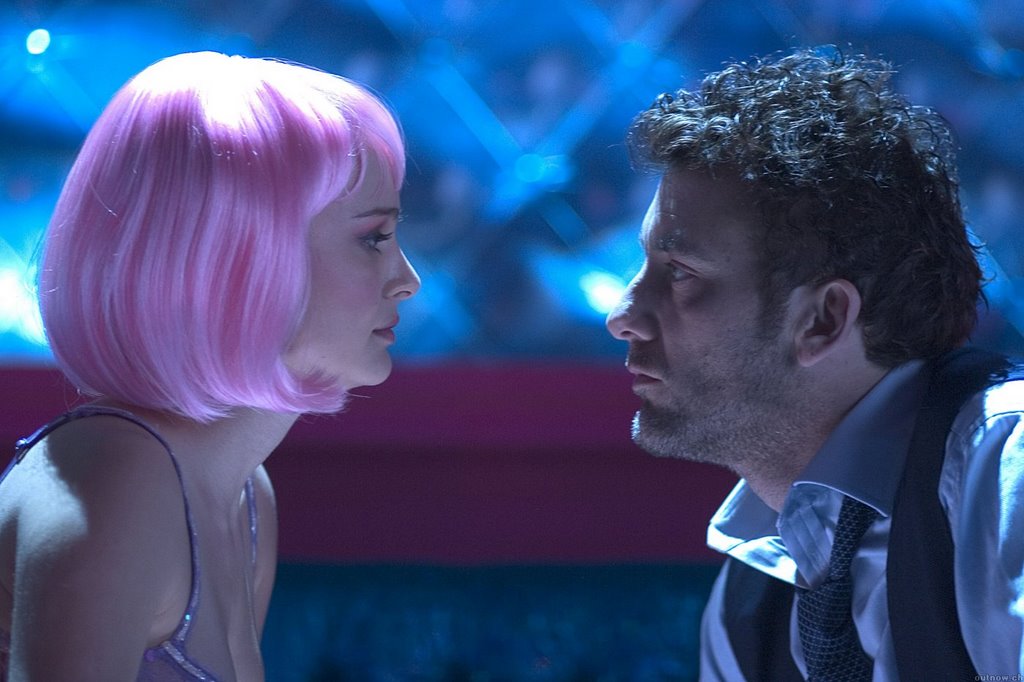
Closer (2004)

RE-view! Rules are here.

I see now what my problem with it was. I couldn't quite put my finger on it before, but I've got it now.

It's not the performances. The performances are excellent. Not uniformly so, but that's too much to expect. It's tough to tell if Portman and Owens play the more compelling characters or if their characters are more compelling because they are so well played. Alice owns Dan from the first moment that she locks eyes on him through the crowded street, and it's her that gives him the courage to pursue Anna so ruthlessly. Portman gives the opposite performance of what a doe-eyed ingenue would do: instead of letting vulnerability show around the edges of her strength, Portman makes strength shine through layers of vulnerability.

Owens has the mean task of playing the most adult character in the movie, one who has emotions and issues but isn't too far gone to recognize responsibility. When he is introduced, he's the victim of a cruel joke, and he spends the rest of the movie floating on top of the other characters, able to observe and plan and execute when the rest are awash.

Although I have a tendency to point the finger at Roberts, she's not as bad as I originally made out. She makes it easy to understand why Anna is drawn to both Dan and Larry. Her early scene with Portman is probably her weakest, but her work with Owens elevates her usual shtick to an impressive level.

It's Dan that remains a mystery to me. Never mind what I feel are Law's diminishing returns. If you consider the relationship between Dan and Anna the movie's catalyst, then it has to be the most believable one, right? Except it's not. Dan's obsession with Anna baffles me. It comes out of nowhere, and it never feels quite right. After awhile you can accept that he is obsessed, but the important why continues to nag in the back of your mind.

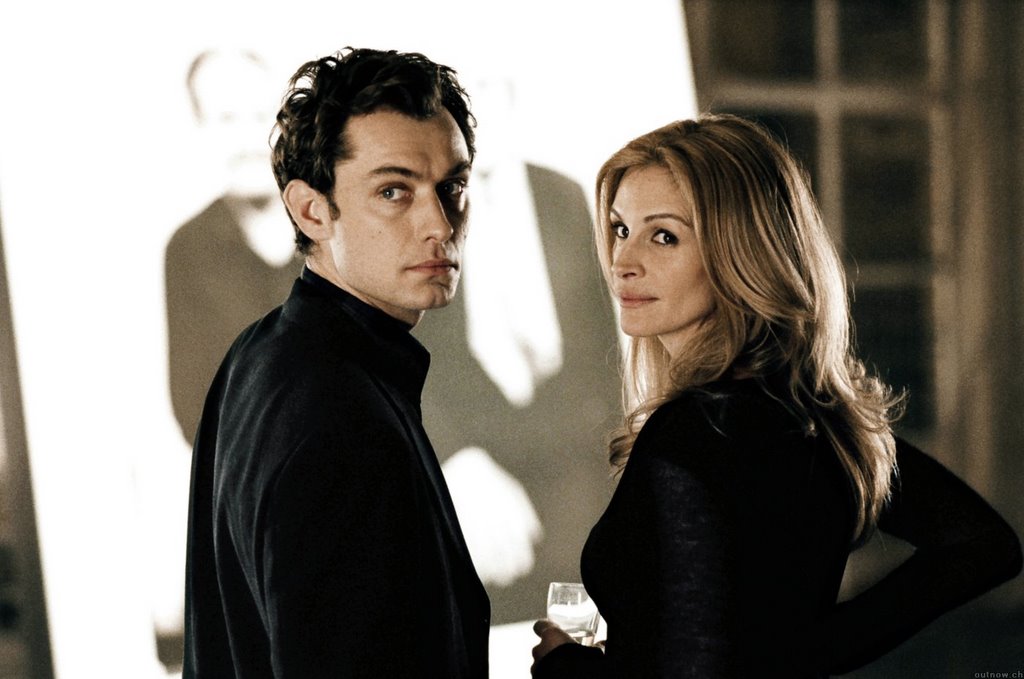
Still, it's not the acting or the direction or the cinematography, for that matter, that holds the movie back. It's the writing. Specifically, it's the screen adaptation that doesn't work. Plays are talky by nature; it's fair to expect a talky movie. Patrick Marber basically "opened up" his play: I'm guessing that there are a lot more locations here than in the original work. Locations aren't enough. Everything happens off screen. Everything. The art show is the centrepiece (right), and it's well done, but it's the scene in the private room between Alice and Larry (top) that has the most going on and feels the most real. Not everything has to happen where we can't see it. Putting the viewer in the middle of the action helps them get more out of what they are seeing.

My original grade (B -) seems generous upon second viewing. C +

Wednesday, August 16, 2006

Mystery Solved
 
And it's a good thing, too. I was in knots wondering what CBC was going to do about The One.
 
While I'd like to feel smart and superior about this, I doubt Canadians would fare any better. I can't name a single judge on that sits on the bench of our Supreme Court.

Tuesday, August 15, 2006

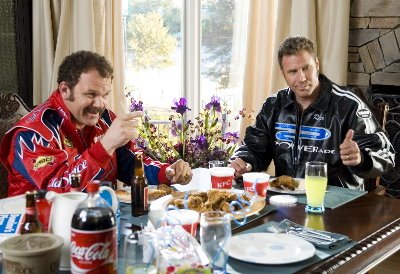
Talladega Nights: The Ballad of Ricky Bobby (2006)

Short: Due to some misguided advice from his stoner absentee father (Gary Cole), Ricky (Will Ferrell) lives his life by the philosophy that "if you're not first, you're last." This motto has propelled Ricky to the top of the NASCAR standings, where he either has to come in first in every race or destroy his car trying. He even keeps his best friend and fellow racer, Cal (John C. Reilly), in second place. The addition of a Formula One French racer (Sacha Baron Cohen) to the circuit creates trouble for Ricky. Then there's the usual crash, fear, redemption and love of a good woman stuff. La-dee-da.

Oh, come on! You don't care about the plot. You want to know if the laughs are worth the ten bucks. So, yes. Yes, they are.

Ferrell is just shy of having me crown him a comic genius, Cohen does a lot with a little, and the camera work is inventive for a comedy. The pacing needs work, and some of the jokes fall flat (I recall the entire audience looking around uncomfortably at least once). Jane Lynch is a treasure is Ricky's tough momma, and Reilly is a great comedian. I also like the idea of him doing two NASCAR movies.

I've been putting off this review because I can't think of much else to say besides the few sentences I've cobbled together up there. It's funny, but I don't want to spoil the many delightful gags the way other reviews have. I enjoyed it it; I'd see it again. I will say that while Leslie Bibb and Amy Adams do seem ridiculously young for Ferrel, there are only seven and eight year age differences, respectively. Solid work. B

The Eject Button
I hereby grant you permission to hit open/power if you discover anyone watching either of the following: Eulogy (2004) - a "dark comedy" that failed to elicit a single smirk from me in the 30 minutes I much too generously gave it - or Taboo (2002) - a "thriller" I unfortunately sat through all of simply because I wanted to watch everyone in it die (and I did). There was nothing surprising in its twists, and its low budget was hilarious ineffective (I made a game of guessing when they would switch to their sole stock shot of the exterior of the mansion, which was also their sole set).

Tuesday, August 01, 2006

50 Greatest Comedies of All Time
 
Well, maybe. I've seen appallingly few of these films, but at least they have Rushmore on the list. Any recommendations?

Sunday, July 30, 2006

Miami Vice (2006)

Summary: When an informant's family is killed, Crockett (Colin Farrell) and Tubbs (Jamie Foxx) go undercover as transporters for the Columbian drug lord José Yero (John Ortiz), who leads them to Arcángel nde Jesús Montoya (Luis Tosar) and Isabella (Gong Li).

Even though I went to this movie Friday night, I can't stop laughing at it. It's so bad. So bad it's funny, in my opinion, but not in the good "knows it's bad and therefore decided to be funny way." Sadly, it's the unintentional way.

Oh, Michael Mann. I can see why you would want to revisit your old stomping grounds, and I think you are one of the few writers or directors that doesn't rely on clichés to establish place. So, it's just your dialogue, characterization, casting, music, pacing, and eyesight that need work.

Dialogue: I liked it when Foxx said, "There's undercover, and then there's which way is up." I did not like it when he suggest that they "take it to limit. One More Time." One is a smart and fresh way of looking at something, and one is lyrics from an Eagles song. One of your male leads says he's "a fiend for mojitos," my response is not, "Sexy!"

Characterization/Casting/Eyesight: These three are tied up in the romance between Crockett and Isabella. I get that Farrell looks like that so that Crockett looks the undercover part, but, well, the actual drug dealers were better groomed. Also, drug dealers around the world should look at Farrell on the poster and decide that they need to step up. As for the supposedly white hot affair, Farrell looked alternatively bored and put upon. He always seemed to be going after Isabella because the script told him to and for no other reason. As for when Isabella and Crocket were having their super-sexy sex, they looked so uncomfortable. I think that, at least a little bit, their all-elbows sex was intended to come across as intense desire, but it just ended feeling awkward. Perhaps the negative chemistry between the two was part of it.

Music: Please get your bad 80s music away from me. I get that that's when the show was on, but you are going for a gritty, more realistic take on the vice squad, no? So drop it. I am practically a connoisseur of bad 80s music, and you do not have my support here. When I stop paying attention to think about how bad the music is, that's a bad sign.

Pacing: This movie is a marvel. No, really, I marvel at it. I don't understand how something with so much going on could also be so very flat. There was not a single moment of tension or suspense. It was all, "Oh, I guess that girl's gonna get kidnapped. Whatever, she'll live." and "Hmm, I guess it's time for that guy to get laid." Throwing lots of sex and violence in a movie isn't a surprise.

So, at least I could laugh at how bad it was. Too bad it couldn't just settle in and laugh at itself. D

Saturday, July 29, 2006

Lady in the Water (2006)

Idea: Building manager Cleveland Heep (Paul Giamatti) discovers Story (Bryce Dallas Howard) swimming in the pool after hours. She's fragile, so he takes her in for the night. Cleveland soon discovers that Story is a narf (think sea nymph), seeking the Vessel to whom she must tell her tale before she can return to the Blue World. As Cleveland tries to track down the right writer within the apartment complex where he works, he also has to locate other participants that Story needs to safely go home.

Much as Mission: Impossible III served as a national referendum on the formerly enduring popularity of Tom Cruise, Lady in the Water seems to be one on writer, director, producer and now supporting player M. Night Shyamalan. I don't want to defend him, per se, because I don't think it's a defense that he needs. He needs . . . he needs a co-writer is what he needs.
Let me explain. With only seven directorial credits to his name, Shyamalan is disproportionately, Cameron Crowe sized famous. That's the way it is, and I'm not in the business of assessing fame, so just take it at face value. He made two movies that no one has ever heard of, and then he rolled out The Sixth Sense. Suddenly, he was an Oscar-nominated prodigy, and every one wanted a piece. Looking back on the varying success of the three intervening movies, I wouldn't go as far as to call it squandered promise. I'm not sure what the promise of The Sixth Sense was, anyway. Artsy? Kind of full of itself? Not that surprising? It was a well done movie, the ghosts creeped me out, and I'd watch it again.

Some critics complain that Shyamalan should drop the art house pretentions and just surrender himself to what he is -- a horror director. Which he isn't. Sure, he and composer James Newton Howard rely on blank camera vistas and sudden musical crashes to scare us, and you could call each of his movies, to a certain extent, creature features, but that's oversimplifying. Simplifying is an idea Shyamalan could benefit from, yes, but that's certainly not the problem with this offering.

A narrator pretty much lays the story out in an opening monologue, and I was rolling my eyes, groaning, and fidgeting my way through it. For a bedtime story (a fairy tale in my parlance), it was awfully self-serious. Kids don't play that way. But then the real movie started, and I got into it. Shyamalan has always done a great job setting the story and characters up, and, as he always brings it in under two hours, I wouldn't say he takes too long doing it.

It is at this point that he should bring in a co-author. It's not Shyamalan's ideas that need work, it's the execution. Someone to look over his shoulder, reading the dialogue, and politely, gently asking, "You sure you wanna go there?"

For all his thriller efforts, all Shyamalan's main movies are about a few simple things: right and wrong, good and evil, the interconnectedness of all things, and interdependence. If anything, it's equilibrium he seeks to achieve.
As a director, he has a knack for finding the one actor that would fill whatever role perfectly and bringing out the one quality that s/he possesses that brings it all together. As a director, he can be strangely literal (esp. here), but he understands humanity in a way that a lot of others don't. As a writer, well, I'm starting to look back on roles in his other works and realize they were the ones he would have played if he could have. A writer often creates a proxy, and I'm too partial to the technique to criticize it.

As an actor, Shyamalan's natural in front of the camera, and he does alright. None of it is ever quite enough (not scared enough, not shocked enough, not happy enough, etc.), but I have seen so much worse so many times that complaining seems unnecessary. Besides, Giamatti, Jeffrey Wright, and Sarita Choudhary (among others) are so enjoyable that it almost doesn't matter.

I say almost because, seriously, what is with Howard? I liked her so much as Ivy in The Village, where her stilted delivery and strange accent worked with the setting. If this is the way she normally talks, then she needs a dialogue coach immediately. She borders on animatronic most of the time. There was one scene where she started talking normally, but it didn't last. If it was an acting choice, I fail to see the reasoning behind it.

Overall, it's a tough call. There's no big twist, just a series of hiccups. It's too self-serious at times, but it gets the job done. You know what? If this was some animated movie for kids, not a single critic would wrinkle his/her nose at the idea of narfs and scrunts and giant birds that carry people away. There's nothing wrong with a fiction writer creating new worlds. Wes Anderson (the contemporary with whom I most closely associate Shyamalan) does it all the time, and critics are quick to embrace his vision. People are unfairly harsh with Shyamalan. This isn't the best movie ever made or even his best, but it's not that bad. And that, my friends, is pretty good. B

Friday, July 28, 2006

This isn't exactly what I had in mind
 
I know what I said, but this isn't exactly the way I thought it would turn out. Ah, well, put the National back in the right place, and we will forget this ever happened.
 
Sidebar: Does anyone else think he looks terrible in that shot?

Thursday, July 20, 2006

Supposedly brilliant players usually miss one move checkmates in critical games. This is akin to a professional race car driver backing his station wagon into the garage door.
 
Ha! I can't believe I haven't found this site sooner. I've only read the chess topic so far, and it's cracking me up.
 
If you would prefer, however, to get whipped into a righteous fury regarding the current state of the English language, may I suggest this?

Monday, July 17, 2006

Wet Hot American Summer (2001)

Summary: Last day at Camp Firewood, August 1981. There's a director (Janeane Garofalo), a lifeguard (Paul Rudd), an arts and crafts lady (Molly Shannon), various counselors (Michael Showalter, Marguertie Moreau, Michael Ian Black, Zak Orth, Ken Marino, Joe Lo Truglio, Amy Poehler, and Bradley Cooper), and a couple of kitchen guys (Christopher Meloni and A.D. Miles). Variegated insanity including a love triangle, a desperate attempt to lose one's virginity, a rafting trip, and a space lab part landing during the talent show ensues.

Okay, let's see here: think of any movie you have seen set during summer camp. Think of any movie set during summer, period. Think of a few romantic comedies. Think of Rocky. Got it all in mind there? Good. Now let's make fun of all of it by blowing it completely out of proportion.

And . . . that's the ball game. Hilarious movie. Not perfect by any stretch of the imagination -- not all the jokes work, some bits don't come together, some of the actors don't fit in their roles -- but wonderfully inspired. Director and co-writer David Wain and co-writer Showalter have a great handle on the sheer insanity that is summer camp as well as the trite film conventions they mock so lovingly. Yes, lovingly. Not ruthlessly. You've really got to love movies to make fun of them this much. That town sequence? Or that moment with Garofalo and Rudd in the dining hall? Or Garofalo and Truglio's destructive search for Marino? Genius.

Although the ensemble is well put together, there's really only one stand out: Rudd. Way, way back in the Clueless days, I liked Rudd well enough, but I didn't see the big deal. His forehead's big, and he's got the kind of lips that demand that you grab his face and smush them up in a "Isn't he adorable?" grandmotherly sort of way. He's the boy next door type. I firmly held that belief until a recent interview convinced me that Rudd was hilarious in the kind of way that made me want him as my friend. As such, I had to track down, of all things, a completely off-the-radar comedy from 2001.

Rudd is a treasure in the movie. A gem. A find. I could watch him pitch that hilarious fit in the dining lodge a hundred times over and still crack up. The delivery on the line, "You taste like burgers. I don't like you anymore." had me in stitches. He has excellent comedic timing: never stepping over anyone else, never let it hang for too long, never giving away that he's sitting on something hysterical. I wish I could hang out with him now.

If only I hadn't sent the DVD back so soon. B+
I liked him as Don John
 
But Dana Stevens does a pretty good job of explaining Keanu Reeves' appeal here. Too bad she misses Thumbsucker. Making an icon out of nothing is a mean feat.

Sunday, July 16, 2006

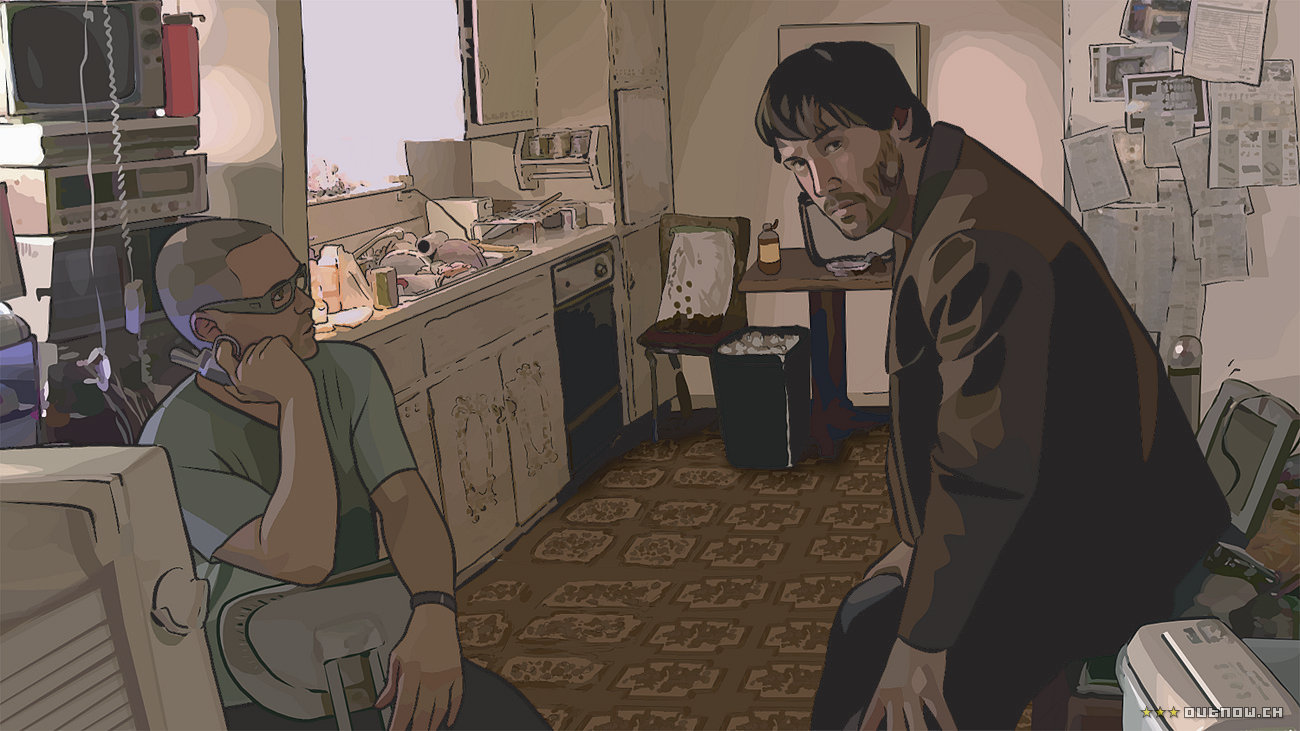
A Scanner Darkly (2006)

Brief: A scanner (Keanu Reeves) known only to his superiors as "Fred" infiltrates a group of Substance D addicts and dealers (Winona Ryder, Robert Downey Jr., Woody Harrelson, and Rory Cochrane) in order to locate the source of the dangerous drug. Fred is asked to closely monitor one member of the group, Bob Arctor, i.e. himself.

Allow me to sum up the reaction of one Elfin April and her viewing partner, Emily, following our screening of said film: What? And also, What?

It should be noted that I've never read the Philip K. Dick's novel based on his own drug experiences, and I suppose if I already knew the plot I may have been able to follow it a little better. As it was, there were about three false endings: the first two made the entire movie make no sense, the third explained the other two, and then the fourth, the actual end of the movie, put all the pieces back together, but a lot of it still went over my head.

First off, rotoscoping still looks cool. It has a way of enhancing the image despite the fact that less is in focus than with traditional camera work. Plus, and maybe this was just me, sometimes the animators leave a little something in, like not colouring over a plant on a desk or an ashtray on a coffee table. I liked that.

Also, Richard Linklater still rocks. Even when he's commercial, he brings an outsider's perspective, a sort of slow charm to his work. His direction has a disarming intelligence to it. Although a lot of the subject matter went over my head, it still had an affect on me, which is more important.

Some stuff I've read talked about how Dick's work is more/just as relevant now. In terms of surveillance, I see the connection. In terms of pretty much anything else, not so much. For instance, and I'm about to give a lot away here, they manufacture the drug, and they regulate the rehabilitative therary. Only the effects are permenant, and they use the worst cases to reproduce more drugs, and the government controls the whole thing or at least acquiesces to it. I feel like this is a metaphor or extended parable, but what's the reference to? Some other kind of drug? I guess it could be, but I think anyone would be hard-pressed to prove that the government manufactures, say, heroin, gets people addicted to it, and then enslaves them. So, death because that's what they call D in the movie? Um, I don't think that's it either. This sucks. I feel like there's more to this movie, but I just can't cut through the fog.

I'm not exceptionally bright by any measure, but I usually get movies. I didn't get this. Maybe I will if I see it a few more times, but, if I don't? Then I am going to have to suspect that the problem lies within the film instead of myself. B+

Tuesday, July 11, 2006

I saw . . . this : Part 2

See Part 1 for instructions.

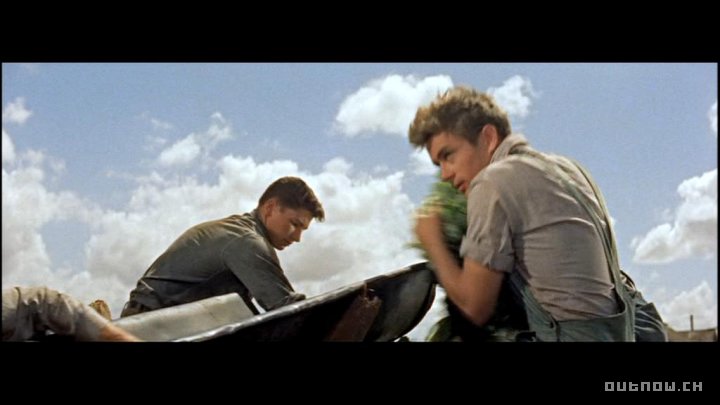
East of Eden
(1955)
It's pretty good for a Steinbeck adaptation. Perhaps the best way to experience Steinbeck, in fact, is on the screen: you wouldn't have to read his ham-fisted FORESHADOWING or his "look at me! look at me!" style of symbolism. I have no idea why the intro had to be, at least, 8 minutes long, or why the girl's interest suddenly and definitely shifted to Cal (James Dean), but the competition between Cal and Aron (Richard Davalos) for their father's love was well done. I can see why they made such a big deal out Dean's big screen breakthrough. For all the imitation, nothing has ever come close to approximating his angst or the magnetic heat underneath it.

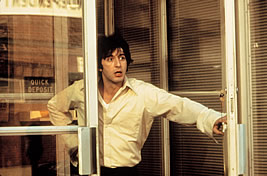
Dog Day Afternoon
(1975)
Part one of my Sidney Lumet weekend. I liked it, and I can think of far worse movies to be locked up with, but I kind of don't see the big deal. Pacino was great (man always shows up to work), Durning was underused, nice to see John Cazale in anything else because he does sweaty and nervous with the best of them. The "Attica! Attica!" bit went over my head because I didn't get what he was referencing (he explains it in the film, but it was still sort of lost on me) and because the "true story" factor seemed slightly beyond my grasp. Maybe I'm just used to watching bank robbery movies with guys in mask who run around with machine guns and hurry to cover the cameras. I did like the way it focused on the robbers' perspective rather than a cat and mouse game between negotiator and criminal. The movie's a product of its time, I guess, but the performances, story, and dialogue have aged well enough to carry it through.

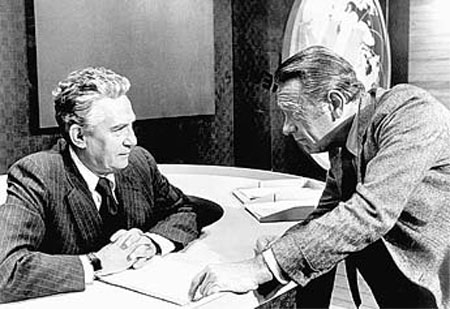
Network (1976)
Part two of said weekend. Eerily prescient and incredibly well cast (Faye Dunaway, William Holden, Peter Finch, and Robert Duvall in the leads), but it's too slow in spots (the famed "I'm as mad as hell, and I'm not going to take it anymore!" scene went on for the better part of forever), it gets repetitive quickly, and the dialogue had serious issues with the overuse of jargon and the under use of natural speech patterns. It's the same with any Aaron Sorkin script (idealistic, romantic language expressed beautifully), but you've got to be into it to work with it, and Paddy Chayefsky's script's difficult to get into. Great name, though.

The Hour will be aired as a late-night show on the main CBC network beginning in the fall.

I knew it! As soon as Emily told me, I thought, "I wonder what they offered him?", and then I thought, "Must be the network." Oh, George, why debase yourself so?
 
Okay, maybe he's really into this idea and thinks it's great for all sorts of reasons I cannot fathom (and don't relate to something that rhymes with yelling clout). But, read those quotes and tell me he's not phoning it in.

Saturday, July 08, 2006

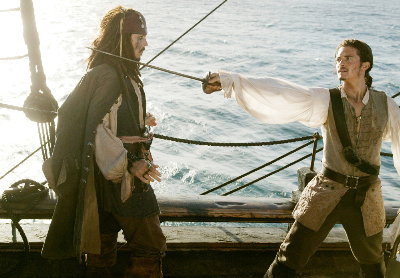
Pirates of the Caribbean: Dead Man's Chest (2006)

Story: On their wedding day, Will (Orlando Bloom) and Elizabeth (Keira Knightley) are arrested for their parts in Capitan Jack Sparrow's (Johnny Depp) escape. Will makes a deal Lord Cutler Beckett (Tom Hollander) : a pardon for Jack's compass. Elizabeth and Will, however, end up part of Jack's scheme to cheat Davy Jones (Bill Nighy) out of the 100 years service Jack owes Jones.

I don't know how I am going to write this post without giving at least one thing away, so I think you are just going to have to accept that. Work with it. Frankly, I'm doing you a favour.

Way, way back in 2003, when Melanie, Kelsa, and I hit the theatre to check out Pirates of the Caribbean: The Curse of the Black Pearl on a whim, it was great. Nothing but fun was had. As a result, I was pleased when I heard a trilogy was in the works.

Unlike what 2004 would like us to believe, sequels don't match what came first. They tend to blow, and this outing was no exception.

To be honest, I don't see the point of a sequel. Profit-wise, it makes sense. The first proved that pirates were no longer box office Kryptonite (heh), provided some youngsters with star turns, and earned Johnny Depp his first Oscar nomination. Why not do it again?

But story-wise, everything was wrapped up in the first outing: the curse was reversed, Jack got his boat back, Will got Elizabeth. There was nothing else to tell. So, the team behind the first movie would have to come up with an entirely new problem for our heroes and heroine. Additionally, they needed to stretch the new situation over two movies in order to complete the trilogy. It sounds hard, but it's not nearly as difficult as Ted Elliott and Terry Rossio (co-writers) would have you believe.

For one, make sense. Obviously an undead crew cursed by Aztec gold or a squid-man that rules the sea requires a certain suspension of disbelief. I get that. My favourite TV show, pretty much ever? Was about a petite blonde that hunted vampires. Trust me, I get suspension of disbelief. But when you go the fantasy route, you still have to stick with the rules that you invented for your world. I found the Bootstrap Bill (Stellan Skarsgard) stuff hard to follow the first time around (and I just watched it for the second time a week ago today as a refresher for yesterday), and this movie made it even worse. I mean, you know, nice for Will to get to finally meet his dad and all that, but what?

Also, am I really supposed to believe that everything we went through "six months ago" didn't occur to firmly convince me of Will and Elizabeth's love and loyalty to one another? Now I'm to buy the idea that Elizabeth might want Jack instead? My eye! For reasons beyond all human understanding, Knightley cannot manage to act attracted to Depp for even a split second. How hard could that possibly be? I thought she was more likely to jump Norrington (Jack Davenport, who is back and a fox) at any given moment than have a go with Jack. And you know what Knightley's performance did suggest? That Elizabeth loves Will. So why all the hoopla? Why the tacked-on drama? Why didn't anyone hit her in the face this time around?

Speaking of Knightley and her face, it's no secret that I am not her number one fan. Something I have acknowledged for years, however, is the fact that she has a beautiful face. No, really, I can't stand her, but those are some pretty cheekbones. I know they had the Domino hair to work with, but I think the hair and make-up people must absolutely hate her. She looked terrible - the colour and cut of the hair was unflattering, the lip colour was all kinds of wrong, the eye make up looked like a seven year old had smeared it on with a melted crayon. First movie? Pretty. Second movie? Dog.

Speaking of a face like Knightley's, Bloomers's looked leaner this time around. No matter what those people at Slate or The Tyee have to say, these movies are ones in which I genuinely like Bloomers -- he makes a good sidekick, a good devoted, idealistic young lover, and a good 17th (guessing) century pirate/blacksmith. Seriously, these styles suit him. And -- for those who want to see this sort of thing -- the shirt even comes off at one point. You're welcome.

I'm not going to go into how good Depp consistently is in this role. It's like he was born to play a perpetually drunk, morally ambiguous fortune hunter. Although, one thing, why was his hair more dread-y this time around? They couldn't find the wig or extensions or whatever from last time?

Why did PotC:TCotBP work? It was intelligent, funny, a dash scary, tightly paced, and, above all, it kept the action moving. Exposition is a necessary evil, but it doesn't have to feel like pulling teeth. This movie was a million years long, boring for spans of eons, only funny when it made callbacks to the original, and avoided sense like the plague. And skeletons are scarier than anthropomorphic fish with bizarre accents. All in all, it had a bad case of The Matrix Reloaded, a sequel so awful that I didn't bother with the third installment.

If you could cut out, oh, say, 60 of the 150 minutes, it might have been fun, greasing the wheels until the final movie in 2007. It's not that this movie is that all that bad - director Gore Verbinski has a great handle on action set pieces and slapstick set up. It's just that it so thoroughly undoes the good work of the first that it makes you hate it. C+

Oh, what the hell: Why is Barbossa back at the end? WHYYYYY?! I hate that ending. HATE. It basically complete re-writes the first movie, and, if he doesn't tell us what's up in the first 15 minutes of the third movie, I am going to kick some ass.

And, while we're here, why is the monkey immortal? See?! See what I mean with the no sense and the general unravelling of the first plot?

Friday, July 07, 2006

The Jack Bull (1999)

Story: Myrl Redding (John Cusack) leaves two of his prize stallions in the care of Henry Ballard (L.Q. Jones) as collateral until he can pay the toll Ballard demands for crossing his land. When Myrl returns, he discovers that Ballard's men have beaten the horses as well as the man Myrl left to care for them. When the law refuses to uphold Myrl's claim that Ballard restore the horses to their former condition and pay his friend a penance, Redding takes the law into his own hands.

You know, there are lots of times when I forget why I put a movie on my Zip List. This one's pretty obvious - John Cusack. My love of John should really start to know some bounds.

Of course, it could have been the horses. I forget where, exactly, I read it, but one of a girl's first loves is horses, and I like horses well enough, so maybe I thought, "John and I have so much in common! We both like horses!" Or maybe I thought I'd like to see him on a horse. It's unclear.

Because really, truly, if I had watched the trailer sooner than yesterday directly before I watched this made-for-cable-TV nightmare, I might have called it quits a lot sooner.

Continuing the thread that Bloomers kicked off last week, Cusack is also a guy that just doesn't work when it comes to the past. Unlike Bloomers, he certainly comes across as masculine, but that's not the problem. Everything about him -- his voice, his way of speaking, his mannerisms, his very face -- screams 20th (and 21st) century. There is just no way a man like him could have possible be born in another time. There are these times in the movie (and I'm not going to go into them) were he drops his voice to a whisper pitch to get his point across, and I seriously found myself thinking, "People back then didn't whisper." I mean, of course someone at some point after the Civil War but before the turn of the century whispered, but, if Dr.Quinn taught me anything, people on the frontier sure liked to raise their voices.

I still like Cusack. I will continue to buy, swoon over, and quote his movies. I accept that he, like the lovely Michelle Pfeiffer, is an actor of limited range. Basically, John mostly plays the same guy over and over ( Lloyd Dobbler) and occasionally ventures outside that mold and does well ( Being John Malkovich or The Grifters). That works for me.

The problem, for me, is that now I have to invent a new range category. You've got your Brad Pitts and Tom Cruises - people who can realistically take on a variety of roles, but you can't distinguish from character to character. You've got your James Gandolfinis - guys who can't play a lot of different characters but can do a lot with the roles they've got. Then you've got the Platonic Ideal of range - someone who can take on a lot of different roles and can do a lot with those roles. Think Johnny Depp. Think Philip Seymour Hoffman. See? Do you see how Cusack is destroying my beautiful three-tiered theory?

So, John, here's what I think - you're just not cut out for this kind of thing. The only thing I did during more than call Emily to complain about how bad this movie was was giggle and ask myself why I continued to watch this crap. There's a lot of things wrong with it - it's too earnest, poorly paced, laden down with improbable dialogue and improbable characters. Most guys would have just shot Ballard for their trouble and gotten on with in. But, oh no, not Myrl. He wants his horses restored (which he could have done himself if he shot Ballard in the first place). And what does he get for his trouble? Giant, asteroid-sized spoiler ahead. Hanged. And then his son (Drake Bell, who looks convincingly like John Cusack, much as he did when he was young Rob Gordon) is walking away with the healthy horses, tears streaming down his face, while Bob Dylan sings.

My games of "Hey, It's that guy!" were not enough to make this venture worthwhile, John. So, listen to me: Just because someone in your family writes the script, it doesn't mean you are required to do it. And, if you do want to be involved, cast someone else. D-

Tuesday, July 04, 2006

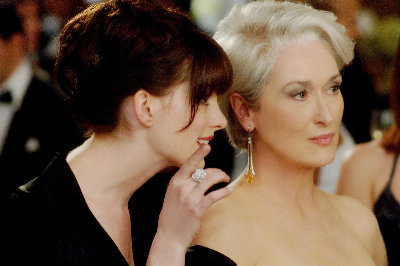
The Devil Wears Prada (2006)

Short: Recent journalism graduate Andy Sachs (Anne Hathaway) is offered a position as notorious "Runway" editor-in-chief Miranda Priestly (Meryl Streep)'s second assistant. Although it doesn't line up with her career goals, Andy decides to take the job "millions of girls would kill for."

Confession: I've never read Lauren Weisberger's novel, but I know the Vogue/Wintour backstory.

And, based on this movie, I never want to read it. Stupid piece of shit, it must be. And why? Because it's impossible to sympathize with the protagonist.

The movie begins with a somewhat racy montage of women, including Andy, getting ready for work. Ladies are carefully choosing their every article, from outer- to underwear and top to bottom. Andy? Grabs pretty much any old thing from her closet. Okay, you think, they are setting up a contrast. I get it.

But, no, it couldn't possibly end there. Women are carefully selecting their breakfast foods (let's side step how ridiculously degrading this part was); Andy stops on her way to the interview to buy an onion bagel loaded with cream cheese. I already picked up on the contrast, but I guess we need to hammer it home for the slow ones in the audience (like the two older ladies sitting behind us. No, seriously, you two. Shut. Up.) But the problem with this part of the contrast isn't that Andy is chowing down, it's what she eats and when. She eats something that anyone would reasonably expect to stink up their breath, and she does it after she's out of the house. While she's on the way to an interview! Stinky breath is no way to make a good impression, and anyone with two brain cells to rub together knows that.

Oh, but then. Yes, there's more. We see all these various girls in various outfits doing what? Hailing cabs. I roll my eyes. "No, no. Just don't. Don't," I try to tell the movie. But it does. It just has to, doesn't it? Andy takes the subway. Listen to me, people: there's nothing wrong with taking a cab to make sure that you are on-time for an interview. Nothing at all. If you are going to take public transportation, I recommend that you take the bus before the bus you think you need in order to make it there early. You're welcome.

By the time "our" "heroine" is informing Miranda that she knows neither Priestly nor Runway and "everyone just calls [her] Andy," while Miranda is doesn't even bother with an eyeroll, I know all I need to know about both characters: Andy is unprofessional, whiny, and refuses to take responsibility for herself. Miranda is my hero.

As cruel and ruthless as Miranda is supposed to be and as Streep makes her, she also gives her an electric spark that no other character comes close to matching in this lifeless, paint-by-numbers piece. Barely raising her voice above a whisper-hush and fabulously flopping her coat and bag down on Andy's desk every morning, Streep also injects more humanity and pathos into her role than Hathaway manages for the whole of the film.

I don't blame Hathaway, specifically. Part of it is that she's overmatched and part of it is that Aline Brosh McKenna's script gives her nothing to work with and part of it is David Frankel's dull direction. The friendship dress down, the relationship trouble, and the eventual Kelly Taylor "I choose me" moment fail to feel earned, much less sensical. Most people take not quite the right job right out of college and put up with a lot for the reward. Why her friends and boyfriend think they are above it is beyond me.

Oh, and thanks to Stanley Tucci for being such a delight as fashion editor Nigel. Most men would have taken him to hammy heights, but Tucci keeps him grounded.

Patricia Fields' (of Sex and the City fame) costume design is alternatingly maddening and enviable. Just thought you might want to know.

I know that you might be thinking that it's supposed to be a trifle, but I don't think I am taking it too seriously. The movie barely does what it sets out to do, and that's a serious problem. Good thing Streep's around. B -