Showing posts with label I saw . . . this. Show all posts

Thursday, August 07, 2008

I saw this . . . : Post war edition

Sometimes I actually get around to seeing the classics.

Les Quatre cents coups (The 400 Blows) (1959)

Before I went to see this New Wave gem from director François Truffaut, my mom asked me what it was about. I fumbled for a while and eventually came up with, "A 12 year-old boy." That was it. Thank goodness I've had blinders on about this one because I know others that have been spoiled by its reputation. Honestly, it's a shame. For them. The first half is as charming as the second half is maddening, and the combination is devastating. The title comes from a French idiom that translates "to raise hell," and that's exactly what Antoine Doinel (Jean-Pierre Léaud) sets out to do. Léaud is a wonder of a child actor, a kid who plays a kid all the way through, never grows up, never has the world on his shoulders, never does much of anything that any kid wouldn't do. The exact same excuse you apply to his earlier indiscretions (Well, he's 12) becomes your whimper as life heaps greater and greater punishment on him (But he's 12!). Guided by Jean Constantin's glorious score, it's a paean to childhood and innocence lost, and the indefatigable spirit that can carry us through if we let it. A

The Graduate (1967)

Alright, I watched. Maybe I come from the wrong time/place, but I don't get it. I get it at when Ben (Dustin Hoffman) is just drifting and when Ben submerges in the middle of the party. I get why Ben would have an awkward affair with Mrs. Robinson (Anne Bancroft). But then Elaine (Katherine Ross) is introduced and, for me, the whole thing comes off the rails. Why in the world would Elaine be interested in Ben? He slept with her mom, he stalks her, and he's annoying and clingy. I get why Ben's doing all this, but we have no insights into why Elaine would want anything to do with this schmuck. Maybe there's more to her in the novel, but here it's just . . . unbelievable. Still, that final scene? That I get. B

The Man in the Gray Flannel Suit (1956)

I somehow got it into my head that this was the first movie to deal with post-traumatic stress disorder in WWII vets, and that probably unfounded idea coloured my opinion of the movie while I was first watching it. I kept waiting for the moment when Tim Roth (Gregory Peck) would flip and, like, try to murder his wife (Jennifer Jones) because he thought she was a Nazi or scale his employer's sky scraper thinking he was a sniper, but nothing like that ever happens. It's more like post-traumatic laconic staring, where Peck spends a lot of time gazing out windows lost in not at all violent memories of the war. If anything it's more about the inherent difficulties in dealing with bureaucracy and with being honest in your home life. Fortunately, that movie's elegant, quiet, and smart, and writer-director Nunnally Johnson won me over by the end. B+

Thursday, January 10, 2008

I saw . . . this: the Hepburn/Stewart edition

Stage Door (1937)

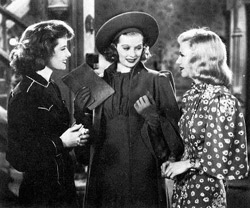
This is sort of a strange picture in that a lot of the plot revolves around what is or isn't happening with Kay Hamilton (Andrea Leeds) at any given moment, yet she has very little screen time compared to top billed stars Katharine Hepburn and Ginger Rogers. Set a boarding house, the Footlights club, occupied young women all jockeying to find a role, any role, on Broadway, the house is thrown off balance when an heiress (Hepburn) decides to try her hand at the theatre. Naturally, everyone hates her until the last possible second when a personal tragedy transforms her into a great actress. What I liked best about Hepburn's character (and the movie) was that she was awesome only when no one was around to see it. Other than those moments, as fun as it is see a bunch of young actresses early in their careers (notably Lucille Ball), it's more of a diversion than a classic.

The Philadelphia Story (1940)

Now this is a classic and with good reason. Minus two remarkably sexist scenes, it's the story of a woman (Hepburn, as you well know) who finds herself days away from wedding number two, struggling to find someone who will love her instead of putting her on a pedestal. She almost finds it with a visiting reporter (James Stewart), but, in the end, love is waiting for her with husband number one (Cary Grant). Hepburn rode the success of this Broadway smash all the way back to Hollywood, and she plays the hell out of this role. I'm not as familiar with Grant's work compared with the other two leads, and I admit that I found myself wondering what the big deal about him is, especially given that after Stewart's "hell fires and holocausts" monologue, that's the one I would have chosen. Still, Grant grew on me as the film rolled. By the time he's pulled his legs up on the chair like a child and giggling, I was hooked. When Tracy finally promises to be yar and Dexter replies, "Be whatever you like," it's impossible not to smile, teary-eyed. One of the sweetest, most charming, and utterly clever movies you will ever see in your life.

The Shop Around the Corner (1940)

As fantastic as Stewart is in the above, it's more Hepburn's movie. Shop here, while it may be a romantic comedy about a relationship conducted by letters between Alfred Kralik (Stewart) and Klara Novak (Margaret Sullivan) who also happen to have a work relationship filled with animosity, it's Stewart's movie. In a lot of ways, it's a movie about a young man getting his life together that just happens to involve an anonymous, amorous pen pal. Whether he's threatening a punch in the nose or explaining the subtle joys of an unopened envelope, he never ceases to amuse or charm, much like the movie itself. Although, I must confess, it's a toss up between Pepi (William Tracy) and Pirovitch (Felix Bressart) for funniest character. This movie is a gem well worth checking out.

Now if only someone could explain to me what all those Americans were doing in Budapest in the first place.

Thursday, April 12, 2007

I saw . . . this: Part 7

Because sometimes, more than one paragraph isn't necessary.

Idiocracy (2006)

Too many critics got me a little too hyped up for this comedy about an average guy (Luke Wilson) who wakes up 500 years in the future to discover that he is now the smartest guy alive. Both for its limited screen run and its quiet DVD release, critics were bemoaning how the genius of this film would quietly slip away. Yes and no. The satire is as deft as it was in writer-director Mike Judge's equally ignored Office Space, but the humour just didn't feel on the same level to me. Given that both Children of Men and V for Vendetta* came out last year, maybe I should just be glad that someone is willing to look at the lighter side of the world going to hell in a hand basket.

*That movie gets better every time I watch it.

Love and Death on Long Island (1997)

I can't tell you the number of times I've tried to watch this movie. I rarely make it past the opening credits. It's the kind of movie that I think I should watch, but I never quite get around to it. I finally suffered through it, and what suffering it was. I just don't get this movie. What is it trying to be? Am I supposed to feel pity for this acclaimed author (John Hurt) who falls for a B-movie actor (Jason Priestly) and flies across the Atlantic to stalk him? Should I find this bizarrely amusing? It's too bad the suffocating air that hangs over the movie like cigarette smoke prevents me from feeling anything other than weighed down and vaguely annoyed.

A Better Place (1997)

I could not, for the life of me, remember why I put this movie on my ZipList. I became briefly convinced, for reasons unknown, that Paul Rudd was in the movie, but that wasn't true. Jason Lee has a wee part, but it wasn't worth sitting through the movie to see him. Could it be that I like Eion Bailey that much? Maybe. Whatever the reason, it wasn't a good one. This movie is a terrible mess. Nothing about it reflects a single moment of what high school is really like. Barret and Ryan speak like they are reading rejected Dawson's Creek scripts, and the whole thing ends in the least believable manner possible.

Dead Man on Campus (1998)

This is not a good movie. Not at all, to be honest. For a brief time, when it first appeared on my parent's satellite lo these many years ago, I watched it. I watched it repeatedly. I watched it so often that jumping in in the middle didn't bother me, as I knew it so well. I knew it wasn't good, but I liked it. Now that's the perfect movie to add to your ZipList. Sometimes you have to ask yourself, "Hey, why did I like that movie where Tom Everett Scott and Mark-Paul Gosselaar try to get find a suicidal roomie and push him over the edge, so they can get As?" The answer: it's kind of funny and mostly stupid, but, by golly, Zack Morris is still way cooler than you.

Get Shorty (1995)

I quite like Scott Frank's adaptation of Elmore Leonard when it results in Out of Sight. Here, not as much. It's not a bad movie; it's a perfectly acceptable way to spend an afternoon. It's funny enough that you don't regret the time you spent on it. Danny Devito and Gene Hackman, as a celebrated actor and a B-movie producer respectively, were fantastic. Still, I'd rather watch the other one.

Friday, February 23, 2007

I saw . . . this: Part 6

Because sometimes, I see movies.

For Your Consideration (2006)

Christopher Guest outlines and directs the kind of movies that I always mean to see. I think I'll watch it, I set aside time to watch it, I never watch it. I made a point of going to see his latest, about a film set that is overrun with Oscar buzz after one of the stars hears about a blog rumour, but it didn't click with me. I liked it just fine. I had a few laughs. Even so, the satire never kicked in. It had no bite. For my money, I'd hit up State and Main for a Hollywood send-up.

Insomnia (2002)

Years ago, I tried to watch his movie because Jonathan Jackson is in it. I knew it was a small part, but I wanted to see him. I watched exactly one scene with him, got really bored, and turned it off. I had already read whodunit, so there was no allure. A while ago, the movie floated back up to the surface because of director Christopher Nolan. I love Nolan, so I put it back on my Zip List. Sure enough, I enjoyed the movie. As operatic as Pacino can be in his later years, he shows up to do the work more than anyone. Under Nolan, he manages something of a low key performance, and it was a nice change. Finding the killer is only half the game with this one. The cat-and-mouse work to bring him holds your attention far better. I don't know that I can think of a man who better knows his way around a plot twist than Nolan.

Northfork (2003)
I'd never seen a Polish Brothers movie before, and I can't say that this one will deter me from seeing another. It appears that a lot of the critical comments marked this movie about the stragglers in a small Montana town about to be turned into a lake as poetic. I'm not sure I agree. I can certainly see how one might find it allegorical, especially the plot line about the family searching for the unknown angel and the little boy who believes he can help them, but I wouldn't call it poetic, exactly. It's more surreal than anything. It's a quiet movie, nothing in particular happens, but it's a nice way to an hour and a half if you feel like being quiet yourself.

The Faculty (1998)

If you feel like being highly amused by a bad movie over the same time frame, however, this one's for you. Emily reminded me that Jon Stewart was the science teacher. We had to see it again. There's nothing in this movie that isn't funny. The plot loves to make no sense, Josh Harnett is one of the least convincing bad boys I've ever seen (unless making it seem like a really obvious affectation was a sly comment on the characterization of teens by the media . . . nah), and Laura " Daisy, Daisy Adair" Harris is hilariously checked out as nude but menacing alien. Personally, nothing is funnier than watching wee little Stewart toss six-foot-plus Harnett across the lab.

Ghost Rider (2007)

Now, you have to know that when a movie isn't screened for critics, it's going to suck. I know it managed $52 million in its opening weekend. I was one of the people that helped put it there. It's so bad, you pretty much have to have fun watching it. Much like the above, nothing about it isn't funny. I used to think I disliked Nic Cage because he was always mugging for the camera instead of acting. Now I get the laugh at him phoning it in, too! I used to think that I maybe liked Eva Mendes, or that I could in the future. After she decided that her best option was to act like her character's development was arrested at 12, I'm thinking maybe I don't like her. I do, however, like Sam Elliott. He makes everything better. Also, Ghost Rider's powers are lame. He stares at people. What's the point of looking that cool if you aren't going to do anything cool?

Wednesday, January 24, 2007

I saw . . . this: Part 5

Because sometimes, I watch movies.

The Odd Couple (1968)

It's pretty funny, and I have had Neal Hefti's score stuck in my head for days. It wasn't, however, as funny as I expected it to be. It's a shame to have high expectations sometimes. And, I feel I really must tell you, Jack Lemmon is a lot funnier than Walter Matthau. Still, it's a pretty good way to spend an afternoon.


The Red Shoes (1948)

A little slow to start and a little too much of the romance happens off screen for my taste, but this take on the Hans Christian Anderson fairy tale is fantastic. Moira Shearer is wonderful as a ballerina caught between her composer and her director. The ballet sequences are beautifully staged and filmed. A delightful and daring picture.


Ninotchka (1939)

"Garbo laughs!" And so will you! No, seriously. Like the above, it's a little slow to start, and Garbo's Ninotchka is downright harsh when she first appears. But she's soon charmed by Paris, as I was by the picture. It's on the ridiculous side, but what screwball comedy isn't?

Friday, January 05, 2007

I saw . . . this: Part 4

Let's go chronologically, shall we?

Gentlemen Prefer Blondes (1953)

It helps when you don't expect much more than singing and fluffy fun. I recall an oddly long class discussion about Monroe not too long ago, and I seemed to be the only one willing to stick my neck out for her. A lot of people don't think she had the chops to do much more than be The Girl, but I disagree. I just don't think she was ever given the chance to really prove herself. Mind you, she's no Jane Russell, but the combination of Russell's earthy presence and luscious growl was the perfect contrast to Monroe's frosted perfection.

GoodFellas (1990)

I don't think I need to go into much detail here, but this is one the best movies I have ever seen. Scorsese and Liotta make it easy to see why Henry is so attracted to the lifestyle. Despite the violence, they manage to make a crew seem warm and congenial. I even teared up when everyone was there to congratulate young Henry after his first pinch. By the time they pull out the rug from under Henry, they've cut an Aristotelian tragic figure. You may have watched him sow the seeds of his own destruction, but it's too difficult not to feel sorry for him. Actually, now I kind of wish I hadn't been so hasty to mail the DVD back.

Mr. & Mrs. Smith
(2005)

My dad warned me not to bother, pronouncing it a "stupid, stupid" movie. I did anyway, and I think we should add "boring" to stupid. While I appreciate that Pitt could hold his own against Jolie (and that's saying a lot), there's little between them on screen. From the stereotypical portrayals to the unnecessary "twist" to wildly anti-climatic finish, there's little of redeeming value to be found. If you're desperate to see one of these actors doing hot things hotly, I can think of a dozen other movies to recommend them.

And while we're here:

Thursday, December 21, 2006

I saw . . . this: Part 3

An on-going series about movies I saw, had some thoughts about, but won't be reviewing.

Sunset Boulevard
(1950)

I really only knew Billy Wilder from his comedies before this, but it doesn't take that much of a leap to see what he could do with darker material. His best comedies, like The Apartment, had a dark edge to them anyway. I liked the movie well enough, but there were moments when I felt like Gloria Swanson was swinging away from truly rocking the role and into high camp. Still, it's her movie from start to finish. William Holden may be the protagonist and the narrator, but he basically has the thankless task of standing back from her whirlwind.

Splendor in the Grass (1961)

I went into this one thinking that it was one of the great teen romance movies of all time, and I turned it off wondering how in the world it got that rep. Natalie Wood and Warren Beatty do great work in their roles, particularly Wood (I can still hear her hitting all the right notes of yearning and desperation), but . . . were they kidding with this stuff? And isn't it supposed to be based on an urban legend from the town in which writer William Inge grew up? Alright, kids, here's today's take home message: go out and lose your virginity immediately because it will drive you completely crazy (Wood) or to a physical collapse (Beatty) if you don't. I get what they are doing here with ideas of growing up right and sexual repression and the whole parents-just-don't-understand thing, but this is too much. At a certain point I only kept the damn thing on because I was waiting Beatty and Wood to finally find their way back to each other, only to get a sickening feeling that they wouldn't. And then they didn't. So they went through all of that for nothing? Okay, then.

Confidential to Warren: I'll take this all back if you would just make some more movies. Thanks.

The Hours
(2002)

If you take three great performances from three great actresses and toss in another tender, haunting, and dense score from minimalist Philip Glass, what do you get? An dull and dry movie, apparently. I can understand why the women in question received such accolades, but what is with this movie? On and on she goes, with no real surprises and not much in way of the character development. If we are supposed to consider it a meditation on a theme (suicide), then it failed in that regard as well. One woman doesn't end up offing herself even though she had a freaky hell-child from whom I wanted her to escape. In other plot, I simply counted the minutes until the suicide occurred. "Now? How 'bout now? Now? Oh, finally." And then that roundabout twist revealed too late into the movie that the mom walked out? How was that supposed to make me feel? Ah, well. I think, in the end, that it's more of a mood piece than anything: impossible to really see what's happening if you're not in the mood.

Tuesday, July 11, 2006

I saw . . . this : Part 2

See Part 1 for instructions.

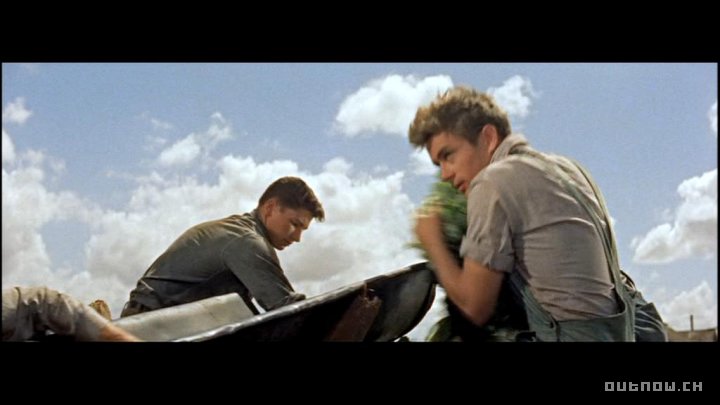
East of Eden
(1955)
It's pretty good for a Steinbeck adaptation. Perhaps the best way to experience Steinbeck, in fact, is on the screen: you wouldn't have to read his ham-fisted FORESHADOWING or his "look at me! look at me!" style of symbolism. I have no idea why the intro had to be, at least, 8 minutes long, or why the girl's interest suddenly and definitely shifted to Cal (James Dean), but the competition between Cal and Aron (Richard Davalos) for their father's love was well done. I can see why they made such a big deal out Dean's big screen breakthrough. For all the imitation, nothing has ever come close to approximating his angst or the magnetic heat underneath it.

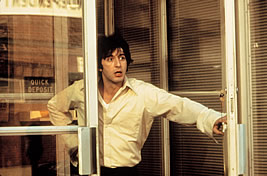
Dog Day Afternoon
(1975)
Part one of my Sidney Lumet weekend. I liked it, and I can think of far worse movies to be locked up with, but I kind of don't see the big deal. Pacino was great (man always shows up to work), Durning was underused, nice to see John Cazale in anything else because he does sweaty and nervous with the best of them. The "Attica! Attica!" bit went over my head because I didn't get what he was referencing (he explains it in the film, but it was still sort of lost on me) and because the "true story" factor seemed slightly beyond my grasp. Maybe I'm just used to watching bank robbery movies with guys in mask who run around with machine guns and hurry to cover the cameras. I did like the way it focused on the robbers' perspective rather than a cat and mouse game between negotiator and criminal. The movie's a product of its time, I guess, but the performances, story, and dialogue have aged well enough to carry it through.

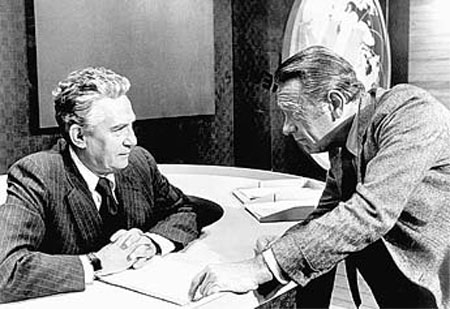
Network (1976)
Part two of said weekend. Eerily prescient and incredibly well cast (Faye Dunaway, William Holden, Peter Finch, and Robert Duvall in the leads), but it's too slow in spots (the famed "I'm as mad as hell, and I'm not going to take it anymore!" scene went on for the better part of forever), it gets repetitive quickly, and the dialogue had serious issues with the overuse of jargon and the under use of natural speech patterns. It's the same with any Aaron Sorkin script (idealistic, romantic language expressed beautifully), but you've got to be into it to work with it, and Paddy Chayefsky's script's difficult to get into. Great name, though.

Saturday, May 20, 2006

I saw . . . this: Part I

IFC has these great commercials for fake movies that are obviously le suck, which eventually dissolve so that they can remind you that life's too short for movies that suck, so you must watch IFC. One of the great features of the commercials are pseudo-comments from non-reviews, including the one above.

Of course, that one kind of reminds me of my own rule regarding the review of classic pictures on this thing here. I like to tack a few sentences on from time to time to let you know that I am still watching and thinking somewhat critically. I decided that I could also string a bunch of them together to inform you that I had, indeed, seen this. So, here's my first whack at it.

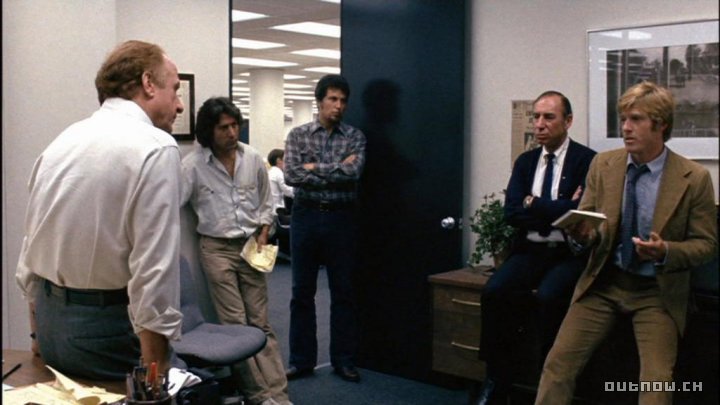
All the President's Men (1976)

This was one of the best movies I have ever seen. The story of how two young reporters cracked Watergate is already well publicized (including in their book, which was the basis for the screenplay), so, really, how much could someone do with this movie? Well, director Alan J. Pakula could create the most tense film I have ever see. There's nothing particularly clever or innovative about the story-telling, camera angles, or lenses, but it forces you to the edge of your seat and keeps you there. It's not just one of the most relevant looks at the how of political cover-ups; its story of journalistic integrity and perseverance against a monolithic and faceless foe is the most relevant movie for today.

Barefoot in the Park (1967)

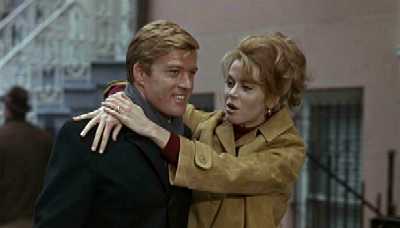
The Neil Simon play turned film may be a light confection, as free spirited as its female lead (played with wonderful charm by Jane Fonda), but it is also delightful, sort of the filmic equivalent of cotton candy: there one minute, dissolved the next, leaving no trace but not forgotten. Redford may exist is a bizarre charismatic chemistry vacuum, but it's a joy to see him try to hold his own against the force that is Fonda.

Alice Doesn't Live Here Anymore (1974)

The problem with putting DVDs on one's Zip list and having months, perhaps even a year, lapse before they arrive in one's mailbox is as follows: one tends to forget the movie. See, I thought this movie, one of Martin Scorsese's earlier works that earned eponymous protagonist Ellen Burstyn a Best Actress Oscar, was about a woman who took her son and left her abusive husband, working as a waitress and singer to make money and provide a stable home for her son. They move around a lot, and her dependence on him grows. Eventually, he goes off to college, and she breaks down, losing all sense of her self, and spouting the title line.

Not so much. Her husband dies, and the moving and working stuff is true. But the growing up and going crazy stuff? Not so much. More like finding space for others in the life of a fiercely independent work in this intelligent pro-feminist tale.