Showing posts with label linklater. Show all posts

Tuesday, June 08, 2010

It's Complicated, Sherlock Holmes, Before Sunset, The Book of Eli: Movies on a Plane

On one hand, selecting your own movie from a fairly well stocked list makes plane travel that much more enjoyable. On the other hand, that teeny screen six inches from your face changes your perspective, doesn't it?

It's Complicated (2009)

I don't ever think I've seen Meryl Streep this sexy before. She's certainly having the time of her life (to be honest, she seems to be having the time of her life all the time lately. It's great to be Meryl Streep these days), and Steve Martin and Alec Baldwin are right there with her for the most part. Too bad the movie is endlessly distracting with it's "oh, look at the problems of these affluent white people" attitude. I mean, that's all Nancy Meyers movies, but I am telling you it stands out more starkly this time around. You've "earned" a reno to make your massive, gorgeous house even more massive and gorgeous? Seriously, every one's like, "I'm so happy you're getting the reno you've always wanted," and, while I get that a perfect kitchen is the great white whale for a chef or baker, could we cool it with the cooing for a minute? Wouldn't it be hilarious if Meyers were to one day find out that people who work at say, NGOs, never make all that much money? She should write a romantic comedy about them. They need love, too. B-

Sherlock Holmes (2009)

A RE-view! We haven't had one of those in forever. It mostly held up the way I remembered it, but I did find it even more slow moving this time around. How long does it take to get to the plot? Also, I'm not sure how I feel about using the same tricks twice in the one movie (both Holmes planning out an attack in slow-mo, then we see it in real time, and when he pulls off some feat, and we go back to see how he got there). Still, the slow pace gave me more time to appreciate Hans Zimmer's score and the dinner at the Royale. I love that Law is styled after Tsar Nicholas II in that scene. B

Before Sunset
(2004)

I can hardly believe that the movie keeps affecting me the same way, but it does: such exquisite agony. By now I know the rhythms and what conversations to expect, and it works for the film. I find myself nearly breathless in anticipation for Jesse to tell Celine he was there or for her to reveal that she thinks all her relationships since have paled in comparison to their one night. And then, there they are in her apartment, one waltz later and Nina Simone on the soundtrack. He is going to miss his plane. It's been six years. Is that enough time to start work on a sequel? A+

The Book of Eli (2010)

It's tough to say because I didn't finish this one, but I'm going to say it anyway: there is a zero percent chance that God wants to you to cross the country killing people when they threaten you but stand by while others are attacked, Eli. Thanks for coming out.

And since we're here, check out my Canadian Cinema Canon on The Trotsky.

Thursday, July 31, 2008

Before Sunset (2004)

Yay, RE-view time! I feel like I haven't gotten down to RE-view time in, like, forever. I have a few movies to RE-view, and I am glad we are starting with this one.

Yes, yes, it did take me nearly four years to watch this movie again. I was once again a victim of my own ZipList, in large part because the sequel arrived before the original, and I was hell bent on watching the original first. I also wasn't ready for it for a long time. When I said in my initial review that watching it the first time was agony, I wasn't kidding. It is agony, but it is exquisite agony.

Oh, why wasn't she there? It's been long enough that I can let the cat out of the bag. It's devastating to learn that Jesse showed up and Celine didn't. Celine was the romantic; Jesse's the one who pays for it. I love that he first lies that he wasn't there either, then brushes it off as unimportant, then pleads with her to attribute some meaning to her actions and his life subsequent all in the span of eighty minutes. They've got no time to waste.

The decision to have Hawke and Delpy write the screenplay with Linklater is nothing short of a stroke of genius. Usually sequels are put out with such short time between the stories that the characters have barely changed or such a long time later that the characters are much, much older. In this case, it's neither, yet Hawke, Delpy, and Linklater write Jesse and Celine as heartrendingly realistic older versions of the characters we met in the first film. The verbal tics they use to carry the characters forward are so small that it's easy to miss them: Celine says that she still wants to believe that there is magic in the world; Jesse kids on the square that Celine "plugs" any guy's name in the waltz she wrote about that night, about their night.

The impassive camera catches him hesitantly trying to touch her and pulling back at the last moment. It's so sad and real when the movie suggests that maybe they weren't wrong to romanticize that night. He wrote a novel to reach her. He's married with a kid now, but he was thinking of her on his wedding day. He thought he saw her out of the corner of his eye on the way to the church, he explains. He might have, she confirms. It isn't a romantic comedy about two people who can't quite get it together; it's a romance about two people who want to get it together but have neither the time nor space to do so. Waking Life had them together, but they weren't really. It was just one of Jesse's recurring dreams about the two of them. She demurs as much as she can, but she's felt his absence every painful minute since as well. It ends, as it should, as ambiguously as the first, as romantic and honest and in love as anything could be. A+

Tuesday, July 29, 2008

Slacker (1991)

Plot: A group of mostly twenty-somethings bump into each other, have strange conversations, and move along in one day in Austin, Texas.

There's no so much a plot to this movie, so I can't really give you more to go on than that. You know how with writer-director Richard Linklater's Waking Life talking about it as a lucid dream that allows the protagonist to slip into the collective unconscious is just a way of labelling what occurs on the screen in conventional forms in order to facilitate discussion of what follows? I can see now, having finally sat down with Slacker, that Waking Life is really an attempt to continue/expand on the former while conforming it to a slightly more recognizable pattern. Of course then he rotoscoped it, I'm beginning to suspect, just for funsies.

I'm having the same sort of love/hate relationship with this movie as I had with Waking Life. It can be frustrating to watch, but it grows on you as individual characters and moments float back into your mind in the days following. There's a picaresque quality to the way Linklater put the vignettes together that manages to have a certain day in the life feel that, in its best moments, nears Killer of Sheep for sheer veracity. It's wholly possible that all these conversations are going on in one day; it's just unlikely that you would hear all of them.

There's just something weird about how he made the film. As a paean to a certain place and generation, it's superb, but, as an actual film that people sit and watch, it's odd. Linklater rarely shows his non-actors' faces. A lot of the scenes feature one or more of the characters from behind. I don't recall a single close up. I'd like to praise these choices as excitingly post-modern and experimental, but I found them too distracting. In my distraction, I think I may have missed some stuff, but the movie's hazy quality deterred me from going back to check. It made me wish the whole thing was available as a collection of short stories, so I could go back over the stuff I wanted to and skip over other sections. Oh, well, I guess that's why the scene selection function exists. B

Sunday, July 16, 2006

A Scanner Darkly (2006)

Brief: A scanner (Keanu Reeves) known only to his superiors as "Fred" infiltrates a group of Substance D addicts and dealers (Winona Ryder, Robert Downey Jr., Woody Harrelson, and Rory Cochrane) in order to locate the source of the dangerous drug. Fred is asked to closely monitor one member of the group, Bob Arctor, i.e. himself.

Allow me to sum up the reaction of one Elfin April and her viewing partner, Emily, following our screening of said film: What? And also, What?

It should be noted that I've never read the Philip K. Dick's novel based on his own drug experiences, and I suppose if I already knew the plot I may have been able to follow it a little better. As it was, there were about three false endings: the first two made the entire movie make no sense, the third explained the other two, and then the fourth, the actual end of the movie, put all the pieces back together, but a lot of it still went over my head.

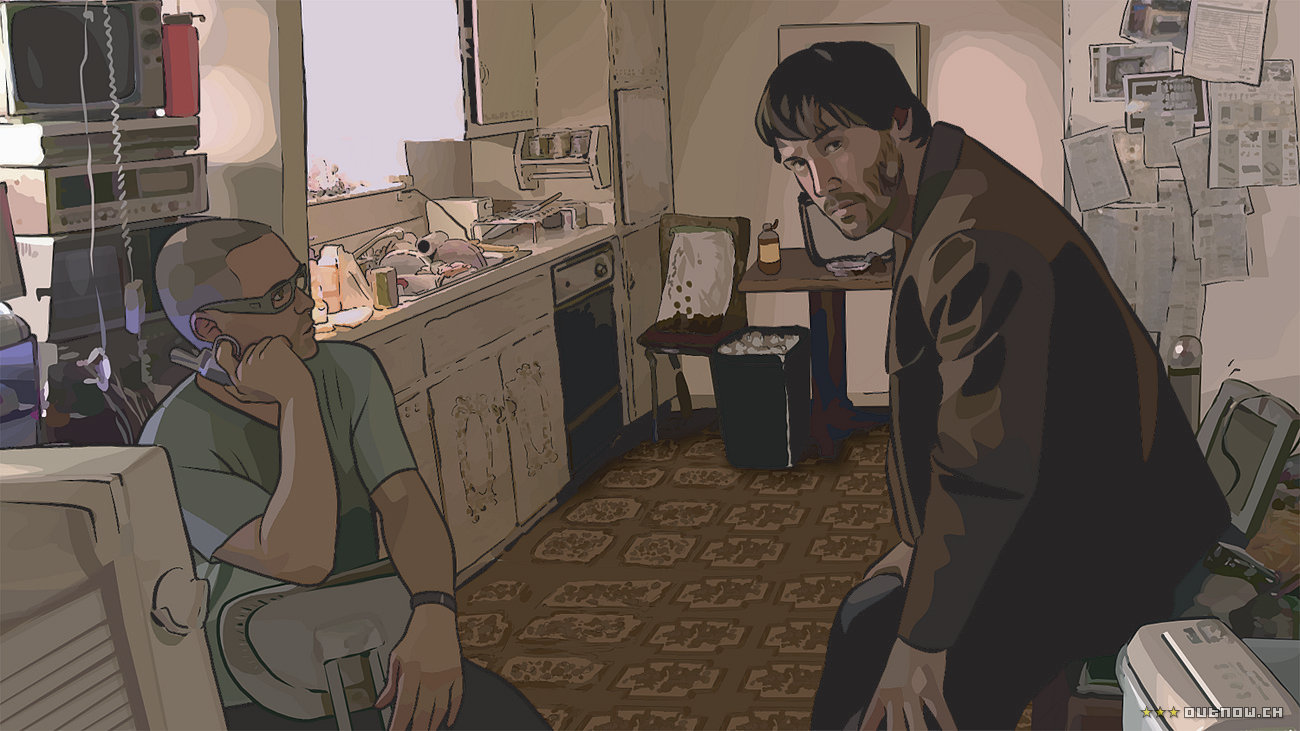
First off, rotoscoping still looks cool. It has a way of enhancing the image despite the fact that less is in focus than with traditional camera work. Plus, and maybe this was just me, sometimes the animators leave a little something in, like not colouring over a plant on a desk or an ashtray on a coffee table. I liked that.

Also, Richard Linklater still rocks. Even when he's commercial, he brings an outsider's perspective, a sort of slow charm to his work. His direction has a disarming intelligence to it. Although a lot of the subject matter went over my head, it still had an affect on me, which is more important.

Some stuff I've read talked about how Dick's work is more/just as relevant now. In terms of surveillance, I see the connection. In terms of pretty much anything else, not so much. For instance, and I'm about to give a lot away here, they manufacture the drug, and they regulate the rehabilitative therary. Only the effects are permenant, and they use the worst cases to reproduce more drugs, and the government controls the whole thing or at least acquiesces to it. I feel like this is a metaphor or extended parable, but what's the reference to? Some other kind of drug? I guess it could be, but I think anyone would be hard-pressed to prove that the government manufactures, say, heroin, gets people addicted to it, and then enslaves them. So, death because that's what they call D in the movie? Um, I don't think that's it either. This sucks. I feel like there's more to this movie, but I just can't cut through the fog.

I'm not exceptionally bright by any measure, but I usually get movies. I didn't get this. Maybe I will if I see it a few more times, but, if I don't? Then I am going to have to suspect that the problem lies within the film instead of myself. B+

Wednesday, August 03, 2005

Waking Life (2001)

Idea: On his way home from the train station, a young man (Wiley Wiggans) accepts a ride from a guy driving a boat car. After he gets out, he is hit by a car. When he wakes up, he discovers that he isn't really awake at all but in a dream state. Unlike the average lucid dream, the more he harder he tries to wake up, the less control he has over what happens in his dreams.

I didn't really give anything away there, I assure you. It's not really about the plot anyway.

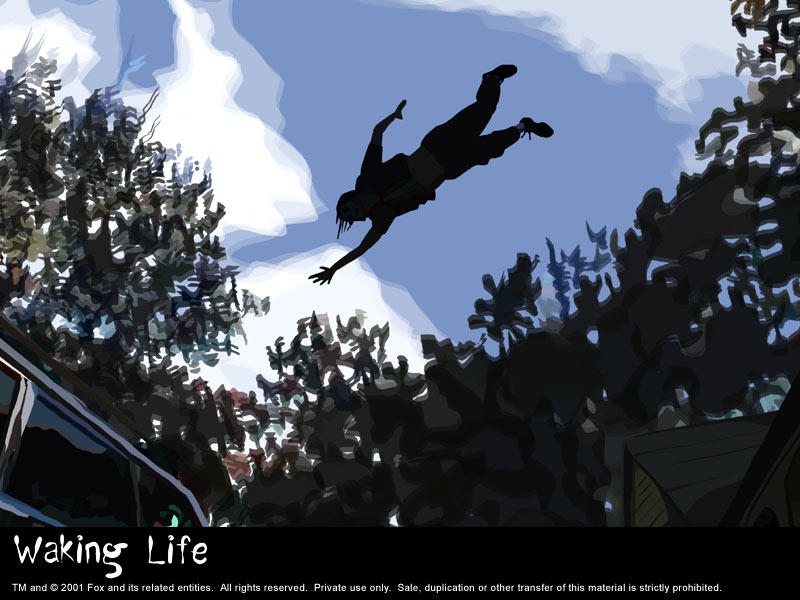
So, the film was shot entirely on video cameras, mostly handheld, then rotoscope-animated on Mac G4 computers and later transferred to 35mm film. A bit technobabble-y, yes, but it helps to basically understand that what you are seeing is animation on top of live action. Otherwise it can be a little weird.

A technological marvel, yes, and a sight to behold aesthetically, but the rest of what Richard Linklater (writer/director, of course) is questionable at best. At first glance it seems like a deep and mysterious gem, as though the secrets of the universe are revealed to you. And they are, in a sense. People are telling the main character much more than they ever would in real life, answering questions that no one ever bothers to ask. More than that, he is somehow privy to private conversations that he wouldn't be part of if not for his (my best guess) coma.

In fact, I thought I was going to have to watch this movie again and maybe even a third time in order to start to understand it. And maybe that's still true. But I did feel up to writing about it after I had a few days to really digest it.

The reality is that while the movie contains new theories that I had yet to come across about life, death, and the meaning of existence, a lot of it seems like the pseudo-deep things we all come up with when we stay up way too late and veer away from the superficial.

And maybe that's exactly what this movie is - an attempt to get away from the superficial. By concealing every speaker's identity with animation, their speech becomes more important than their visage. It certainly helps give the film that crisp, close feeling of a 4 am talk.

Strangelove once said that universities breed liberalism (he meant that in a complimentary way, of course). That kind of liberty of the mind plays a large role in Linklater's politics that infuse the dialogue and my subsequent interpretation of it.

While intensely quotable and full of ideas to ponder, I'm not sure to what extent I am willing to assign true meaning to this picture yet. I will have to put it away for a few months, six even, come back to it, and watch again to understand what I saw. Until then, let it speak for itself: "Yes, it is empty, but with such fullness." B

Sunday, August 08, 2004

Before Sunset (2004)

Premise: Jesse (Ethan Hawke) and Celine (Julie Delpy) meet up again in Paris nine years later at the end of Jesse’s French book tour, where he is promoting a book that is strangely similar to that night they spend together all those years ago. Jesse has about an hour and a half before he must fly back to America, and he and Celine decide to spend it catching up.

So, in case it isn’t clear, it’s the sequel to Before Sunrise, and it occurs in real time.

Also, if you thought the first film was dialogue heavy, you have no idea. The film is a constant conversation, free of nervous pauses and, well, action. They simply wander the streets of Paris, winding away their time with a contrasted sense of urgency and intimacy.

I’d love to fill you in on all the details of if they did meet up again six months later and what happened, but that would be a betrayal.

This film, in addition to being a sequel that outdoes the first, can be almost agony to watch. Richard Linklater (director and co-writer) gives you the sense that you are watching something frighteningly private. You are absolutely glued in place yet oddly wondering if you should look away as though you are inappropriately watching something you really shouldn’t be looking at.

Hawke, Delpy, and Linklater co-writing this sequel together was a stroke of genius. The scene where Celine and Jesse ask each other if their appearances have changed is one of the most telling in the movie.

Hawke is possessed of an animal magnetism that his nervous school boy lacked in the first movie, and Delpy brings newfound sensuality to her character.

The true test of their mettle is the fragility that their characters now possess. I’m often told that youth live their lives as though they believe that they are invincible. At 32, their characters have found their mortality, and they fill it with an immediacy that is heartbreaking to consider.

Like all good films, the air is electric with conversation and possibilities afterwards. You walk into the film not knowing what you are getting yourself into, and you leave with the exact same feeling.

Sunday, July 04, 2004

Tape (2001)

Premise: When Vince (Ethan Hawke) travels to Lansing to attend a film festival where his high school best friend Jon’s (Robert Sean Leonard) latest film is shown, he decides to look up Amy (Uma Thurman), his high school sweetheart whom John slept with after they broke up.

I can definitely say that this is one of the best independent films I have seen in a while.

Unfortunately, some independent films have such a phoney air about them. It’s like they are made by those film students that annoy me so much. “We’re the genius children of the counter culture,” they all seem to say. The trouble with that statement is that they don’t realize that the counter-culture is the culture now.

But enough about them.

If there is one thing I like about Richard Linklater’s direction, it’s his focus on all the minutiae of conversation: every gesticulation, every change in tone, every gesture. Words are powerful, and they honestly mean so much. Linklater just gets that.

Stephen Balber’s screenplay is something else. It revolves are three very different perspectives of a seemingly (or, rather, ideally) in-interpretable event. I wouldn’t call it subtle, but it deals with a serious issue in a way that I have never seen it dealt with before. It’s quite alarming, actually.

And how awesome is it that Leonard still does movies? I love those movies, those leading roles that made him famous (e.g. Dead Poet’s Society). I tell you truly, he’s still got it. All that anger, angst, talent, passion that made him so impossible to ignore is still there.

There is one teeny little problem: I feel unresolved. I am still wondering what happened that night. I seems like they all had one score or agenda that they wanted to play out when they met up again in that motel room, and I think they all did, to a certain extent. I just don’t feel like they came to a consensus about any of it.

I suppose they don’t have to, and I really wish they would.

Saturday, March 20, 2004

Before Sunrise (1995)

Idea: Celine (Julie Delpy) and Jesse (Ethan Hawke) meet on the Budapest-Vienna train, where Jesse convinces Celine to get off the train and spend the day with him before he leaves for America the next morning.

Now, I may have personal grievances towards Hawke right now, but he used to be in my Top 5 actors. I find that difficult to ignore when writing this blog. Damn his easy talent!

As you might surmise, you can't put two good looking college-aged kids together like this and expect them not to get together. The power of the short time frame is that it causes them to dispense with all the bullshit. In the beginning of a relationship, most people spend their time putting their best selves forward instead of their real selves. Let me let you in on a little secret: no matter how great this character you have come up with to play is, the real you is at least ten times more desirable.

Delpy is so sweet, all quiet beauty and unassuming grace. Hawke, despite my present distaste, is as gregarious as always. Not in an overt way, but you can't help but like him. He comes across as this sensitive genius in a world of ignorance, and you find yourself falling for it until it's too late to get out. And he does what I refer to as "greasy 1994 Ethan Hawke" so well. Damn him.

Looking at Richard Linklater's (director and co-writer) filmography, it all make sense. He did Dazed and Confused, he did The Newton Boys, he did Waking Life. He also apparently did Before Sunset, the sequel to Before Sunrise, for 2004. I will have to look into that. He is the quintessential Gen X-er, portrayed on the screen by Hawke. Or he is has a big crush on Hawke. Tough call to make.

A story like this is only as good as its cinematography. Thank you, Lee Daniels, you made me fall in love with Europe far before I had ever been.

So, this movie is sweet and simple. It is a little over the top, but I think it needs to be to make this story believable. It is a valentine to love itself, and love is nothing if not over the top.