Feria Films is turned three yesterday. Today is the anniversary of my first review. We've had some highs and some lows, but nothing's really changed, has it? I just keep seeing movies and telling you about them. I'm no more qualified than I was when I started, but I show up. I show up at the theatre, and I sit back down here. I suppose that's all the qualification I need.
Last summer, a lovely young man asked me for a Feria Films Top 10. It took me a while to figure out what that would mean (within a genre? within a given time period? ever?). I settled on "personally." Below is an excerpt from that list:
Before Sunrise and Before Sunset (Collective grade: A)
I know that they are two movies, but I can hardly think of one without the other, much less talk about them separately. Despite all the romances I write about and see, it is these two that best represent both the ecstasy of falling in love and the exquisite pain of losing that love.
Rushmore (Grade: A+)
The more I see this movie, the more I get out of it. Wes Anderson has such a great talent for creating little worlds that are just a slight horizontal shift from our own, for suspending our disbelief with grace and wit, and for attention to detail.
The Yards (Grade: A -)
You must have guessed that I would put at least one Joaquin Phoenix movie on the list. It was a tough call, and my joy over the commercials for Gladiator or my purchases of Inventing the Abbotts , Walk the Line, or Quills doesn't exactly suggest it's the right one. Still, despite the talent he is surrounded by, he owns this movie start to finish, and that final sequence, sitting alone in his car, patiently waiting . . . that's what great cinema's about.
Sin City (Grade: A+)
I love this movie. I love it to the point where I watch it, I watch it again, and then I get up the next day to watch it some more.
Brokeback Mountain (Grade: A+)
Again, tough choice: this time it was choosing an Ang Lee picture. It's not even the only one I own, but I think it's his best work to date. He treats the physical relationship between Ennis and Jack almost reverentially, and that's part of the appeal. Lee is telling a powerful love story, and he brings more humanity to it than any other director could ever dream of doing.
Monday, January 29, 2007

Thursday, January 25, 2007
Pop Culture Round-Up IX
Exciting stuff! I'm sure most of the choices will be pretty obvious in the end, but it's fun to see what they've come up with.
Holy shit! Not just a reason to live, but a reason to tune back into CSI . I love Liev.
Holy shit! Not just a reason to live, but a reason to tune back into CSI . I love Liev.
V. useful in awards season. I just wish they'd put one of these together more often.
A sweet tribute. The writing is a touch off, but it's nice nonetheless.
What? No Teen Wolf? Pfft.
And I thought the Academy didn't like Canadians. An interesting perspective.
This Galaxy of Fame is laugh out loud funny. I know you might think that I do that a lot, but I usually stifle it at work. Not possible with this one.
Scott Baio probes the Hollywood dating labyrinth. I really want this book now.
Wednesday, January 24, 2007
I saw . . . this: Part 5
 Because sometimes, I watch movies.
The Odd Couple (1968)
It's pretty funny, and I have had Neal Hefti's score stuck in my head for days. It wasn't, however, as funny as I expected it to be. It's a shame to have high expectations sometimes. And, I feel I really must tell you, Jack Lemmon is a lot funnier than Walter Matthau. Still, it's a pretty good way to spend an afternoon.
The Red Shoes (1948)


A little slow to start and a little too much of the romance happens off screen for my taste, but this take on the Hans Christian Anderson fairy tale is fantastic. Moira Shearer is wonderful as a ballerina caught between her composer and her director. The ballet sequences are beautifully staged and filmed. A delightful and daring picture.
Ninotchka (1939)

"Garbo laughs!" And so will you! No, seriously. Like the above, it's a little slow to start, and Garbo's Ninotchka is downright harsh when she first appears. But she's soon charmed by Paris, as I was by the picture. It's on the ridiculous side, but what screwball comedy isn't?
Tuesday, January 23, 2007
Ryan Gosling, people!
 Yesterday I warned Em (either during Heroes or 24, both of which were awesome last night) that I might spend most of today pissed off. Pissed off at the Academy for their poor choices in nominations. And when I caught sight of the Best Picture nods, I felt a certain tightness in my throat. Because I am at work, I had to restrain myself from yelling, "WHERE THE FUCK IS CHILDREN OF MEN?" I pretty much guessed it wouldn't be there, but still. I wanted it to be there.
But then, people. But then. I took a good long look at Performance by an actor in a leading role, and something strange happened. I let out a startled laugh. Then I started to clap. Ryan Gosling has been nominated for Half Nelson. I'm not too sure about his chances to win . . . but I can't stop smiling. It's so right. So called for. So what I want to see.
When I hit Performance by an actress in a supporting role, I had to do it all again. Rinko Kikucki and Abigail Breslin? Bearing in mind that I haven't taken a complete leave of my senses, and that I am, in point of fact, aware that I was not nominated for anything nor in anyway related to any sort of nomination, I found myself positively giddy again. Getting things right! It's what the Academy is (sometimes) about!
Anyway, those were the big happy surprises. Other things that pleased me include:
- Leonardo DiCaprio for Blood Diamond. I know it's sort of an obvious role and therefore, perhaps, an obvious choice, but I don't care. You forget about the accent weirdness five minutes in, and it truly is an achievement.
- Pretty much everything going on in supporting actor, especially Mark Wahlberg. Loved, loved, loved him in the role.
- Pretty much everything going on in Performance by an actress in a leading role. Again, no surprises here, but good solid choices all. That's something I can respect.
- Achievement in directing. No, I didn't really like Babel, and I can see everything going that way come February 25. The choices are, to a certain extent, obvious, but I like them. I'll be sad when Marty doesn't win. Again.
- Original Score. Now those are some nominations I can get behind.
There are some other things that I liked (e.g. any time I saw the words "Pan's Labyrinth" or "Children of Men"), but we don't have to get into that right now. What we do have to talk about, however, is the absolute lack of consideration for The Fountain in areas like art direction and visual effects. Listen, voters, I can see how you might be watching The Fountain, thinking something along the lines of, "What's going on here? What the fuck? Also, is there a plot?" Those are good questions. But regardless of linear concerns, that movie looked amazing. Truly mesmerizing. And that deserves some attention.
Monday, January 22, 2007
Pan's Labyrinth (2006)
 Premise: Ofelia (Ivana Baquero) and her pregnant mother, Carmen (Ariadna Gil), move to Northern Spain at the end of the Spanish Civil War. Carmen's new husband, Capitán Vidal (Sergi L ópez), is responsible for rounding up the remaining rebels. Ofelia meets Pan (Doug Jones), a faun who charges her with three tasks she must complete in order to return to her rightful throne as the Princess of the underworld.
Now, I know what I just told you might make you think that this is a lovely little fairy tale/fantasy to which you can take the kiddies. It's rated R for many a good reason, folks. Reasons like, "horrifically violent" and "gory." I saw a 12-ish looking girl come in with her parents and remarked to one viewing partner that I couldn't believe someone had brought their kid. A grown woman got up and left at one point. I'm laying this all on now, and thick, because I feel I didn't do enough to warn my viewing companions that this movie was going to be as gory as I knew it was.
All that said, this movie is awesome. It's disturbing, and more than once did I try to climb inside my seat, but it is so good that I have no problem telling you that it is one of the best movies of the year and probably one of the better movies I have ever seen in my life. Writer-director Guillermo del Toro doesn't let you off for a second. There is no reprieve in this movie. There is general high tension only broken up by moments of slightly less tension. It's pretty much a cinematic heart attack with hallucinations thrown in for good measure.
Most of the time when I watch movies in a language I don't understand, I find it a little difficult to assess the performances. Not so here. López is positively monstrous throughout, and it is impossible not to be chilled simply by looking at him. Baquero is moving as the sensitive and driven protagonist. But it is Maribel Verdú as Mercedes, Vidal's traitorous housekeeper, that really caught my attention. Her Mercedes is as generous as she is dangerous, and, to be honest, she kicks ass. Her performance is the kind that makes you wish that you could be the character.
Javier Navarrete's score is as filled with as much imagination as Ofelia and as much menace as Vidal. Guillermo Navarro's inspired cinematography enhances the already enchanting experience.
Excellent, excellent movie. A+*
* Star because it is really, really violent. I'll may never be able to watch it again.
Friday, January 19, 2007
Pop Culture Round-Up VIII
Critics get into what goes into a Top 10. Treasure the crackpots, indeed, David.
It's about time. Now, could someone explain to me what "an overdose riddle" is?
I so love this list. Personally, I'd go with Amanda's so-called friends from Some Kind of Wonderful. Plus, James Spader is so completely awesome as Steff that I find it impossible to really hate him.
Heh. Certainly an amusing way to look at movies.
You guys? This photo gallery makes me giddy. I love dystopia on the silver screen.
Tuesday, January 16, 2007
The Queen (2006)
 Premise: After the death of Diana, HM Queen Elizabeth II (Helen Mirren) struggles with her family's public perception, as well as to understand the public's outpouring of grief, while newly elected Prime Minister Tony Blair (Michael Sheen) attempts to seize the moment politically as well as guide the Queen into the modern political arena.
You guys, I don't really feel like reviewing this movie. After all the attention it has received, after Mirren's win last night, what's the point, really? Basically, you're thinking, is it really that good? Short answer: Yes.
Long answer: This is so stupidly obvious and done at this point, but, my goodness, people, look at Mirren go. One of the keys to Mirren's talent is the way she creates a new body language to go with each role instead of relying on actorly tics, to the point where you sort of forget that she's an actress at all instead of, well, Her Majesty. Never mind the balls it takes to play the royal currently sitting on the throne, you'd be hard pressed to come away from this film without new found respect for the Queen. By the time Mirren, director Stephen Frears (a jack of all trades, that one), and writer Peter Morgan are done with her, all your sympathy lies with the woman forced to go against decades of training for the sake of her country.
Morgan may present it as a comedy of manners, and, to a certain extent, it is, but there's an undercurrent of tragedy that kept the laughs from turning into howls. And no, I don't mean the death of Diana, although that was tragic in and of itself. I mean the way the country expected HM to turn on a dime and lay prostrate in front of them in rendered clothes with ashes on her head for an ex-HRH. To be honest, I found the public outpouring of grief a little bizarre both then and now, and good for HM to show a little restraint and respect.
Sheen doesn't seem to getting attention, which is too bad, as he had the equally difficult task of playing a now-reviled politician back when he was quite popular. And he manages to make him likable. It helped that Helen McCrory played Cherie as a shrew that I wanted to smack. Even so, I felt a twinge of sympathy for the man who was determined to "save these people from themselves" when everyone around him was happy to hand them a few more inches of rope.
My viewing partner had one complaint, which I will let her express for herself in comments, and I will move on to my one complaint: Alexandre Desplat's score was, at times, a little too whimsical for my tastes. There were moments when I half expected Mirren to wander off into Narnia or metamorphize into a woodland creature.
So, yeah, it is all that. Go see for yourself. A
Thursday, January 11, 2007
Pop Culture Round-Up VII
Vote for which TV series you'd like to see again via DVD. I recommend Cupid as your first choice. And your second. You can pick your own third choice, but I'd recommend Cupid.
"He had figured out how to live without regrets." Probably not the final word on Altman but certainly a nice one.
Noel Murray and Scott Tobias talk about some shows you should be watching, including those that have drawn me back to NBC.
Tuesday, January 09, 2007
The Good German (2006)
 Story: Captain Jacob Geismer (George Clooney) returns to Berlin to cover the peace conference at Potsdam at the end of WWII. His driver, Tully (Tobey Maguire), is suspicious. When Jake discovers that Tully is going around with his old girl, Lena (Cate Blanchett), it only looks all the more suspicious to Jake. By the time a body turns up at the conference, Jake's got one heck of a mystery on his hands.
The movie I saw the day after Children of Men obviously had a tough act to follow. I couldn't bring myself to turn on the TV, and popping in a DVD was out of the question. Even so, we made our way over the ye olde Bytowne.
I gotta say - this movie was a lot of fun to watch. Few directors can infuse their films with energy the way Steven Soderbergh does, and I'm pretty sure the fact that he acts as his own cinematographer and editor (under pseudonyms) has something to do with it. All that hoopla about 40s technology and imitating a more stagey style of acting is pretty soon forgotten. The film moves along at a good clip, and it's easy to enjoy.
Oh, Thomas Newman. First Little Children and now this? It's like you've been listening to my complaints. Your big, booming score recalled Bernard Herrmann in the best possible way.
I didn't write this review yesterday because I realized that beyond the above, I didn't have much else to say. I was entertained by what I saw up the screen, and I'm certain that I will enjoy seeing it a second and third time. But, to me, it's like Ocean's Eleven. It's fun and well done. Soderbergh's equally adept with that caper as he is with this noir, but it's not a heady movie. It's noir, to be sure, but it's still light. On the other hand, it's quite the feat to make a noir that isn't heavy.
Basically, it's fun and the topic can be serious, but the movie doesn't really take itself that seriously. It's a diversion in the best sense of the word. B+
Sunday, January 07, 2007
Children of Men (2006)
 Premise: In 2027, people have grown infertile. In Britain, chaos reigns, borders are closed, and illegal immigrants are rounded up in cages to await deportation. Theo (Clive Owen) is contacted by his ex-wife, Julian (Julianne Moore), the leader of a radical political group, to assist in the transportation of an illegal out of the country. Theo discovers that the young girl in question, Kee (Claire-Hope Ashitey), is pregnant, and he must deliver her to the Human Project in the hopes of saving both the girl and her unborn child.
Although I have yet to read the review, I understand that Dana Stevens called Children of Men the "movie of the millennium." She backtracked a bit in the Movie Club, and I have no idea why. Set twenty years in the future, director Alfonso Cuarón has created a world that is as close as tomorrow and as far away as WWII. He brings the Guernica to life, weaves T.S Eliot into the dialogue, takes time for a laugh, and never stops surprising you. He does that which every movie attempts, and, I see now, most movies fail.

As Theo, Owen plays the living embodiment of 1 Corinthians 13:13. It's so close to the chest because both the screenplay and Owen himself refuse to make Theo's motivations explicit until the very end. There's no real reason for Theo to put himself on the line like this, but he does, and it's exquisite.
A couple of those I went with last night remarked that Ashitey wasn't quite at the calibre they would have liked, but I can't say that I agree. The most extraordinary thing is happening to Kee, but it's also the most dangerous thing. She's young and not very bright, but Ashiety gives Kee the will to survive in a real and honest way. The bond Kee and Theo form is so sweet.
I could probably spend a whole day on the supporting cast, perfect as it was, but I don't want to do that. People were surprising me left, right, and centre. People I didn't think could surprise me anymore (Michael Caine), people I constantly underestimate (Chiwetel Ejiofor), people who are better than I know how to express (Julianne Moore). Pam Ferris, as the well named Miriam, was the standout for me. Miriam was a true-believer surrounded by liars and even her short monologue on her own experience could not dampen her faith and dedication.
I know it was a novel, and I know that there are five credited screenwriters, but I really have to give it up to Cuarón here. There were lighter moments, but every second of ease and tranquility meant that whole minutes of sorrow and strife would follow. Every frame of cinematographer Emmanuel Lubezki's was telling the story, every note in John Tavener's score, every location. It all adds up to Cuarón putting together something so amazingly uplifting from the ashes.
Children of Men appears to be getting shut out of major American awards, and I can't come up with words to explain how fucking stupid that is. What Owen does here is why men should win Best Actor awards. What Cuarón does here is why people should win Best Director. What happened on the screen isn't just why movies should win Best Picture awards. It's why we go to the movies. It's why we should care about what's happening in our world. It's a glimpse at the not-at-all distant future, at a world of despair, and it has the courage to tell us to take heart. Dana Stevens is right. It's not just the best picture of 2006. It's the movie of the millennium. A+
Friday, January 05, 2007
I saw . . . this: Part 4
 Let's go chronologically, shall we?
Gentlemen Prefer Blondes (1953)
It helps when you don't expect much more than singing and fluffy fun. I recall an oddly long class discussion about Monroe not too long ago, and I seemed to be the only one willing to stick my neck out for her. A lot of people don't think she had the chops to do much more than be The Girl, but I disagree. I just don't think she was ever given the chance to really prove herself. Mind you, she's no Jane Russell, but the combination of Russell's earthy presence and luscious growl was the perfect contrast to Monroe's frosted perfection.
GoodFellas (1990)

I don't think I need to go into much detail here, but this is one the best movies I have ever seen. Scorsese and Liotta make it easy to see why Henry is so attracted to the lifestyle. Despite the violence, they manage to make a crew seem warm and congenial. I even teared up when everyone was there to congratulate young Henry after his first pinch. By the time they pull out the rug from under Henry, they've cut an Aristotelian tragic figure. You may have watched him sow the seeds of his own destruction, but it's too difficult not to feel sorry for him. Actually, now I kind of wish I hadn't been so hasty to mail the DVD back.
Mr. & Mrs. Smith (2005)

My dad warned me not to bother, pronouncing it a "stupid, stupid" movie. I did anyway, and I think we should add "boring" to stupid. While I appreciate that Pitt could hold his own against Jolie (and that's saying a lot), there's little between them on screen. From the stereotypical portrayals to the unnecessary "twist" to wildly anti-climatic finish, there's little of redeeming value to be found. If you're desperate to see one of these actors doing hot things hotly, I can think of a dozen other movies to recommend them.
And while we're here:
Thursday, January 04, 2007
Pop Culture Round-Up VI
Slate's Movie club's started.
Now, this is just stupid. Also, they were assassins not spies. Look it up.
I'd like to pretend that the second movie so turned me off of the series that I won't go see the third, but between a recent viewing of Ocean's 11 (which, I confess, I own) and the delightful trailer for Ocean's 13 (which gives everyone props, to its credit), I'm probably going to be catching the movie this summer. Ah, that eye roll.
Wednesday, January 03, 2007
25th Hour (2002)
 Premise: On his last free day before a seven year prison sentence, Monty (Edward Burns) says goodbye to his dad (Brian Cox), has one last hurrah with his two best friends (Barry Pepper and Philip Seymour Hoffman), and tries to figure out if his live-in girlfriend Nat (Rosario Dawson) is reasonable for his fall.
I've read a couple of things in year-end round-ups that have celebrated the return of Spike Lee or, more specifically, the return of quality Spike Lee joints. Between Inside Man and When the Levees Broke: A Requiem in Four Acts , he's certainly had a successful and lauded year, but I found myself replying, "What about 25th Hour?"
Sure, there are a few commercial and critical failures wedged in between, but directing David Benioff's self-adapted screenplay is one of the best things Lee has ever done. I feel no shame in telling you that I love this movie. I've watched three times already, and I hope there is no end to the screenings.
The book came out pre-9/11, but under Lee's initiative Benioff rewrote what remains the clearest and most honest depiction of post-9/11 New York in a film to date (Rescue Me does the same thing on TV) . Lee weaves that reality in seamlessly with Benioff's original tale of melancholy, and it works because of the way events and emotions are allowed to inform each other in the story. It is as compelling and heartbreaking as they come.
The supporting cast is bar none with note perfect performances from Hoffman (no surprise there), Cox, Pepper (one of the best supporting actors out there), Anna Paquin, and Dawson. I like Dawson, but I'm still surprised when she really brings it in a movie. Dawson lets the way Monty's life and money have altered her bleed through Nat's every word and action. The two-step Monty and Nat are doing throughout the film is as realistic and lived-in as it comes.
O Edward Norton! Bully for me that it's time to promote The Painted Veil, which means that I read two interviews with him this morning. Is there an actor that can pack as much intensity into his wiry frame? Actually, I got to thinking this morning about how Norton and Ryan Gosling are cosmic acting twins (watch American History X and The Believer before you tell me I'm wrong), so I'd really like it if the two could star opposite each other in a movie. Maybe Norton's the good guy and Gosling's the bad guy, and maybe there's some sort of a reversal? We'll iron out the details later. I've never seen Norton do something I can't get behind (mind you, I never bothered with Death to Smoochy), and . . . well, I think this might be my favourite of his performances. Monty's got this sort of languid tiredness that fits with his depression, but Norton shows him trying to fight his way out of it in order to enjoy his last moments, as well as trying to find a way to survive once he gets there. I was already choked up twice over by the time I got to his bravura soliloquy, but Norton just had to push it a little further into a breathtaking cinematic moment that redraws the line on a love-hate relationship. And, as a bonus to me, Benioff and Lee make it a reference to my favourite part of Catcher in the Rye. And, oh, how does he do that thing with his voice when Monty finally figures out which way is up? So much hurt and betrayal!
 promote The Painted Veil, which means that I read two interviews with him this morning. Is there an actor that can pack as much intensity into his wiry frame? Actually, I got to thinking this morning about how Norton and Ryan Gosling are cosmic acting twins (watch American History X and The Believer before you tell me I'm wrong), so I'd really like it if the two could star opposite each other in a movie. Maybe Norton's the good guy and Gosling's the bad guy, and maybe there's some sort of a reversal? We'll iron out the details later. I've never seen Norton do something I can't get behind (mind you, I never bothered with Death to Smoochy), and . . . well, I think this might be my favourite of his performances. Monty's got this sort of languid tiredness that fits with his depression, but Norton shows him trying to fight his way out of it in order to enjoy his last moments, as well as trying to find a way to survive once he gets there. I was already choked up twice over by the time I got to his bravura soliloquy, but Norton just had to push it a little further into a breathtaking cinematic moment that redraws the line on a love-hate relationship. And, as a bonus to me, Benioff and Lee make it a reference to my favourite part of Catcher in the Rye. And, oh, how does he do that thing with his voice when Monty finally figures out which way is up? So much hurt and betrayal!
 Okay, I've got to stop with that now before I spend the rest of the day waxing rhapsodic over Norton's undeniable talent.
If I were to put together a list of American filmmakers, that being those who showcase their deep love of their country in their films, Lee would hover near the top. I suppose it's the same love-hate relationship that Monty has with New York, impossible to ignore. Much like the film. A+
Thursday, December 21, 2006
I saw . . . this: Part 3
 An on-going series about movies I saw, had some thoughts about, but won't be reviewing.
 Sunset Boulevard (1950)
I really only knew Billy Wilder from his comedies before this, but it doesn't take that much of a leap to see what he could do with darker material. His best comedies, like The Apartment, had a dark edge to them anyway. I liked the movie well enough, but there were moments when I felt like Gloria Swanson was swinging away from truly rocking the role and into high camp. Still, it's her movie from start to finish. William Holden may be the protagonist and the narrator, but he basically has the thankless task of standing back from her whirlwind.
Splendor in the Grass (1961)
 I went into this one thinking that it was one of the great teen romance movies of all time, and I turned it off wondering how in the world it got that rep. Natalie Wood and Warren Beatty do great work in their roles, particularly Wood (I can still hear her hitting all the right notes of yearning and desperation), but . . . were they kidding with this stuff? And isn't it supposed to be based on an urban legend from the town in which writer William Inge grew up? Alright, kids, here's today's take home message: go out and lose your virginity immediately because it will drive you completely crazy (Wood) or to a physical collapse (Beatty) if you don't. I get what they are doing here with ideas of growing up right and sexual repression and the whole parents-just-don't-understand thing, but this is too much. At a certain point I only kept the damn thing on because I was waiting Beatty and Wood to finally find their way back to each other, only to get a sickening feeling that they wouldn't. And then they didn't. So they went through all of that for nothing? Okay, then.
Confidential to Warren: I'll take this all back if you would just make some more movies. Thanks.
The Hours (2002)

If you take three great performances from three great actresses and toss in another tender, haunting, and dense score from minimalist Philip Glass, what do you get? An dull and dry movie, apparently. I can understand why the women in question received such accolades, but what is with this movie? On and on she goes, with no real surprises and not much in way of the character development. If we are supposed to consider it a meditation on a theme (suicide), then it failed in that regard as well. One woman doesn't end up offing herself even though she had a freaky hell-child from whom I wanted her to escape. In other plot, I simply counted the minutes until the suicide occurred. "Now? How 'bout now? Now? Oh, finally." And then that roundabout twist revealed too late into the movie that the mom walked out? How was that supposed to make me feel? Ah, well. I think, in the end, that it's more of a mood piece than anything: impossible to really see what's happening if you're not in the mood.
Wednesday, December 20, 2006
A Top 10 I wish was mine
For those who wonder why film criticism is important. Rarely have I read an elegiac ode to movies that is more passionate, more heartfelt, or more whip smart than what the good folks over at the AV Club have cooked up for this year's review. I've always been jealous of their ability to reduce a movie to cinders in three paragraphs, and now I have to be jealous of their ability to suffuse film criticism with imaginative joy as well.
Pop Culture Round-Up V
The kind of thing more people should be writing about. Because my ZipList isn't long enough.
Sounds like this guy knows what he's talking about. Good list.
Why didn't my school ever get on this?
These are so fun. I only got half right, mind you, but they were fun.
How embarrassing. I have seen only 5.5 of these movies.
Sounds like this guy knows what he's talking about. Good list.
Why didn't my school ever get on this?
These are so fun. I only got half right, mind you, but they were fun.
How embarrassing. I have seen only 5.5 of these movies.
Tuesday, December 19, 2006
Driving Lessons (2006)
 Outline: Straight-laced mother Laura (Laura Linney) convinces her 17 year-old son Ben (Rupert Grint) to get a summer job. He takes a position as an assistant to Evie (Julie Walters), a former actress turned eccentric (don't they always?).
There's not much else to write up there without giving away all the plot points, but I will tell you that there is an affair and a road trip.
I've been reluctant to review this particular film as it is going to force me to say some things that I'd really rather not. Let's start with the good.
The good: Walters and Grint, of course. They have such a sweet and natural chemistry that it borders on miraculous when their lonely hearts find each other. Writer-director Jeremy Brock reportedly based the work on his own experience working for a Dame as a teenager. If Dame Peggy Ashcroft was anything like Evie Walton, he was lucky to have found her. Walters plays her as the kind of carefree spirit that only gets that way after a lifetime of losing that for which she cares the most, and it is hard not to get caught up in her spell as Ben does. Grint is also delightful as a young man struggling desperately against the apron strings.
Those strings, mind you, are more like a noose the way Brock has written Laura. I've long held that Linney is one of the best actress out there doing the work today, but, regardless of the accent or the blasé one-dimensionality of the character, Linney is awful in the role. I don't think it's that she's miscast because she did a similar take on suburban life and acting out a proscribed role to a much better effect in The Truman Show. Linney offers a reprehensible monster and no insight into why she needs to control Ben so desperately. I mean, what was with her always standing in the driveway waiting for him? Could she hear him shuffling along? And her final, undeserved comeuppance? What was the point, exactly?
Also, why was super-cute Bryony (Michelle Duncan) interested in Ben? Oh, you're not going to show us any of that? Thanks, Brock.
And finally, could Clive Carroll and John Renbourn have written a more ridiculous and cutesy "look at me with the piano and the hand-claps!" score? Don't get me wrong, I was initially swayed by its syncopated fun, but it wouldn't have killed them to vary the routine a little. After a while, it was grating and lent itself to negative comparisons to Tim DeLaughter's similar and superior Thumbsucker work.
Alright, small praise for Nicholas Farrell as Robert Marshall because he seemed like a nice enough guy trying to figure a way out of a bad situation, which is exactly what I thought the role should be. And nailing those tent pegs in at the end? That's parenting.
As one Bytowne mate succinctly put it, "cute but dumb." Indeed. C
Monday, December 18, 2006
Blood Diamond (2006)
 Premise: During the civil war in Sierra Leone, Solomon Vendy (Djimon Hounsou) is separated from his family and taken to work in the mines. He finds a massive diamond and manages to hide it from his captors. Smuggler Danny Archer (Leonardo DiCaprio) wants the diamond in exchange for helping Solomon find his family. Journalist Maddy Bowen (Jennifer Connelly) wants Danny's story and agrees to help Solomon in the process.
Well, that was horrifying. At the beginning, there was a brief second that my mind flitted back to a comment I read a few years back as to whether there is a such a thing as a "genocide genre," but it didn't last. The movie is shockingly yet un-gratitously violent, and it's difficult to think of much else while you are watching it. To be honest, given the sheer weight of Hounsou's performance, it's nigh impossible to process any thoughts at all.
Although there is a certain paint by numbers quality to Charles Leavitt's screenplay, it's also terrifying and uplifting and ballsy. He's a writer not afraid to call his characters out on their flaws, and he's willing to push them. Perhaps his best quality as a writer, however, is his reluctance to push them too far. Too often we see characters in these do-or-die situations, with road block heaped upon outrage and yet always ready to overcome. Here the characterizations are much more mild as well as complex. Well, maybe not all of them.
There's a single-mindedness to Solomon that I am tempted to label one-dimensionality, but Hounsou embraces the role with such ferocity that I admit I cannot. Hounsou plays him as a man constantly at the tipping point, but he has the strength of mind to always bring himself back from the brink. It is an award-worthy performance and provides the film's moral centre.
DiCaprio shines as a materialist with minimal possessions. Arhcer's development is predetermined, but DiCaprio gives it such a natural feel that you can forget your misgivings. There isn't a moment were his opportunist isn't renegotiating, and he lets all that conflict show. As for the accent, it's a little odd for the first few minutes (bear in mind that it's supposed to be South African by way of Rhodesia), but you get used to it and even get to enjoy it.
Ah, Connelly. I'm starting to like you. It was nice that you could show Maddy's feelings without resorting to tears, and your lovely opaque irises demonstrate a formidable resilience in a time of crisis.
I should just come out and tell you that I love director Edward Zwick. I love the TV shows he produces, anyway. The movies he directs tend to be long and all work along the same idea, but they have an earthy, humanist quality to them that is difficult to ignore much less dislike. He takes odd casting choices and brings out a sublime quality to the performances.
Props to James Newton Howard for his hearty and dramatic score. There were a few moments that were a tad clichéd but none of them too much. Actually, that's the movie in a nutshell. A-
Thursday, December 14, 2006
Golden Globes
Nominations are out. I gotta say, I'm a bit disappointed. I'm looking at some of the titles thinking, "That wasn't very good. That wasn't very good. Neither was that." What's happened to movies this year? Were they not very good?
Ah, well. There are the nods that I do appreciate: Justin Kirk, Mary Louise Parker and Weeds; Masi Oka and Heroes*; Katherine Heigl, as Izzie is my fav intern; Sarah Paulson, who is doing yeoman's work on that sad-sack show**; Kyra Sedgwick, who rocks The Closer pretty damn hard; Hugh Laurie; Keifer Sutherland and 24; the double nod for Clint Eastwood that I sort of hope will split the vote and give the award to Martin Scorsese; Rinko Kikuchi, who was the best part of Babel; Will Ferrel, even though I would call that a dramatic role; Meryl Streep and Emily Blunt for The Devil Wears Prada, even if the movie itself was not so good; any props whatsoever for Kate Winslet and Leonardo DiCaprio are fine by me.
 Oh, and the lifetime achievement award going to Warren Beatty. Now if it would only convince him to come out of retirement. Le sigh. At least I have Bulworth.
*If you're not watching, you need to start.
**Which I faithfully watch every week, like an idiot.
Ah, well. There are the nods that I do appreciate: Justin Kirk, Mary Louise Parker and Weeds; Masi Oka and Heroes*; Katherine Heigl, as Izzie is my fav intern; Sarah Paulson, who is doing yeoman's work on that sad-sack show**; Kyra Sedgwick, who rocks The Closer pretty damn hard; Hugh Laurie; Keifer Sutherland and 24; the double nod for Clint Eastwood that I sort of hope will split the vote and give the award to Martin Scorsese; Rinko Kikuchi, who was the best part of Babel; Will Ferrel, even though I would call that a dramatic role; Meryl Streep and Emily Blunt for The Devil Wears Prada, even if the movie itself was not so good; any props whatsoever for Kate Winslet and Leonardo DiCaprio are fine by me.
 Oh, and the lifetime achievement award going to Warren Beatty. Now if it would only convince him to come out of retirement. Le sigh. At least I have Bulworth.
*If you're not watching, you need to start.
**Which I faithfully watch every week, like an idiot.
Monday, December 11, 2006
Pop Culture Round-Up IV
Just reading this list makes my eyes well up.
National Board of Review's Top 10 of 2006 is out (already!). Too bad many of the films aren't.
National Board of Review's Top 10 of 2006 is out (already!). Too bad many of the films aren't.
Giggles. I'd like to say there was some sort of Western-centrism to this that offends me, but it's too funny to be annoyed. I would pay good money to see that.
Sunday, December 10, 2006
Little Children (2006)
 Idea: Depressed suburban housewife Sarah (Kate Winslet) and emasculated househusband Brad (Patrick Wilson) begin a tentative friendship that leads to an affair. Convicted sex offender Ronnie (Jackie Earle Hickey) moves back in with his mother (Phyllis Somerville) in the same neighbourhood. Larry (Noah Emmerich) becomes Brad's football buddy and obsessed with personally policing Ronnie.
It's been a while now, but I'm still not sure how I feel about this movie. Okay, that's not entirely true. I have a fairly good handle on how I feel about this movie, but I don't want to come out and say how I feel about this movie.
I know I have come out against narration in movies in the past, but I think my stance on the issue has been considered much more harsh than it really is. In certain movies, it more than works - it's necessary. It worked in, say, American Beauty because Lester, while the protagonist, was only one character, and he didn't go around telling us how everyone else felt. It was necessary for Sunset Boulevard because it was tied to the very conceit of the story - a writer telling the story of his death from beyond the grave. It works in the first Bridget Jones movie because it mimics the source material (all the events are Bridget's interpretation or memory thereof) and because it is used sparingly.
It works well here, in certain cases. Particularly for Brad's character. It's not that Wilson doesn't do a good job (because he does); it's that certain ideas and how they make Brad feel, like that bit about the jester's hat as it slowly sails to the floor, could do with a bit of exposition.
Of course, there were other times when I wanted to yell, "Shut up, Will Lyman, SHUT UP!" Again, particularly as they applied to Sarah. Winslet is an incredible actress - there isn't a fraction of a second where the exact right emotion, as well as a plethora of others, doesn't register on her face. Mind you, the idea of trying to make her plain is laughable, but that doesn't stop Winslet from putting her all into Sarah's boredom and detachment.
I get that there are difficulties in adapting a book for the screen, particularly when the director (Todd Field) works with the author of the novel (Tom Perrotta). I get that there are chunks of prose so beautiful, so rich and meaningful that it is painful to cut them. On other hand, I doubt you want your audience to waste the denouement thinking, "Really? X is surprised to find himself in this situation? This moment is meant to be, in some way, ironic? Thanks, narrator! How would I have discovered that on my own?"
Alright, leaving aside my personal vendetta against unnecessary narration, let's give credit where it is due. Hickey was both scary and incredibly sad. It takes confidence to return to the screen after more than a decade of absence to this kind of role, and he does it will aplomb. Jennifer Connelly, who I never thought much of in the past, dazzled me with her mincing gaze. Thomas Newman, whom I have railed against, wrote a score than is sparse but elegant, working with the natural sounds of the neighbourhood (particularly the train that rolls through town) instead of another Shawshank rip-off.
And, finally, Field. Let us marvel at his talent - his ability to get inside of people's emotions and insecurities and present them in a way that feels fresh and honest. His exploration of grief in In the Bedroom was heavy without being heavy-handed, and now, examining the causes and short-term consequences of infidelity (of all sorts), he creates an intelligent and wholly believable world littered with the debris of the everyday.
But Madame Bovary at the book club? Come! On! At least Winslet got an amazing line out of it. B+
Wednesday, December 06, 2006
Deliver Us from Evil (2006)
 Focus: Victims and their families share their stories of abuse and the difficulties they have had rebuilding their lives as writer-director Amy Berg recreates the timeline of when Oliver O'Grady was first accused of molesting a child, the years the Catholic Church spent shuffling him around from one small-town California parish to another as he sexually abused untold numbers of children, and his arrest nearly three decades later.
It's tough to separate the subject matter from the documentary. I am in awe of the courage it took Anne, Nancy, Adam, and their parents to participate in this feature. Their interviews are gut-wrenchingly honest. None are more heartbreaking than the interviews with the parents, particular with Bob and Maria, Anne's parents. It's horrifying what they all went through, and the bravery that it takes for these parents to face the camera and admit the extent to which they were duped and the extent to which they blamed themselves is beyond noble. If I went in for that sort of thing, I'd call for them to be elevated to the realm of saints.
That said, and truly meant, Berg's not the best director. She lines up an erudite and articulate group of experts, and they do a very good job of illuminating the situation from both perspectives. That she gets O'Grady to walk her through everything that happened (he's roaming free back in Ireland, just so you know) is a testament to her power as a interviewer, especially given that the Church declined to comment. But the first twenty to thirty minutes of this 101 minute documentary drag, mostly because of poorly chosen clips. Berg finds her footing and send the thing humming along, but, given the highly disturbing subject, she really should have gotten the doc moving far sooner in order to prevent the audience from walking out.
Mind you, she does an incredible job of waiting for her interviewees to tell the real story.
Still, I find myself wishing that I had seen the movie promised by the trailer, a doc so powerful it dared you to ignore it, all set to Johnny Cash's cover of "God's Gonna Cut You Down."* Even so, it is all but impossible to overlook. A-
*Okay, perhaps I would have been placated if the song had appeared in the film.
Friday, December 01, 2006
Pop Culture Round-Up III
 EW hits the spot with their celebrity endorsement photo gallery. Too bad they missed the Revlon/Robert Altman matchup.
Congratulations, Ryan! And Half Nelson generally! And also Little Miss Sunshine.
Should I be alarmed by how many of these I have seen?
About this list: There are movies that I think are overrated on there, movies that I think understand why other people think are overrated, but some of them were complete surprises. I mean, of all time? Are people still talking about, much less watching and having strong reactions to Chariots of Fire? Good Will Hunting? Being overrated at the time and being cannon and overrated aren't really the same thing, Premiere.
Tuesday, November 28, 2006
The Fountain (2006)
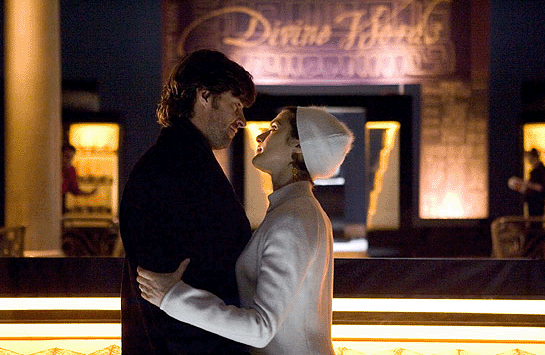 Idea: Spanish conquistador Tomas (Hugh Jackman) searches the jungles of what is now Ecuador for the Tree of Life, as charged by his Queen, Isabel (Rachel Weisz). Present day (or slightly into the future?) Tommy searches for a cure for his wife, Izzi's, terminal brain tumor. Far into the future, Tom traverses the universe to reach the centre of a nebula wrapped around a dying star.
For far more time than is reasonable or necessary, Em and I went back and forth after screening this movie on Sunday. The back and forth had two parts: 1) wondering what we just saw, and 2) giggling. Which makes this review a little more difficult than usual.
Darren Aronofsky's third feature length film is visually stunning. His DP, Matthew Libatique, better be getting his due in a big way come awards time. Instead of the now-standard CGI, they opted for micro-photography of chemical reactions to create the film's unique look. Everything is set up perfectly for the eye: from the shots (heavy on the close-ups and high angles) to the lighting (take a look above - all very low and supernatural, as though the earth itself is lit from within).
Darren Aronofsky's third feature length film is superbly acted. Weisz and Jackman have
 wonderful chemistry, and it's a testament to both of them, as well as their writer-director, that they manage to make their relationship seem passionate yet tentative (in the conquistador story) and warmly lived-in (in the almost now one). Jackman quivers with impassioned fury as the embodiment of chivalrous love, and he's gut-wrenching as he crawls his way through the stages of grief. Weisz matches him frame for frame, though she's much less the protagonist than he is, and, to a certain extent, much less of a character. As is so frequently the case in these sort of stories (think The Odyssey or any medieval romance), the woman is less a person than she is the avatar of virtue. Weisz gives Izzi more three dimensionality than I am suggesting, but still.
Darren Aronofsky's third feature length film is alive with imagery. The way he criss-crosses through world religion, folklore, and traditional theatrical symbolism is a sight to behold. In any one scene there are hundreds of culture clues to pick up. With Clint Mansell's lovely, lilting score drifting through the scenes, it's hard not to let it carry you off as well.
So it's too bad that Darren Aronofsky's third feature length film makes no sense. Symbolism without substance has no meaning at all (although it did occur to me that this movie would be a semiotician's dream). As a mediation on grief, Aronofsky's picture is bar none, but as a movie? Emotional and evocative, to be sure, but it lacks a core argument to sustain the premise as it moves through time. I wouldn't recommend this movie to anyone, but I wouldn't ward them off of seeing it either because I know I would see it again. It sort of casts a dreamy haze over you. B
Saturday, November 25, 2006
Casino Royale (2006)
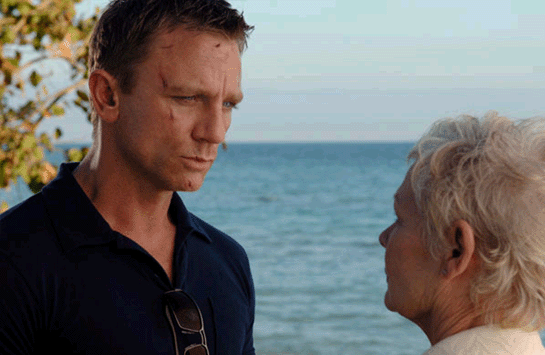 Premise: M (Judi Dench) promotes James Bond (Daniel Craig) to double-oh. For his inaugural mission, Bond must track down Le Chiffre (Mads Mikkelsen), who launders money for terrorists, and defeat him in a high stakes game of Texas Hold 'Em. Vesper Lynd (Eva Green) is sent by the Treasury to oversee their investment, as they have provide Bond's 10 million dollar buy-in.
A few of us were talking in class the other day about how we wanted to see this movie , about the re-invigoration of the franchise, and the new direction of the protagonist. A return to the roots as Ian Fleming imagined them, to be sure, but far different from what we have seen in the past. At one point, while taking about how The New Bond isn't going to come across as a suave, pleasure-seeking playboy, one guy declared, "He's a thug." He said 'thug' so many times that it became something of a jarring credo, and I was wryly amused when M informed Bond that he is meant to be more than just that.
 She's right, though, and Craig plays him as more of a cold-blooded mercenary than anything else. To be fair, this is Craig we are talking about, so he tends to be using his icy-blue eyes to conceal more than he'll ever show. Even so, this is by far a different sort of Bond. There's no Q, and he's not really one for gadgets - a gun and some serious hand-to-hand are his take down methods. In the past, Bond seemed to take out the baddie while stifling a yawn. Violence was a necessary component of his vocation. Here, however, Craig's Bond is something far nastier - he'll kill you, with his bare hands, just for the heck of it. There's an edge that has replaced the devil-may-care attitude of Bonds past.
Unfortunately for Bond, and fortunately for the viewer, there's a lesson to be learned on his first 00 mission. I inwardly cringed when I saw Paul Haggis' name flash on the screen. With two other screenwriters to temper him (Neal Purvis and Robert Wade) and the general possibility that the name that appears has nothing to do with the finished product, he appears not to have bollixed this one up. The bed-hopping and double-entendres are kept to a minimum, providing us with a sleeker, leaner, and, oddly enough, longer feature. From the opening adrenalin-pumping chase sequence to the utterly satisfying closing, you'll hardly notice the length.
Thank goodness Dame Judi remains in place after the re-jig. I adore her in this thoroughly anti-maternal role. She also happens to be the best looking woman in the pic.
I think we all know what happens to villains in this sort of movie, which is too bad. I enjoyed Mikkelsen as the number-crunching villain.
Can I just say one thing, though? What's with Bond villains and facial scars? Can anyone explain that to me?
Ah, well. It's the Bond we've all been waiting for, made possible by the darkness that has crept into, of all things, comic book movies. Enjoy this sinister delight. A-
Friday, November 17, 2006
Pop Culture Round-Up II
Glad to see that Mimi and I are on the same page re: Larry Clark. (You'll have to scroll a little bit) I don't know if that's what I would say if I saw him in the street, but, still: same page.
The wait, she is over. People has finally gotten around to reminding me which Hollywood men are sexy. Let's see . . . totally agree; agree; nope; lost me with the quote; no doubt about it (also, "in a relationship"? Is that official copy?) ; is going to die of a terrible infectious disease from his alien girlfriend; who?; maybe; true, but that pic doesn't really show it; sure; who, again; who because I don't watch the show and because he looks like a killer; yup; Tim from the L word? looks like a killer, too; accepted cannon. So, 6.5 out of 15.
Tuesday, November 14, 2006
Babel (2006)
 Plot: Yussef (Boubker Ait El Caid) and Ahmed (Said Tarchani) are practicing shooting with their father's new rifle, using cars on the highway below them as targets. One of Yussef's bullets hits an American woman, Susan (Cate Blanchett) on vacation with her husband, Richard (Brad Pitt). Their crisis prevents them from making it home in time to relieve their live-in nanny, Amelia (Adriana Barraza), so that she may attend her son's wedding. When she can find no one else to take Susan and Richard's kids (Elle Fanting and Nathan Gamble), Amelia decides to take them across the border with her and her nephew, Santiago (Gael García Bernal). Meanwhile, a deaf-mute girl, Chieko (Rinko Kikuchi), struggles with her relationship with her father (Kôji Yakusho) after her mother's suicide, in addition to all that adolescent fun.
Avoiding the press on this one has been difficult. I did, however, read this Crosstalk, in which Scott Tobias alleges that, in lesser hands than those of director Alejandro González Iñárritu, Babel would have been "Crash 2, an inelegant, deeply contrived narrative about the ripple effects of violence across the globe, or some such pretentious nonsense." For some reason, despite the fact that I am aware of how highly praised this movie, I got the distinct impression from this conversation that there was something wrong with the movie.
Unfortunately for the droves of people I have seen streaming from the movie's showings at ye olde Bytowne (or perhaps fortunately as no one else seems to have noticed), there is something wrong with this movie.
Guillermo Arriaga's screenplay tells four varied stories very well. Each individual story is expertly handled, but things start to fall apart when it comes to interlocking them. The two Morrocan stories and the Californian/Mexican story work well together, although they are not all chronologically linked up. Each story contains believable characters who, for the most part, make momentarily stupid decisions that end up going very poorly. Overall, it seems unlikely, but, in the moment, the acts seem plausible, even possible.
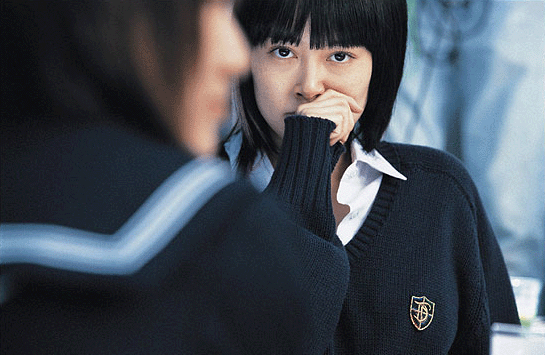
The Japanese story, though it is integrated about a hundred years in, is also well done, complete with fairly believable characters and performances. It's too bad that it really doesn't sync up with the rest of the themes. Sure, a few parallels could be drawn between, say, Yussef and Chieko. Even so, the story feels completely disjointed with the rest. It's too bad that they didn't make a movie just about Chieko, to be honest. I would have gone to see that.
Yes, the performances are all they are cracked up
 to be, with a particularly compelling turn from Pitt. Normally he seems like a fairly limited actor. Here, he pushes far beyond those bounds to get in touch with raw human emotion in a way he has never done in the past.
As for González Iñárritu's much celebrated visual style, I'm going to have to plead partial ignorance on this one. I've never seen any of his work before this movie. To be honest, if this is the norm, I don't think I want to. Disorienting your viewers can have its place, but making them nearly fall over because you refuse to find a focus in a given situation isn't a style at all. In his defence, the kind of instances I speak of were rare.
So, what am I saying exactly? Perfomances: good, story: good, visual style: mostly good? Where's the beef? It's here: this movie is the kind that can't just be good. It has to be more than the sum of its parts. Or, alternatively, it doesn't all add up. Everything sepearately is good but, taking all together, isn't good. Each individual section needs to be excellent for this kind of movie to achieve the harmony necessary to make it palatable. Instead, it feels long and somewhat overblown, even dull in sections. There are individual scenes that veer in the direction of excellence but not enough of them. As such, the whole movie is bogged down.
At least we get another evocative guitar driven score from Gustavo Santaolalla. B-
Sunday, November 12, 2006
Stranger Than Fiction (2006)
 Story: Harold Crick (Will Ferrell) is an IRS auditor leading a dreary, repetitive existence until he is sent to audit a baker, Ana Pascal (Maggie Gyllenhaal). Karen Eiffel (Emma Thompson) is struggling to finish her latest novel with no help from the publisher's assistant (Queen Latifah). The very novel Karen struggling to finish happens to be about Harold, and, when Harold realizes that the narrator he has been hearing is determined to kill him, he determines to find her. To this end, he enlists a literature professor (Dustin Hoffman).
As a director, I find Marc Forster pretty hit and miss. Screenwriter Zach Helm has written exactly one made-for-TV movie. Despite their short comings, this movie is a delight. The very premise is enchanting.
Ferrell gives a career best performance. He is wonderfully subtle and nuanced in the role. I don't want to give too much away about this scene, but there is one where he hits the exact right note of clever and dorky. I loved that.
Although Hoffman was likable in his role, it kind of felt like he was merely playing a more lucid version of his character in I ♥ Huckabees. On the other hand, when he begins waxing rhapsodic on "little did he know," a moment like that is a dream come true. You can see the fun the actor is having - it's impossible not to be infected by it.
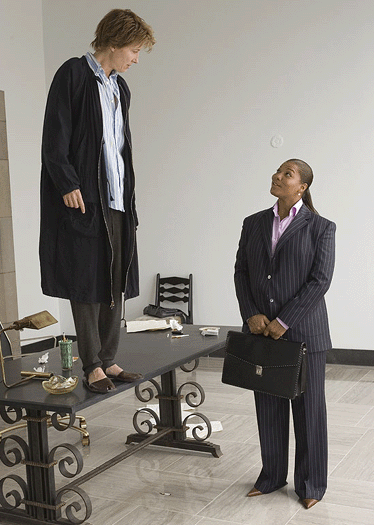
Thompson decided to act the hell out of her role. Very few people can bring such delightful quirk to desperation in my opinion.
Gyllenhaal was also a welcome breath of fresh felicity. I have worried that there is a little similarity in the roles she has played in the past, so this movie serves as a welcome reminder that she can (and does) branch out.
As much as I like Queen, I don't really get the point of casting a name of such stature in a rather small role. I feel like a great number of other people could have gotten the job done just as well.
Unfortunately, Helm turns the whole thing rather oddly dramatic toward the end. Even worse, he goes sentimental on us. I get that writing about writers writing is a difficult task, and, in a way, it is a brave choice. I'd say that not changing the ending would have been a braver choice, but I'm not certain that that is true. Either way you'd end up feeling like you've gotten the short shrift. The problem is that the very conceit of the movie is self-defeatist. Harold knows he's going to die. Either he's going to die or he's going to live. There's not a lot of wiggle room there.
Logistics aside, this movie is the kind that would be described as a "feel good" movie. It's more than that - it's a feel better movie. B+
Thursday, November 09, 2006
V for Vendetta (2005)
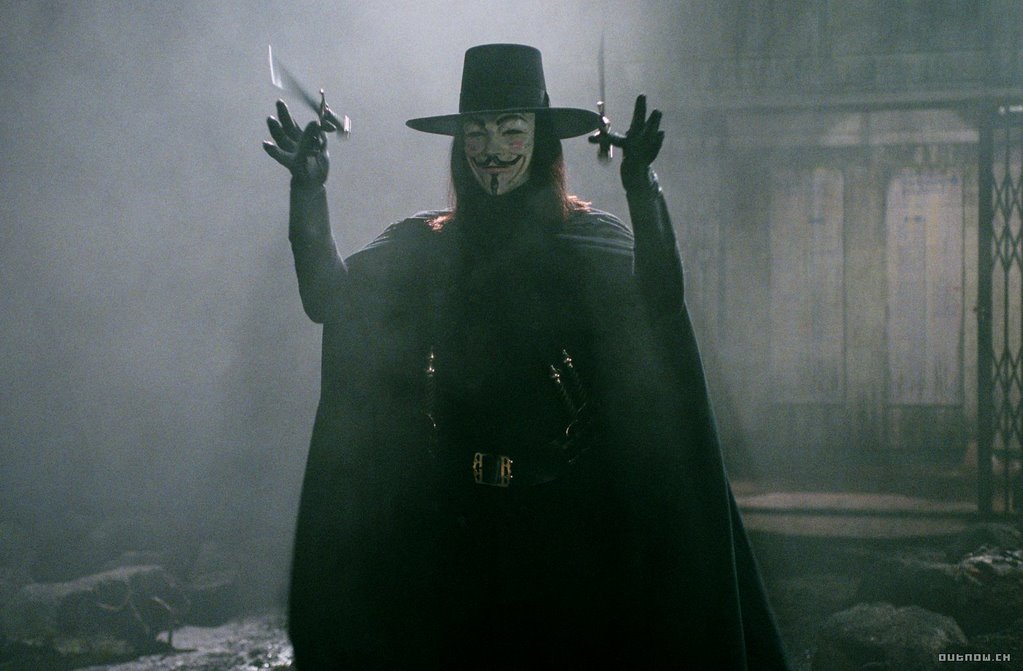 RE-view insanity!
Just the other day, I thought to myself: what am I going to put in this year's Top 10? Because, although things have picked up lately, I haven't seen that many good movies this year. Then I thought, "V! I'll put V on the list! And I was so pleased.
Imagine my confusion when I pulled up the review to write this RE-view and discovered that I put the year as 2005. Then I looked it up on IMDb and saw 2005. "But didn't I see this is March of this year?" I asked. Apparently, I did. I looked up the release dates and sorted myself out.
I know you don't care about any of that, but at least you got a preview of what will likely be part of the Top 10 that you won't read until March 2007!
Also, thanks to A & M for this lovely b-day gift!
I had been saving this movie to watch in honour of Bonfire Night. Prior to this, I had been trying to convince myself that my high opinion of the movie had been falsely inflated. I didn't want to see it again only to be disappointed, so I kept trying to lower my expectations. As is my custom, I watched the trailer before I started the movie, which, I have to tell you, makes the movie look pretty crappy. Stupid, even.
Listen, guys - I don't normally read my reviews and say, "Oh, good work, self!" I mostly read them over and notice the things I didn't remember to include from my mental check list. But I was reading this review . . . and I was spot on. No, really, I feel like I hit the nail on that head with that one.
The movie is much better than it has any right to be, given (in my opinion) its pedigree. It is far more intelligently penned than one would expect. It is thoughtful and insightful, and McTeigue has an incisive eye. The way he calls up Kent State and Vietnam to go with the other allusions is particularly perceptive.
Portman and Weaving do have some intense chemistry, which amazes me under the circumstances. And, though I am loath to sound like a squeeing fangirl, I have such a crush on him now. V may be the embodiment of revenge, but Weaving fills him the idea that remains unspoken until Evey pulls that lever. There's no way that someone you never see is going to nominated for any best actor awards, which is a shame. Weaving gives one of the best performances of the year.
I did miss one point, though - Natasha Wightman as Valerie. She isn't in the movie for long, yet her stirring monologue brought tears to my eyes. I hope I get to see her in many more movies.
Although I was right about the slow second act, it's not as bad as a remember it. Besides, this movie is so wonderful it charmed my low quality DVD player-through-VCR set-up into behaving. That makes me feel like bumping the movie up to an A. I won't just yet, but I am thinking about it.
Wednesday, November 08, 2006
Walk the Line (2005)

RE-view extravaganza!
Although I had picked up this movie months earlier, I had been saving it to watch with my mom. My mom, great though she is, never goes to the movies. She appearently used to go with my nana, but I have no understand of when or what movies they saw. I think they used to go to the downtown theatre, which closed when I was about 13. She once told me that the last movie she and my dad went to see in the theatre was The Godfather, which probably means that was the last movie my dad saw in the theatre.
And yet, I fully blame them for getting me hooked on movies.
Anyway, the point here is that I thought my mom would like this movie. When we were listening to the soundtrack at Christmas, my mom remarked that sometimes, not everytime, but sometimes, Joaquin Phoenix's voice could be mistaken for that of Johnny Cash.
After we watched the DVD together, I asked her what she thought. "Oh, it was good," she said. I blinked. "It was very good." My mom wasn't dismissive, she was emphatic, but still. "Very good"? Had I been mistaken about the quality of this film?
Yes and no. I don't think I was wrong about the performance, which are among the best from two highly talented actors. I think they do excellent work, and together that work makes the movie snap with electric energy.
Even so, the movie's sort of oddly paced. It speeds up and slows down, rushing through some perfomances, yet letting itself breath for beaitfully done scenes like the one in the diner near the beginning. She gets him to talk about Jack for the first time in years; she confesses to him all her feelings inadequacy as she stands in her family's shadow. Scenes like that are the stuff of great cinema.
I recall when I read Owen Gliberman's comment that WtL had the potential to become a "monster chick flick." I didn't get it at the time, but I can see it now. The film, probably conciously although it goes unmentioned, sets up Johnny's addiction in direct relation to his tortured, protracted romance with June. June turns him down for a kiss? He pops pills for the first time. He accidentally makes June cry? He rips a sink out of the wall, then scrambles to pick up the scattered pills and chase them with beer. He's like House, only with music instead of medicine. And, you know, real.
I wasn't wrong about Vivian, though. No offense to Goodwin, but what a harpy! Could she have resented his career a little more? She didn't want to him to talk about it? That's all he does! What the hell else is he going to talk about?
I admit that I may have over-estimated this movie when I originally reviewed it but only by a hair. It's still one of the best. New grade: A-
Tuesday, November 07, 2006
Eternal Sunshine of the Spotless Mind (2004)
 More RE-views!
No, I haven't seen this movie in two years either. It's not like I didn't want to see it, and I think I may have watched parts of it, but I didn't sit down and watch the whole thing through again until not so long ago.
My goodness, how my review didn't do justice to this film! I seem to have overlooked cinematographer Ellen Kuras' arresting visual style, Jon Brion's playful yet melancholy score, the perfect harmony of Michel Gondry's direction with Charlie Kaufman's incredible script. Overlooked no more!
Oh, Kate Winslet, how do you do it? How do you play everything so naturally? How do you manage to generate believable chemistry with just about anyone? (I even buy the pairing of her and Jack Black) Kate, I find it exceedingly difficult to place this mantle on anyone, but I think you are my favourite actress. You take risks, but you're selective. You're sensual and ethereal and achingly amazing in this movie. Clementine is seductive and bitchy and cruel and lovable.
The other half of the relationship, as presented by Jim Carrey, is pitch perfect. Joel is everything that Clementine hates to see and wants to possess. His futile attempts to save her are as romantic as they are idiotic, but the way he seems to write her into his memory - knowing that she's only the version of herself that he chooses to see - it's the way Carrey plays the cruelty of desperation matched with the courage necessary to try anyway that makes your breath catch in your chest.
That final, urgently whispered plea before Clementine disappears entirely from Joel's memory? That last scene in the hallway, knowing what they do and choosing what they do anyway? Makes this the most romantic movie I have ever seen.
As this review was also from the time before grades, allow me to attach another: A+
Monday, November 06, 2006
Mean Creek (2004)
 RE-view time!
Now, I know you might be thinking, "Elfin April, you haven't watched this movie again in two years?" And the simple answer is, "Le no." I probably put it on my Zip list as soon as it came out on DVD, but it didn't arrive until recently.
As I recall, I saw this movie not only because of Caulkin but also because a few select reviews sold me on it. Occasionally, when I do not know about a movie in advance, the right review can sell me on seeing it. The problem with many of the reviews I read, however, was that they gave away the film's entire plot.
George's accidental (or not-so-accidental, depending on your point of view) death doesn't happen in the beginning of the film, and the film isn't solely about the fallout. George's death is the climax: there's a lot of rising action before it that centres around the group's ever-shifting opinion about George. Making the plan, calling off the plan, who's in, who's out - all of these things are in flux for most of the movie.
Peck's villain is the most eerily, true-to-life portrayal in the movie precisely because he gets what being a bully is all about - that he's a lonely kid with problems and no foreseeable solutions. The best part of his performance, however, is the way neither him nor the direction nor the screenplay allow us to forget the default setting. Even when he moves to mocking Marty's dead dad, you can see how much the betrayal has gotten to him. His voice has a too-casual anger to it, but his tearful, hurt look is unmistakable.
To have a prank turn fatal isn't a concept that Estes introduced to film. His exploration of it, nevertheless, is bar none. The shock, the rushed yet reluctant burial, the acceptance of consequences . . . it all feels so natural in a completely artificial situation.
But, really, it is all about Caulkin. Right at the end there, when the detective leaves the room, and he knows he doesn't have to say or do anything, when he turns to the camera and slowly, deliberately announces that he has never seen Rocky so out of control in his life - that's when the movie socks you in the gut. You see him, in the span of 30 or 45 seconds, age years, decades. The child is gone in a instant.
Because I wrote the original review before I graded movies, let's grade this one now: A
Subscribe to:
Posts (Atom)